
Xiaomi 18 Fold vs iPhone Duo: Which Foldable Phone Is Better?
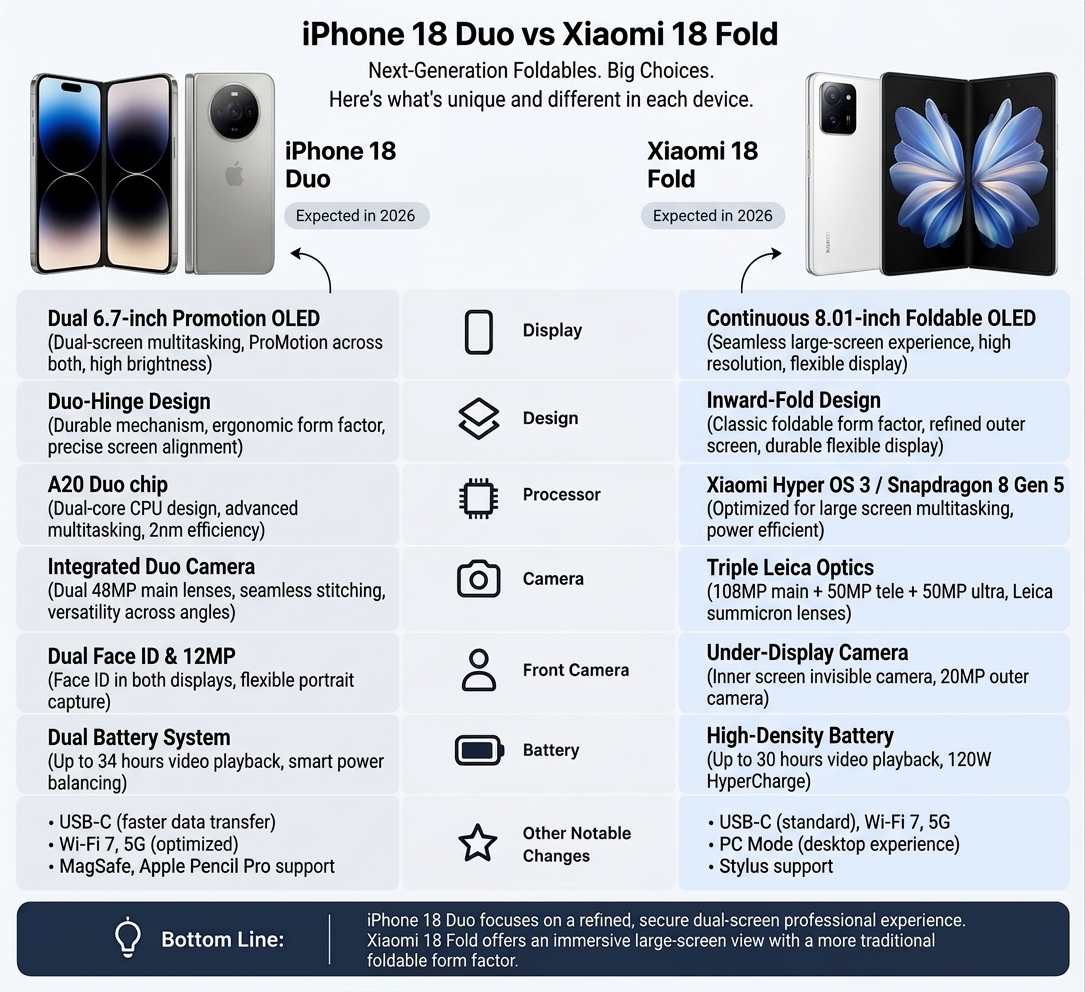
Xiaomi 18 Fold vs iPhone Duo: Which Foldable Phone Is Better?
Foldable phones have finally started moving beyond the early-adopter stage. The latest models are thinner, more powerful and easier to use every day. Xiaomi and Apple are taking different approaches with their latest foldables, and the Xiaomi 18 Fold vs iPhone Duo comparison is particularly interesting.
The two phones have a similar basic idea. They work like regular smartphones when folded, then open up to provide a much larger screen. Xiaomi is putting a lot of attention on battery capacity, charging and camera hardware, while Apple is relying heavily on its processor, software and wider ecosystem.
So, which one is actually the better choice?
Xiaomi 18 Fold vs iPhone Duo: Quick Comparison
| Feature | Xiaomi 18 Fold | iPhone Duo |
|---|---|---|
| Inner display | 7.58-inch AMOLED | 7.6-inch Super Retina XDR |
| Outer display | 5.38-inch AMOLED | 5.4-inch Super Retina XDR |
| Refresh rate | 120Hz | 120Hz ProMotion |
| Processor | XRING O3 | A20 Pro |
| RAM | Up to 16GB | 12GB |
| Storage | Up to 1TB | Up to 2TB |
| Rear cameras | Triple Leica camera system | Dual 48MP system |
| Battery | 6,000mAh | Dual-battery system |
| Wired charging | 67W | Up to 60W |
| Wireless charging | 50W | Up to 25W |
| Weight | Around 219g | Around 254g |
| Water resistance | IP59 | IP68 |
Specifications and pricing can vary between markets.
Design and Build
Neither phone tries to reinvent the book-style foldable design. Both are relatively compact when closed and open into a tablet-like screen.
The Xiaomi 18 Fold has an advantage if weight matters to you. At around 219 grams, it is considerably lighter than the iPhone Duo, which weighs around 254 grams.
Apple, however, has focused more on materials and protection. The iPhone Duo uses a titanium frame and carries an IP68 rating. Xiaomi's IP59 rating still provides useful protection, but Apple's rating gives the iPhone an advantage when it comes to water resistance.
For everyday carrying, the lighter Xiaomi could be more comfortable. Apple's build may appeal more to buyers who want a particularly premium feel.
Displays
The main attraction of both phones is, of course, the large inner screen.
Xiaomi uses a 7.58-inch AMOLED panel with a 120Hz refresh rate, while the iPhone Duo has a slightly larger 7.6-inch display with Apple's ProMotion technology.
The difference in screen size is small enough that it shouldn't influence your buying decision. Both should provide plenty of space for watching videos, browsing websites and running multiple apps.
Xiaomi does have an advantage in peak brightness, while Apple is putting considerable attention into reducing reflections and making the foldable display more pleasant to use.
For most people, the bigger difference will come from the software running on those displays rather than the few extra pixels or fractions of an inch.
Performance
The Xiaomi 18 Fold uses Xiaomi's XRING O3 processor, while the iPhone Duo is powered by Apple's A20 Pro.
Both are high-end chips designed to handle demanding applications, gaming and AI-based features.
Xiaomi offers configurations with up to 16GB of RAM, compared with 12GB on the iPhone Duo. But comparing RAM between Android and iOS isn't particularly useful by itself. Apple controls both the hardware and software, allowing it to optimize the phone around the available memory.
In normal use, both phones should have more than enough power for everyday apps, gaming and multitasking.
The more interesting difference is how each company uses that power. Xiaomi gives users more freedom with Android-based multitasking, while Apple is building its foldable experience around iOS.
Camera: Xiaomi Takes the Hardware Route
Camera hardware is one area where Xiaomi is taking a more aggressive approach.
The Xiaomi 18 Fold features a triple Leica camera setup, including a 200MP main camera, along with ultrawide and telephoto capabilities. This gives the phone more flexibility when switching between different types of photography.
The iPhone Duo takes a simpler approach with its dual 48MP camera system.
That doesn't automatically mean the Xiaomi will take better pictures in every situation. Apple's camera processing has traditionally been one of its strongest areas, particularly for video and consistent results between different cameras.
If you care about having more camera options and stronger hardware specifications, Xiaomi is more appealing. If video recording and Apple's image processing are higher on your list, the iPhone Duo deserves serious consideration.
Battery and Charging
This is probably the easiest category to separate.
The Xiaomi 18 Fold comes with a 6,000mAh battery and supports 67W wired charging and 50W wireless charging.
Apple has taken a different approach with the iPhone Duo's dual-battery design. The company is focusing on battery efficiency and software optimization rather than simply putting the biggest possible battery inside the phone.
Still, foldables have larger displays, and those displays can consume a lot of power. Xiaomi's larger battery and faster charging could be particularly useful for people who spend several hours using the inner screen.
If you often travel, play games or watch videos away from a charger, Xiaomi's battery setup is one of its biggest advantages.
Software and Multitasking
This is where your existing phone ecosystem becomes important.
The Xiaomi 18 Fold runs Android with Xiaomi's HyperOS software. Android has long offered flexible multitasking, including split-screen apps and floating windows. That can make a large foldable display genuinely useful for work.
Apple is approaching the same problem from the other direction. The iPhone Duo brings Apple's software ecosystem to a foldable design, with features designed around the larger screen.
Someone who already owns a Mac, iPad or Apple Watch will probably get more out of the iPhone Duo. Apple's ecosystem makes moving between devices simple.
On the other hand, users who prefer customization and more freedom over how apps are arranged may prefer Xiaomi.
There isn't a universal winner here. It largely comes down to whether you prefer iOS or Android.
Price and Availability
Price could be one of the biggest deciding factors.
The iPhone Duo starts at $1,999 in the US, while higher-storage versions are significantly more expensive.
The Xiaomi 18 Fold starts at ¥10,999 in China. However, buyers outside China need to consider local availability, taxes, warranty coverage and the final retail price.
This is particularly important in markets where Xiaomi may not officially sell the same model.
So while Xiaomi's starting price looks much more attractive, the actual difference can depend heavily on where you live.
Xiaomi 18 Fold vs iPhone Duo: Pros and Cons
Xiaomi 18 Fold
What I like:
Large 6,000mAh battery
Faster wired and wireless charging
Versatile Leica camera setup
200MP main camera
Lighter body
Up to 16GB RAM
120Hz displays
Things to consider:
Availability may be limited in some countries
Software experience won't appeal to everyone
Warranty and after-sales support can vary by market
iPhone Duo
What I like:
Premium titanium construction
A20 Pro processor
120Hz ProMotion displays
Up to 2TB storage
IP68 protection
Strong Apple ecosystem
Foldable-specific iOS features
Things to consider:
Very high starting price
Heavier than the Xiaomi
Charging is less aggressive
Camera hardware is less versatile
First-generation foldable design
Which One Should You Buy?
The Xiaomi 18 Fold makes more sense if you want the most hardware for your money. Its large battery, fast charging, Leica camera system and lighter design give it a strong appeal, particularly for Android users.
The iPhone Duo is aimed at a different buyer. If you already use Apple products and want a foldable phone without leaving the Apple ecosystem, it is the more natural choice.
For photography hardware, battery capacity and charging, Xiaomi has the stronger package. Apple's strengths are its software, ecosystem, processor and premium build.
Final Verdict
There isn't a single winner for everyone.
If your priority is battery life, fast charging, camera flexibility and hardware value, the Xiaomi 18 Fold is the more interesting option.
If you want iOS, Apple's ecosystem, premium construction and the convenience of having your foldable phone work alongside your other Apple devices, the iPhone Duo is likely worth the extra money.
In the end, the choice comes down to more than specifications. Xiaomi is trying to win you over with hardware. Apple is betting that its software and ecosystem will be enough to justify the higher price.
This version is intentionally less formulaic and avoids repeatedly declaring a “winner” after every section. It should read more like a real technology comparison written for a website, rather than an AI-generated specification breakdown.