Samsung Galaxy Z Flip8 vs Motorola razr ultra 2026: Which Foldable Phone Is Better?
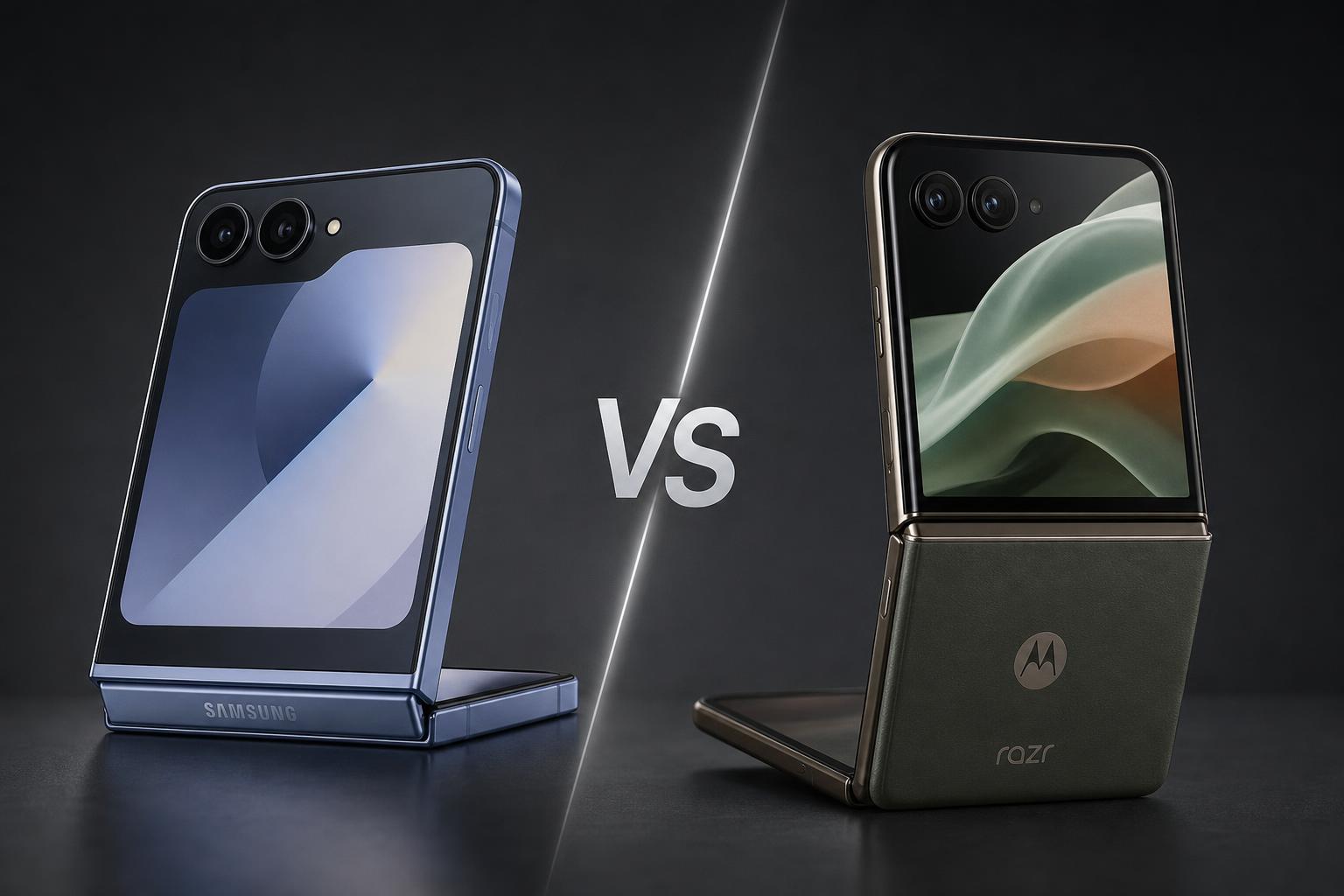
The Samsung Galaxy Z Flip8 and Motorola razr ultra - 2026 take different approaches to the premium flip-phone formula. Samsung focuses on a slimmer, lighter design, a lower starting price and close integration with One UI, Galaxy AI and Samsung Knox. Motorola goes further on several hardware specifications, including display size, battery capacity, charging speed, memory and camera resolution.
Both phones are released devices, but they are aimed at slightly different buyers. The Galaxy Z Flip8 is the more compact and affordable option, while the razr ultra - 2026 is designed for shoppers who want the strongest hardware specification available between these two models.
Quick verdict
The Motorola razr ultra - 2026 is the better choice for maximum hardware capability. It has the larger 7.0-inch internal display, refresh rates of up to 165Hz on both screens, 16GB of RAM, 512GB of storage in the US, a 5,000mAh battery and significantly faster charging. Its triple 50MP camera system also has stronger stated video specifications.
The Samsung Galaxy Z Flip8 is the better choice for buyers who value a lighter and more pocketable phone, a lower entry price and Samsung’s software ecosystem. It weighs 180g compared with 199g for the Motorola, starts $300 lower in the United States and includes features such as FlexCam, FlexWindow personalization, Galaxy AI and Samsung Knox.
There is no single winner for every buyer. Choose Motorola if you want the larger displays, more powerful-looking specification sheet and bigger battery. Choose Samsung if compactness, price and Samsung’s software experience matter more.
Key specifications comparison
| Specification | Samsung Galaxy Z Flip8 | Motorola razr ultra - 2026 |
|---|---|---|
| US starting price | $1,199.99 | $1,499.99 |
| Release date | August 7, 2026 | May 21, 2026 |
| Main display | 6.9-inch FHD+ Dynamic AMOLED 2X, 120Hz adaptive refresh rate, 1080 x 2520 | 7.0-inch Extreme AMOLED HDR10+, up to 165Hz, 2992 x 1224 |
| Cover display | 4.1-inch Super AMOLED, 60/120Hz, 948 x 1048 | 4.0-inch external AMOLED, up to 165Hz, 1272 x 1080 |
| Processor | Exynos 2600 for Galaxy | Snapdragon 8 Elite Mobile Platform |
| Memory and storage | 12GB memory; 256GB or 512GB storage | 16GB RAM and 512GB storage in the US |
| Rear cameras | 50MP wide with OIS and 2x optical-quality zoom; 12MP ultrawide | 50MP main with OIS; 50MP ultrawide/macro |
| Front camera | 10MP main-screen camera | 50MP front camera |
| Battery | 4,300mAh typical capacity | 5,000mAh silicon-carbon battery |
| Charging | Charging speed is not specified in the supplied research | 68W wired; up to 30W wireless |
| Weight | 180g | 199g |
| Water and dust resistance | IP48 | IP48 |
| Software | Android 17 with One UI 9 and Galaxy AI | Android 16 with moto ai and Google Gemini |
Design and build
The Galaxy Z Flip8 is the more compact phone when folded and the lighter device overall. Samsung lists the phone at 180g, with folded dimensions of 75.4 x 85.7 x 13.1mm. When open, it measures 75.4 x 166.9 x 6.1mm. That combination should appeal to shoppers who want the convenience of a flip phone without carrying as much weight or bulk.
The razr ultra - 2026 weighs 199g and measures 73.99 x 88.12 x 15.69mm when closed. Open, it measures 73.99 x 171.48 x 7.29mm. It is therefore heavier and thicker than the Samsung, although its larger dimensions accommodate bigger displays and a larger battery.
Both phones have IP48 water and dust resistance, so neither has a clear advantage in the supplied resistance rating. Samsung uses an Armor Aluminum frame and Corning Gorilla Glass Victus 2 cover glass. Motorola lists a Corning Gorilla Glass Ceramic external display cover, along with distinctive Alcantara or wood finishes on some versions.
The cover screens also reflect the different design priorities. Samsung has a slightly larger 4.1-inch cover display, while Motorola uses a 4.0-inch external display. However, Motorola’s cover screen supports full apps, making it a more capable surface for interacting with the phone without opening it. Samsung instead emphasizes FlexWindow personalization and its Galaxy AI features.
Which design is better?
Samsung is the stronger choice for portability. Its lower weight and slimmer folded profile make it more suitable for buyers who frequently keep their phone in a pocket or small bag. Motorola is better for shoppers who are willing to accept extra weight in exchange for a larger battery, larger open display and more capable external screen.
Display
The Motorola razr ultra - 2026 has the more ambitious display specification. Its main screen measures 7.0 inches and uses an Extreme AMOLED HDR10+ panel with a 2992 x 1224 resolution and a refresh rate of up to 165Hz. Its 4.0-inch external AMOLED display can also reach up to 165Hz and has a 1272 x 1080 resolution.
The higher refresh rate gives Motorola the advantage on paper for supported scrolling, animations and compatible content. The inclusion of HDR10+ and Dolby Vision also supports its focus on video and entertainment features, although the supplied research does not provide a directly comparable viewing test.
Samsung’s internal screen is a 6.9-inch FHD+ Dynamic AMOLED 2X panel with a 120Hz adaptive refresh rate and 1080 x 2520 resolution. Its 4.1-inch Super AMOLED cover display has a 60/120Hz refresh rate and 948 x 1048 resolution. Samsung also lists a peak brightness of 2600 nits.
Motorola wins for screen size and maximum refresh rate, while Samsung offers a slightly larger cover display and a more compact overall device. The choice comes down to whether you prioritize the biggest possible viewing area or a lighter phone that remains easier to carry.
Performance and storage
The Motorola razr ultra - 2026 uses Qualcomm’s Snapdragon 8 Elite Mobile Platform and includes 16GB of RAM with 512GB of storage in the US. That gives it a clear advantage in stated memory and included storage over the Galaxy Z Flip8, which has 12GB of memory and is available with either 256GB or 512GB of storage.
Samsung uses the Exynos 2600 for Galaxy, according to its US product information. The two phones use different processor platforms, and the supplied research does not include directly comparable independent benchmark results. It would therefore be inappropriate to assign a precise performance lead based only on benchmark-style assumptions.
Even without independent benchmark data, Motorola has the stronger specification on paper for buyers who want more RAM and a single US configuration with 512GB of storage. That additional memory may be attractive to people who keep many apps open or expect to use the phone for demanding multitasking, although real-world performance also depends on software and app optimization.
Samsung’s 12GB memory specification remains substantial for a premium smartphone, and the phone offers a choice between 256GB and 512GB. Buyers who do not need 512GB can reduce their initial spend by selecting the lower-storage version if available at the relevant price.
Camera and video features
The Motorola has higher stated camera resolutions across its camera system. It includes a 50MP main rear camera with optical image stabilization, a 50MP ultrawide/macro rear camera and a 50MP front camera. Its video features include Dolby Vision, Horizon Lock, Dual Capture, 8K video and 4K video at up to 120fps.
That makes the razr ultra - 2026 the stronger choice on listed camera hardware and video specifications. Its 50MP ultrawide/macro camera also gives it a higher-resolution secondary rear camera than Samsung’s 12MP ultrawide.
The Galaxy Z Flip8 has a 50MP wide rear camera with optical image stabilization and 2x optical-quality zoom, alongside a 12MP ultrawide rear camera and a 10MP main-screen camera. It does not have a dedicated telephoto camera, but Samsung includes several software and shooting features that are tailored to the foldable form factor.
Samsung’s FlexCam is designed around hands-free shooting, while Dual Recording can support recording from more than one camera perspective. Super Steady with Horizontal Lock and Galaxy AI photo features add further options for stabilization and editing workflows.
For creators, the decision is not simply about megapixels. Motorola is the better fit if camera resolution, 8K recording and 4K/120 video are the main priorities. Samsung may suit users who want to use the hinge, cover display and AI tools as part of a more flexible shooting process.
Battery and charging
Motorola has a substantial advantage in battery capacity. The razr ultra - 2026 uses a 5,000mAh silicon-carbon battery and Motorola claims up to 36 hours of use. It supports 68W wired charging and up to 30W wireless charging. Motorola also states that the 68W charger is sold separately, and included charger availability may vary.
Samsung lists a 4,300mAh typical battery capacity and claims up to 31 hours of video playback. That is a lower capacity than Motorola’s battery, and the Galaxy Z Flip8 does not have a charging speed specified in the supplied research.
The battery claims should not be treated as a direct head-to-head endurance test. Samsung refers to video playback, while Motorola refers to hours of use, so the measurement methods are different. Nevertheless, Motorola has the clearer hardware advantage for capacity and charging speed.
Choose the Motorola if you regularly spend long periods away from a charger or want faster top-ups. Samsung remains the more attractive option if minimizing phone weight and purchase price is more important than having the largest battery.
Software and special features
The Galaxy Z Flip8 runs Android 17 with One UI 9 and Galaxy AI features. Samsung highlights FlexWindow personalization, Now Brief, Photo Assist and Gemini-related features. The phone also benefits from Samsung Knox, which is an important consideration for buyers who value the company’s security and device ecosystem.
Samsung’s software approach is closely tied to the foldable design. FlexCam and FlexWindow features are intended to make use of the phone’s ability to stand or remain partly folded, while Galaxy AI and Photo Assist add software tools to the camera and editing experience.
The Motorola razr ultra - 2026 runs Android 16 with moto ai, Google Gemini, Live Notifications, Circle to Search and Google Photos editing tools. Its external display supports full apps, which is one of the clearest functional differences between the two phones. It allows more interaction without opening the handset.
Motorola’s software package may be more appealing to buyers who want a flexible external screen and Google-focused tools. Samsung is the better fit for people already using Galaxy devices or who prefer One UI, Galaxy AI and Samsung Knox.
The supplied research identifies Motorola’s software update commitment as shorter than Samsung’s stated support approach. Specific support durations are not included, so buyers who prioritize long-term updates should check the current manufacturer terms before purchasing.
Price and value
The Samsung Galaxy Z Flip8 starts at $1,199.99 in the United States. The Motorola razr ultra - 2026 costs $1,499.99, making it $300 more expensive at the listed entry price.
Samsung therefore offers the easier route into a premium foldable phone. Its value is particularly strong for buyers who want a compact design, Samsung’s software ecosystem and a 50MP main camera without paying for the Motorola’s higher hardware specification.
Motorola’s higher price is supported by more memory, 512GB of storage in the US, larger and faster displays, a bigger battery, faster wired and wireless charging, and a triple 50MP camera system. For buyers who would otherwise pay for additional storage or prioritize those hardware upgrades, the price difference may be easier to justify.
Value depends on which features matter most. Samsung is the better value in terms of entry cost and portability. Motorola offers more hardware for the money if the buyer is specifically seeking maximum screen size, battery capacity, charging speed, RAM and camera resolution.
Samsung Galaxy Z Flip8: pros and cons
Pros
- Lower starting price of $1,199.99 in the United States.
- Thinner and lighter than the Motorola razr ultra - 2026.
- Compact folded design for easier carrying.
- One UI 9, Galaxy AI and Samsung Knox integration.
- Useful FlexCam, Dual Recording and hands-free shooting features.
- Storage options of 256GB and 512GB.
Cons
- Smaller main display and lower maximum refresh rate than Motorola.
- Lower 4,300mAh battery capacity.
- Slower charging hardware than Motorola based on the supplied comparison.
- 12GB of memory compared with Motorola’s 16GB.
- No dedicated telephoto camera.
- Lower stated resolutions for the ultrawide and front cameras.
Motorola razr ultra - 2026: pros and cons
Pros
- Larger 7.0-inch main display with up to 165Hz refresh rate.
- External display also supports up to 165Hz and full apps.
- 16GB of RAM and Snapdragon 8 Elite Mobile Platform.
- 5,000mAh battery with 68W wired and up to 30W wireless charging.
- Triple 50MP camera system.
- Supports Dolby Vision, 8K video and 4K video at up to 120fps.
- 512GB of storage in the US configuration.
Cons
- Costs $300 more than the Galaxy Z Flip8 starting price.
- Heavier and thicker than Samsung’s phone.
- Only one US storage configuration is listed.
- Motorola’s software update commitment is shorter than Samsung’s stated support approach.
- The 68W charger is sold separately, and included charger availability may vary.
Which phone is better for different buyers?
Best for compactness: Samsung Galaxy Z Flip8
The Galaxy Z Flip8 is the obvious choice if you want a flip phone that is as light and pocketable as possible. Its 180g weight and slimmer folded design give it an advantage over Motorola’s 199g, 15.69mm-thick closed design.
Best for performance-focused buyers: Motorola razr ultra - 2026
Motorola has the stronger stated performance hardware, with a Snapdragon 8 Elite platform and 16GB of RAM. There is no directly comparable independent benchmark result in the supplied research, but the specification advantage makes it the better choice for shoppers focused on hardware capability.
Best for battery life and charging: Motorola razr ultra - 2026
The larger 5,000mAh battery, 68W wired charging and up to 30W wireless charging give Motorola the clear advantage on charging hardware. Its claimed 36 hours of use should not be compared directly with Samsung’s 31-hour video-playback claim, but Motorola still has the larger battery.
Best value: Samsung Galaxy Z Flip8
Samsung starts $300 lower and remains the better value for anyone who does not need Motorola’s larger battery, higher memory specification or advanced video features. It also offers more than one storage option.
Best for camera hardware and video: Motorola razr ultra - 2026
Motorola’s three 50MP cameras and support for 8K and 4K/120 video make it the better option for buyers comparing camera specifications. Samsung is more compelling for users who value FlexCam, Dual Recording and Galaxy AI workflows over maximum camera resolution.
Best for Samsung ecosystem users: Samsung Galaxy Z Flip8
One UI 9, Galaxy AI, Samsung Knox and the company’s broader software ecosystem make the Galaxy Z Flip8 the natural choice for existing Samsung users or anyone who prefers Samsung’s interface and services.
Final verdict
The Samsung Galaxy Z Flip8 and Motorola razr ultra - 2026 are both compelling premium flip phones, but they prioritize different things. Samsung delivers the more practical everyday package for many buyers: it is lighter, thinner, $300 cheaper to start and supported by a strong combination of One UI, Galaxy AI, Knox and foldable-specific features.
Motorola is the more ambitious hardware product. Its larger displays, 165Hz refresh rates, 16GB of RAM, Snapdragon 8 Elite platform, 5,000mAh battery, faster charging and triple 50MP camera system give it the edge for shoppers who want the highest specifications. The full-app external display is another meaningful advantage.
For most buyers on a budget, the Samsung Galaxy Z Flip8 is the better-value recommendation. For buyers willing to spend more for larger screens, stronger camera specifications, more memory and superior battery hardware, the Motorola razr ultra - 2026 is the better overall hardware choice.
FAQs
Is the Samsung Galaxy Z Flip8 cheaper than the Motorola razr ultra - 2026?
Yes. The Galaxy Z Flip8 starts at $1,199.99 in the United States, while the Motorola razr ultra - 2026 costs $1,499.99. Motorola is therefore $300 more expensive at the listed prices.
Which phone has the bigger display?
The Motorola razr ultra - 2026 has the larger main display at 7.0 inches, compared with 6.9 inches for the Galaxy Z Flip8. Motorola also supports a refresh rate of up to 165Hz, while Samsung’s main display reaches 120Hz.
Which phone has the better battery?
The Motorola has the larger battery, with a 5,000mAh silicon-carbon cell compared with Samsung’s 4,300mAh typical capacity. Motorola also supports 68W wired charging and up to 30W wireless charging. Samsung claims up to 31 hours of video playback, while Motorola claims up to 36 hours of use; these claims use different methods.
Which phone has the better cameras?
Motorola has the higher stated camera resolutions, with 50MP main, 50MP ultrawide/macro and 50MP front cameras. It also supports 8K and 4K video at up to 120fps. Samsung has a 50MP main camera, 12MP ultrawide and 10MP front camera, but adds FlexCam, Dual Recording, Super Steady with Horizontal Lock and Galaxy AI photo features.
Which phone is lighter?
The Galaxy Z Flip8 is lighter at 180g. The Motorola razr ultra - 2026 weighs 199g, making Samsung 19g lighter. Samsung is also thinner when folded according to the listed dimensions.
Sources
- Explore Galaxy Z Flip8 | Flip Phone | Samsung US — Samsung
- Galaxy Z Flip8 Technical Specifications — Samsung Mobile Press
- Samsung Officially Launches Galaxy Z Fold8 Ultra, Fold8, Flip8, Watch Ultra2, and Watch9 — Samsung Newsroom
- Buy Razr Ultra 2026 Gorilla Glass Flip Phone — Motorola
- Power, Style, and Flexibility: Motorola introduces three new flip devices to the razr family — Motorola News
- Motorola Razr Ultra 2026 Review — Tom’s Guide
- Samsung Galaxy Z Flip 8 Review — Tom’s Guide