
Apple iPhone Duo vs Samsung Galaxy Z TriFold: Which Foldable Is Better?
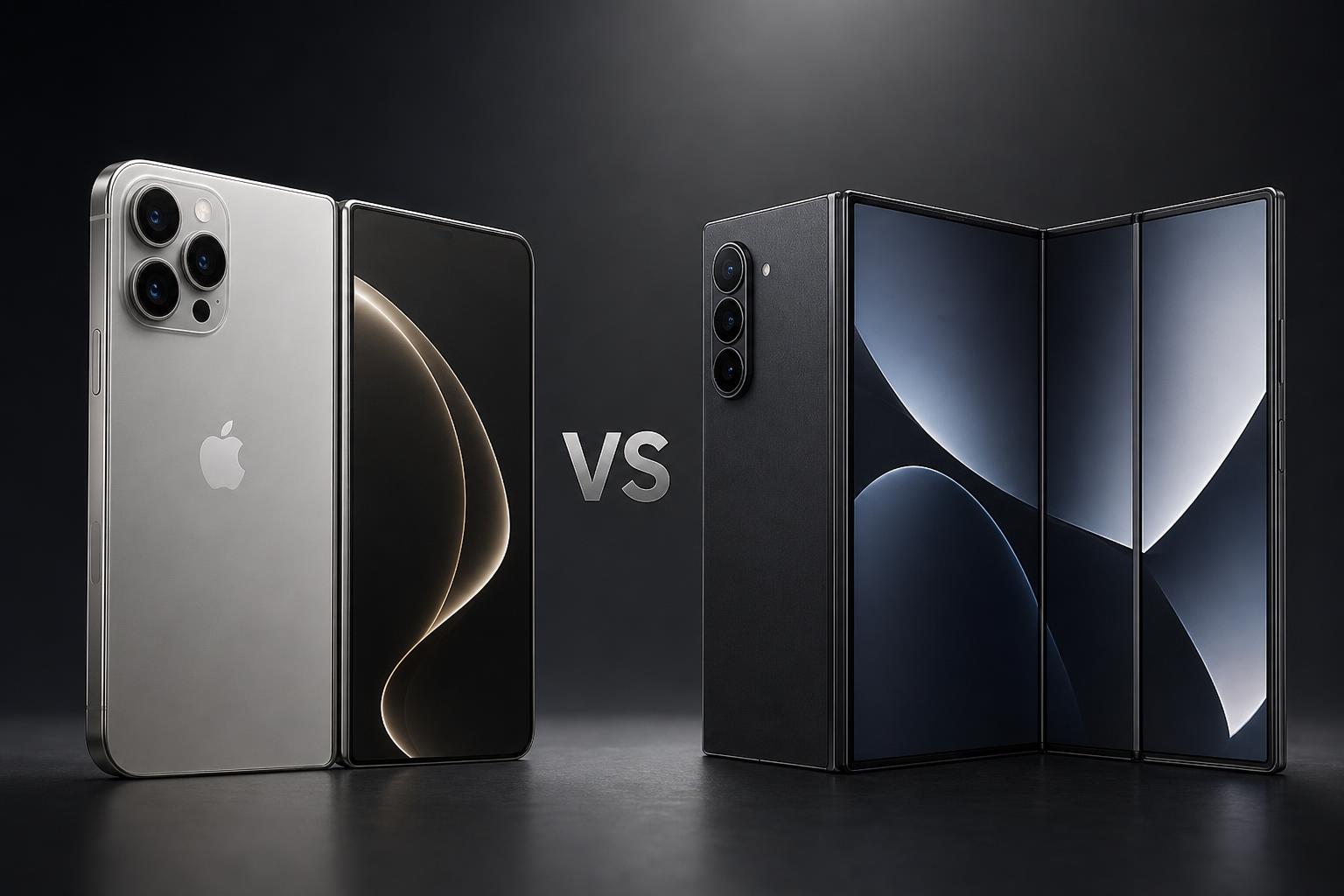
The Apple iPhone Duo and Samsung Galaxy Z TriFold are both large-screen foldable smartphones, but they are designed around different priorities. Apple takes a two-panel book-style approach, while Samsung uses a three-panel design that opens into a tablet-like 10-inch display.
The iPhone Duo starts at $1,999 in the U.S. for 256GB, making it substantially less expensive than the Galaxy Z TriFold’s $2,899 U.S. price for 512GB. Samsung counters with a larger unfolded screen, 16GB of memory, a more versatile listed rear-camera system and built-in Samsung DeX support.
This comparison is based on the manufacturers’ published specifications and product information. It does not treat either device as independently benchmarked or hands-on tested.
Quick verdict
The Apple iPhone Duo is the better choice for buyers who want a lower official starting price, a lighter foldable, IP68 water and dust resistance, Apple ecosystem integration and up to 2TB of storage. Its 7.6-inch inner display is smaller than Samsung’s, but Apple specifies a high resolution, nano-texture finish and up to 3000 nits outdoor brightness.
The Samsung Galaxy Z TriFold is the better fit for buyers who want the largest possible mobile workspace. Its 10-inch unfolded display, 16GB of memory, three-camera rear system, 3x optical telephoto camera and standalone Samsung DeX make it the more productivity-focused design. It is also considerably heavier and costs $900 more at the official U.S. starting price.
There is no verified overall performance winner from the published specifications alone. The iPhone Duo uses Apple’s A20 Pro chip, while the Galaxy Z TriFold uses the customized Snapdragon 8 Elite Mobile Platform for Galaxy, and comparable independent benchmark results are not provided in the research.
Key specifications comparison
| Specification | Apple iPhone Duo | Samsung Galaxy Z TriFold |
|---|---|---|
| U.S. price | $1,999 starting price for 256GB | $2,899 for 512GB |
| Release date | October 23, 2026 | January 30, 2026 |
| Inner or main display | 7.6-inch Super Retina XDR OLED, 1878×2670, 430 ppi | 10.0-inch QXGA+ Dynamic AMOLED 2X, 2160×1584, 269 ppi |
| Outer or cover display | 5.4-inch Super Retina XDR OLED, 1398×2034, 460 ppi | 6.5-inch FHD+ Dynamic AMOLED 2X, 2520×1080, 422 ppi |
| Refresh rate and brightness | ProMotion up to 120Hz; up to 3000 nits outdoor brightness | Adaptive 120Hz; 1600 nits main-display peak brightness and 2600 nits cover-display peak brightness |
| Processor | Apple A20 Pro | Customized Snapdragon 8 Elite Mobile Platform for Galaxy |
| Memory and storage | RAM not published; 256GB, 512GB, 1TB or 2TB | 16GB memory; 512GB or 1TB depending on market or channel |
| Rear cameras | 48MP Fusion Main and 48MP Fusion Ultra Wide; up to 2x optical-quality telephoto | 200MP wide, 12MP ultrawide and 10MP telephoto with 3x optical zoom |
| Battery and charging | Up to 31 hours inner-display video playback or 44 hours outer-display playback; up to 50% in around 20 minutes with a 60W-capable adapter or higher | 5,600mAh typical; 45W wired charging and up to 50% in around 30 minutes |
| Weight | 254 grams | 309 grams |
| Durability | IP68; titanium foldable design | IP48; titanium hinge housing and Advanced Armor Aluminum frame |
| Software | iOS 27, Apple Intelligence, Siri AI and Split View | Android 16, One UI 8, Galaxy AI, Gemini Live and Samsung DeX |
Design and build
Apple iPhone Duo
The iPhone Duo uses a conventional two-panel book-style foldable design. It measures 164.6 × 117.8 × 5.2mm when open and 84.1 × 117.8 × 11.3mm when folded. At 254 grams, it is 55 grams lighter than the Galaxy Z TriFold.
Apple specifies a titanium foldable design and IP68 water and dust resistance. That rating is a significant distinction in this comparison because Samsung specifies IP48 for the Galaxy Z TriFold. Samsung’s specification indicates water resistance and protection against solid objects, but the research states that the Z TriFold is not dust- or sand-resistant according to Samsung’s specification.
The iPhone Duo uses Touch ID in the side button, supports dual eSIM only and has a USB-C port with USB 3 transfer speeds. It also supports Wi-Fi 7 and Bluetooth 6. Buyers who need a physical SIM card should note that the iPhone Duo does not offer physical SIM-card compatibility.
Samsung Galaxy Z TriFold
The Galaxy Z TriFold folds twice into a three-panel design. It measures 159.2 × 75.0 × 12.9mm when folded and 159.2 × 214.1mm when unfolded, with thickness varying from approximately 3.9mm to 4.2mm depending on the panel location. Its 309-gram weight makes it substantially heavier than the iPhone Duo.
Samsung uses a titanium hinge housing and Advanced Armor Aluminum frame, with a Crafted Black finish listed in the research. The design’s main advantage is the amount of screen it carries when opened, but its larger three-panel structure contributes to the added weight.
The Galaxy Z TriFold supports up to two Nano SIM cards as well as multi-eSIM. It also includes Wi-Fi 7, although its listed Bluetooth version is Bluetooth 5.4 rather than the iPhone Duo’s Bluetooth 6. MicroSD expansion is not supported.
Display
Samsung wins on physical screen size. The Galaxy Z TriFold opens to a 10.0-inch QXGA+ Dynamic AMOLED 2X display with a 2160×1584 resolution, 269 ppi and a 120Hz adaptive refresh rate. The larger panel is likely to be particularly useful for split-screen work, documents and other tablet-style tasks, although this comparison does not claim independent usability testing.
The iPhone Duo’s inner display measures 7.6 inches. It uses a Super Retina XDR OLED panel with a 1878×2670 resolution and 430 ppi. It also offers ProMotion up to 120Hz and a nano-texture finish on the inner display. On paper, the iPhone has the higher pixel density, while Samsung provides more physical workspace.
Apple specifies up to 3000 nits outdoor brightness on both displays. Samsung specifies 1600 nits peak brightness for the main display and 2600 nits peak brightness for the cover display. These figures are not described identically by the two manufacturers, so they should not be treated as a direct laboratory comparison.
The cover displays also reflect the different design choices. The iPhone Duo has a 5.4-inch Super Retina XDR OLED outer display with 1398×2034 resolution and 460 ppi. The Galaxy Z TriFold uses a larger 6.5-inch FHD+ Dynamic AMOLED 2X cover display with 2520×1080 resolution and 422 ppi. Both list a 120Hz refresh rate, with Apple calling its system ProMotion and Samsung describing its panel as adaptive.
Performance and memory
The iPhone Duo is powered by Apple’s A20 Pro. Apple lists a six-core CPU, a seven-core GPU with Neural Accelerators, a dual 16-core Neural Engine and hardware-accelerated ray tracing. The phone is available with 256GB, 512GB, 1TB or 2TB of storage, but Apple does not publish the RAM capacity in the supplied specifications.
The Galaxy Z TriFold uses the customized Snapdragon 8 Elite Mobile Platform for Galaxy, manufactured on a 3nm process. Samsung lists 16GB of memory and either 512GB or 1TB of internal storage depending on market or channel. There is no microSD card support.
These specifications show that both phones are positioned as high-end devices, but they do not prove which one is faster. The processors come from different platforms, and the supplied research does not include comparable independent benchmark results. For that reason, the sensible buying decision is based on ecosystem, software and intended workload rather than an unverified performance ranking.
Storage is another clear difference. The Samsung model starts at 512GB in the cited U.S. configuration, while the iPhone Duo starts at 256GB but offers a 2TB option. Buyers should compare the specific capacity they need rather than looking only at the entry prices.
Camera and graphics
Rear-camera hardware
The Galaxy Z TriFold has the more versatile listed rear-camera arrangement. It combines a 200MP wide camera with optical image stabilisation and 2x optical-quality zoom, a 12MP ultrawide camera and a 10MP telephoto camera with optical image stabilisation and 3x optical zoom. Samsung also lists up to 30x Space Zoom.
The iPhone Duo uses a dual rear-camera system consisting of a 48MP Fusion Main camera with 2x optical-quality telephoto and a 48MP Fusion Ultra Wide camera. It does not have a dedicated telephoto camera with the Samsung’s listed 3x optical zoom. On hardware versatility alone, the Galaxy Z TriFold is the stronger choice for buyers who regularly use telephoto and ultrawide perspectives.
Video, selfie and creative features
Apple lists video recording up to 4K Dolby Vision at 120 frames per second. The iPhone Duo also has a 12MP Center Stage outer camera and an under-display inner FaceTime camera. The supplied comparison information highlights Center Stage, Dual Capture and Apple Pencil support as features that may appeal to creators, although the research does not provide additional technical detail about Dual Capture.
The Galaxy Z TriFold has a 10MP cover-screen selfie camera and a 10MP main-screen camera. Its rear-camera combination gives it more dedicated hardware for different focal lengths, while the iPhone Duo’s listed video specification is more distinctive for buyers prioritising Dolby Vision recording.
On graphics hardware, Apple publishes a seven-core GPU and hardware-accelerated ray tracing as part of the A20 Pro specification. Samsung does not publish a separate GPU specification on the cited product page. That omission does not establish a graphics performance winner.
Battery and charging
Samsung publishes the larger battery capacity. The Galaxy Z TriFold has a 5,600mAh typical three-cell battery system, with a rated capacity of 5,437mAh. It supports 45W wired charging, with Samsung stating that the phone can reach up to 50% charge in around 30 minutes. It also supports 15W wireless charging and Wireless PowerShare.
Apple does not publish the iPhone Duo’s battery capacity in the supplied research. Instead, it specifies video-playback figures: up to 31 hours when using the inner display or up to 44 hours when using the outer display. Apple also states that the phone can reach up to 50% charge in around 20 minutes with a 60W-capable adapter or higher. MagSafe and Qi2 wireless charging are supported at up to 25W.
The two sets of information are not directly equivalent. Samsung gives a battery capacity and charging result but no comparable video-playback-hour figure. Apple gives playback estimates but not a capacity figure. Therefore, the Galaxy Z TriFold is the choice for buyers prioritising the larger published battery, while the iPhone Duo offers the clearer manufacturer-published playback estimates.
Software and features
iOS 27 on the iPhone Duo
The iPhone Duo runs iOS 27 and includes Apple Intelligence and Siri AI. Apple also lists Split View multitasking, StandBy and Apple Pencil USB-C support. Split View is especially relevant to a foldable because it is designed to make use of the larger inner screen, while Apple Pencil compatibility gives the phone an additional note-taking and drawing use case.
Apple’s ecosystem may also be a deciding factor for people who already use Apple products and services. The research supports describing the iPhone Duo as an iOS-focused option with Apple ecosystem integration, but it does not provide a detailed list of compatibility requirements or supported accessories beyond Apple Pencil USB-C.
Android 16, One UI 8 and DeX on the Galaxy Z TriFold
The Galaxy Z TriFold runs Android 16 with Samsung’s One UI 8. It includes Galaxy AI and Gemini Live, as well as standalone Samsung DeX. Samsung DeX supports multiple workspaces and external-display features according to the supplied comparison research, making it the more explicitly desktop-oriented option.
The Galaxy Z TriFold also includes a six-month Google AI Pro trial with eligible purchase. This is a purchase-related offer rather than a permanent hardware specification, so buyers should check eligibility and current terms before treating it as part of the phone’s long-term value.
In practical terms, the software choice comes down to platform preference. The iPhone Duo offers iOS 27, Apple Intelligence, Split View and Apple Pencil support. The Galaxy Z TriFold offers Android 16, One UI 8, Galaxy AI, Gemini Live and DeX. Neither software platform can be declared universally better from the verified research alone.
Price and value
The iPhone Duo has an official U.S. starting price of $1,999 for 256GB. The Galaxy Z TriFold costs $2,899 in the U.S. for 512GB. That makes Samsung’s listed price $900 higher, although the Galaxy includes twice the base storage.
Apple’s advantage is strongest for buyers who want to enter the foldable category at the lowest official price among these two models. It also offers more storage headroom, reaching 2TB, whereas the research lists the Galaxy Z TriFold at up to 1TB. However, Apple’s starting price does not include higher storage tiers or accessories.
Samsung’s higher price pays for a larger unfolded display, 16GB of memory, a three-camera rear system with dedicated telephoto hardware, a larger published battery capacity and DeX. Those features may make sense for someone replacing both a phone and a compact tablet or seeking a more desktop-like mobile setup. The value case is weaker for buyers who do not need the 10-inch display or advanced camera flexibility.
Apple iPhone Duo: pros and cons
Pros
- Lower official U.S. starting price at $1,999.
- Lighter 254-gram design compared with the Galaxy Z TriFold.
- IP68 water and dust resistance.
- High-resolution 7.6-inch inner display with nano-texture finish.
- Up to 2TB of storage.
- Apple publishes up to 31 hours of inner-display video playback and up to 44 hours using the outer display.
- Apple Pencil USB-C support and foldable-focused iOS 27 features such as Split View.
- Dolby Vision video recording up to 4K at 120fps.
Cons
- No physical SIM-card compatibility.
- RAM capacity is not published by Apple.
- The 7.6-inch inner display is smaller than Samsung’s 10-inch panel.
- Two rear cameras provide less listed focal-length flexibility than Samsung’s three-camera system.
- The official starting price does not include higher storage tiers or accessories.
Samsung Galaxy Z TriFold: pros and cons
Pros
- Larger 10-inch unfolded display for multitasking and workspace use.
- 16GB of memory and up to 1TB of internal storage.
- 200MP wide, 12MP ultrawide and dedicated 10MP 3x optical telephoto cameras.
- Standalone Samsung DeX with multiple-workspace and external-display features.
- Larger published 5,600mAh typical battery capacity.
- Supports physical Nano SIM cards as well as eSIM.
- 45W wired charging and Wireless PowerShare.
Cons
- Much higher official U.S. price at $2,899.
- Heavier 309-gram design.
- IP48 does not provide dust or sand resistance according to Samsung’s specification.
- The cited U.S. launch configuration is limited to 512GB.
- MicroSD expansion is not supported.
- Samsung does not publish a directly comparable battery-life-hour figure.
Which phone is better for different buyers?
Best for value: Apple iPhone Duo
The iPhone Duo is the clear choice if value means the lowest official entry price. It costs $900 less than the Galaxy Z TriFold, while still offering a high-end processor, 120Hz displays, Apple Intelligence, IP68 resistance and up to 2TB of storage. Its smaller inner screen is the main compromise.
Best for a tablet-like workspace: Samsung Galaxy Z TriFold
The Galaxy Z TriFold is better for buyers who want the largest screen in a phone-sized category. Its 10-inch inner display is substantially larger than the iPhone Duo’s 7.6-inch panel, and Samsung’s DeX features further support a productivity-oriented setup.
Best for camera versatility: Samsung Galaxy Z TriFold
Samsung has the stronger listed rear-camera hardware, with wide, ultrawide and dedicated 3x optical telephoto cameras. Choose it if having separate focal lengths is more important than the iPhone Duo’s Dolby Vision video specification.
Best for Apple users and creators: Apple iPhone Duo
The iPhone Duo is the more natural choice for buyers already invested in Apple’s ecosystem or those who value iOS 27, Apple Intelligence, Apple Pencil USB-C support, Center Stage and Dolby Vision video recording. The Galaxy remains attractive for creators who prioritise rear-camera versatility and a larger workspace.
Best for SIM flexibility: Samsung Galaxy Z TriFold
Samsung supports up to two Nano SIM cards and multi-eSIM. The iPhone Duo is dual eSIM only, so the Galaxy Z TriFold is the safer option for buyers who specifically require physical SIM support.
Best for durability specifications: Apple iPhone Duo
Apple has the stronger published durability rating in this comparison. The iPhone Duo is rated IP68 for water and dust resistance, while the Galaxy Z TriFold is rated IP48 and is not dust- or sand-resistant according to Samsung’s specification.
Final verdict
The Apple iPhone Duo and Samsung Galaxy Z TriFold are aimed at different definitions of a premium foldable. Apple offers the more approachable price, lighter construction, IP68 resistance, strong storage options and a set of iOS and Apple Pencil features designed for its ecosystem. It is the better all-round choice for most buyers who want a foldable iPhone without paying the Galaxy’s much higher launch price.
Samsung’s Galaxy Z TriFold is the specialist option. Its 10-inch unfolded display, 16GB of memory, dedicated 3x telephoto camera, larger published battery and Samsung DeX give it a more ambitious productivity profile. Those benefits are meaningful, but they come with a 309-gram weight, IP48 protection and a $2,899 official U.S. price.
Choose the iPhone Duo for value, lighter weight, IP68 protection, Apple ecosystem features and storage capacity. Choose the Galaxy Z TriFold for the biggest display, more flexible rear cameras, physical SIM support and DeX-based productivity. Neither processor can be named the definitive performance winner from the verified specifications alone.
Frequently asked questions
Which is cheaper, the Apple iPhone Duo or Galaxy Z TriFold?
The Apple iPhone Duo is cheaper. Its official U.S. starting price is $1,999 for 256GB, while the Samsung Galaxy Z TriFold costs $2,899 in the U.S. for 512GB.
Which foldable has the larger display?
The Samsung Galaxy Z TriFold has the larger unfolded display. Its main panel measures 10.0 inches, compared with 7.6 inches for the iPhone Duo’s inner display.
Which phone has the better camera system?
The Galaxy Z TriFold has the more versatile listed rear-camera hardware, with 200MP wide, 12MP ultrawide and 10MP telephoto cameras with 3x optical zoom. The iPhone Duo has dual 48MP rear cameras and supports Dolby Vision video recording up to 4K at 120fps.
Which phone has the better battery?
The Galaxy Z TriFold has the larger published battery capacity at 5,600mAh typical. Apple does not publish the iPhone Duo’s capacity, but it does specify up to 31 hours of inner-display video playback or up to 44 hours using the outer display. The figures are measured and presented differently, so they are not directly comparable.
Does the iPhone Duo support a physical SIM card?
No. The iPhone Duo is dual eSIM only. The Galaxy Z TriFold supports up to two Nano SIM cards as well as multi-eSIM.
Which phone is better for productivity?
The Galaxy Z TriFold has the larger 10-inch display and standalone Samsung DeX with multiple-workspace and external-display features, making it the stronger choice for a large mobile workspace. The iPhone Duo offers Split View and Apple Pencil USB-C support, which may suit buyers already using Apple’s ecosystem.
Sources
- iPhone Duo - Technical Specifications — Apple
- iPhone Duo — Apple
- Apple unveils iPhone Duo — Apple Newsroom
- Introducing Galaxy Z TriFold: The Shape of What’s Next in Mobile Innovation — Samsung Newsroom
- The Highly Anticipated Samsung Galaxy Z TriFold is Available in U.S. — Samsung Newsroom