
Samsung Galaxy S26 vs OnePlus 15: Which Flagship Phone Is Better?
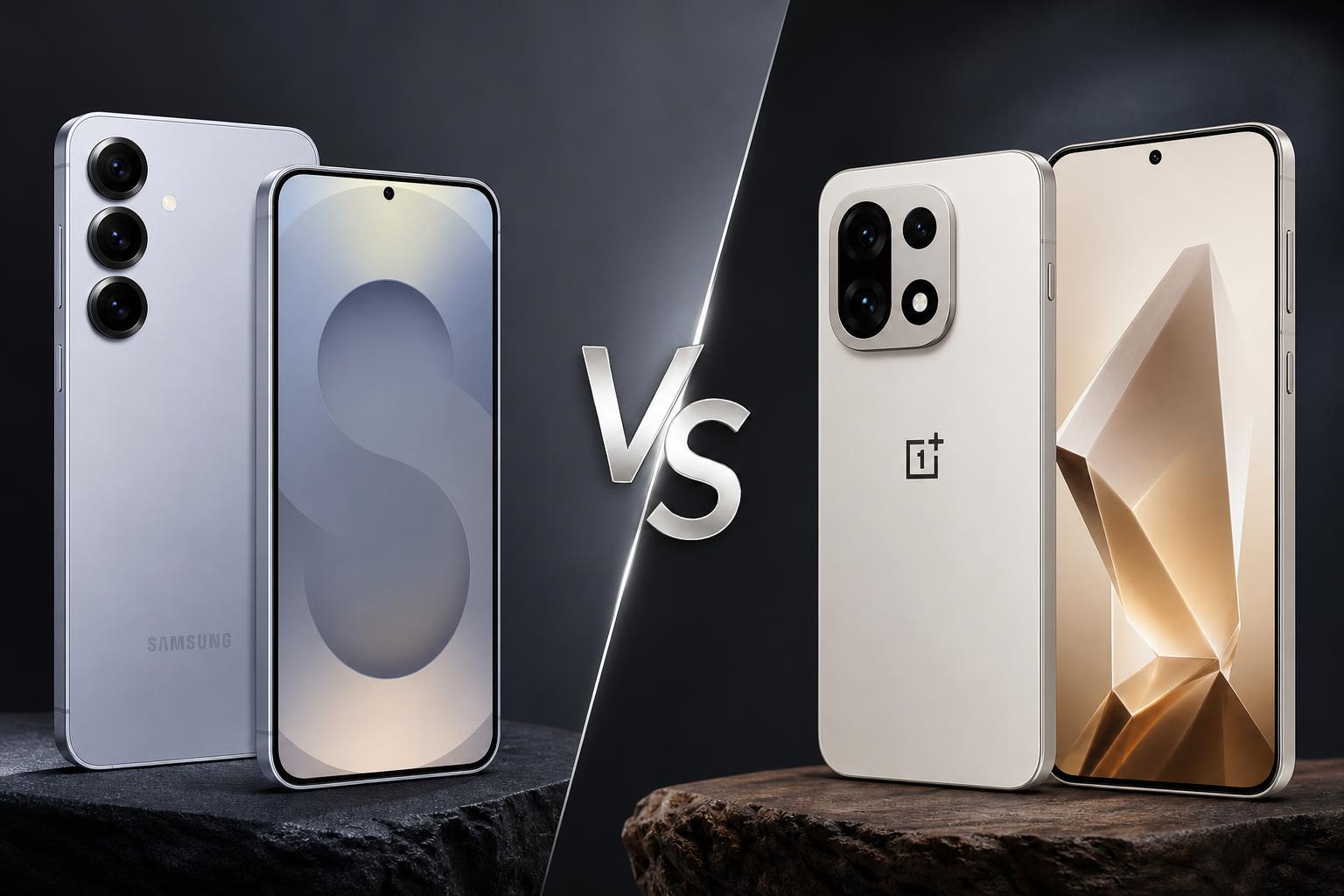
The Samsung Galaxy S26 and OnePlus 15 are closely matched on price, but they are designed for different priorities. The Galaxy S26 is the smaller, lighter and more compact flagship, with Samsung’s Galaxy AI features, a dedicated 3x optical telephoto camera and a notably longer stated software-support commitment. The OnePlus 15 is built around endurance and performance features, offering a much larger battery, faster charging, a larger high-refresh-rate display and up to 16GB of RAM.
Both phones use Qualcomm’s Snapdragon 8 Elite Gen 5 platform family, and both start at $899.99 in the US. The key question is not simply which phone is faster, but whether you value Samsung’s compact Galaxy experience and long-term support more than OnePlus’s battery capacity, charging speeds and specification-heavy approach.
Quick verdict
The OnePlus 15 is the stronger choice for battery life, charging, gaming-oriented display features, memory and camera hardware on paper. Its 7,300mAh battery, 80W US wired charging, 50W wireless charging, optional 16GB of RAM and 165Hz gaming mode give it a clear hardware advantage for demanding users.
The Samsung Galaxy S26 is better for buyers who want a compact flagship, Samsung’s broader ecosystem, Galaxy AI and a longer update commitment. It is substantially smaller and lighter, reaches a higher stated peak brightness, includes a dedicated 3x optical telephoto camera and offers seven generations of OS upgrades plus seven years of security updates.
At the same $899.99 starting price, the OnePlus 15 offers more hardware in several areas. The Galaxy S26 makes a more compelling case through its size, software support and Galaxy platform integration.
Key specifications comparison
| Feature | Samsung Galaxy S26 | OnePlus 15 |
|---|---|---|
| US starting price | $899.99 for 256GB | $899.99 for 12GB/256GB |
| Release date | March 11, 2026 | November 13, 2025 globally; December 4, 2025 in the US |
| Display | 6.3-inch Dynamic AMOLED 2X, 2340 x 1080, adaptive 1-120Hz | 6.78-inch LTPO OLED, 2772 x 1272, adaptive 1-120Hz; up to 165Hz in supported games |
| Peak or stated brightness | Up to 2600 nits peak brightness | 1800 nits HBM brightness |
| Processor | Snapdragon 8 Elite Gen 5 for Galaxy | Snapdragon 8 Elite Gen 5 |
| RAM and storage | 12GB RAM; 256GB or 512GB | 12GB or 16GB RAM; 256GB or 512GB UFS 4.1 storage |
| Rear cameras | 50MP wide, 12MP ultrawide, 10MP 3x telephoto | 50MP main with OIS, 50MP ultrawide, 50MP periscope telephoto with OIS and 3.5x optical zoom |
| Front camera | 12MP autofocus | 32MP autofocus |
| Video | Up to 8K at 30fps | 4K at up to 120fps with Dolby Vision |
| Battery | 4300mAh; up to 30 hours of video playback rated by Samsung | 7300mAh dual-cell |
| Charging | 25W wired | 80W wired in the US, up to 100W with the specified OnePlus adapter, 50W wireless |
| Software | Android 16 with One UI 8.5 and Galaxy AI | OxygenOS 16 based on Android 16 |
| Durability | IP68 | IP66, IP68, IP69 and IP69K ratings listed |
| Dimensions and weight | 149.6 x 71.7 x 7.2mm; 167g | 161.42 x 76.67 x 8.10-8.20mm; 211g or 215g |
Design and build
The Galaxy S26 is the obvious choice if you prefer a phone that is easy to handle. It measures 149.6 x 71.7 x 7.2mm and weighs 167g, making it considerably shorter, narrower and lighter than the OnePlus 15. That difference should matter to anyone who uses a phone one-handed, carries it in a smaller pocket or simply dislikes the feel of large flagship devices.
The OnePlus 15 measures 161.42 x 76.67 x between 8.10mm and 8.20mm, depending on the specification provided, and weighs either 211g or 215g depending on colour. In return for the additional size and weight, it houses a much larger 6.78-inch display and a 7,300mAh dual-cell battery. This is a classic trade-off: Samsung is more portable, while OnePlus prioritises screen area and endurance.
Both phones have strong stated durability credentials, although their ratings are presented differently. Samsung lists IP68 water and dust resistance. OnePlus lists IP66, IP68, IP69 and IP69K durability ratings. These specifications indicate that both models are designed with substantial protection in mind, but buyers should still follow each manufacturer’s care guidance rather than treating any water-resistance rating as permanent protection.
For design, the Galaxy S26 is the better fit for compact-phone buyers. The OnePlus 15 is more appropriate if a larger chassis is acceptable and the benefits of its bigger screen and battery are more important than pocketability.
Display
Samsung equips the Galaxy S26 with a 6.3-inch Dynamic AMOLED 2X display. It has a 2340 x 1080 resolution, an adaptive refresh rate from 1Hz to 120Hz and a stated peak brightness of up to 2600 nits. The smaller panel and high brightness make the Galaxy S26 an appealing option for users who want a relatively compact phone without giving up a flagship display specification.
The OnePlus 15 has a much larger 6.78-inch LTPO OLED panel with a 2772 x 1272 resolution. Its refresh rate adapts from 1Hz to 120Hz for regular use and can reach 165Hz in supported games. OnePlus also lists 1800 nits HBM brightness and Gorilla Glass Victus 2 protection. The phone’s 1.15mm bezels on all four sides are another part of its screen-focused design.
The OnePlus 15 wins for size and gaming features. Its 165Hz mode gives supported games a higher refresh-rate ceiling, although the benefit depends on game support and other factors. The Galaxy S26 has the higher stated peak brightness, at up to 2600 nits, and its smaller dimensions may make the display easier to manage for one-handed use.
Neither phone is a simple universal winner. Choose the OnePlus 15 for a more immersive large-screen experience and gaming-focused refresh rate. Choose the Galaxy S26 if compact dimensions and higher stated peak brightness matter more.
Performance and storage
Both models use Qualcomm’s Snapdragon 8 Elite Gen 5 platform family. Samsung identifies its version as the Snapdragon 8 Elite Gen 5 for Galaxy, while OnePlus lists the Snapdragon 8 Elite Gen 5. Based on the verified research available here, there is no directly comparable benchmark testing that establishes a performance winner, so it would be inappropriate to claim that one phone is definitively faster in general use.
The OnePlus 15 does have the more generous memory options. It is available with 12GB or 16GB of LPDDR5X Ultra or Ultra+ RAM, alongside 256GB or 512GB of UFS 4.1 storage. The Galaxy S26 offers 12GB of RAM with 256GB or 512GB of storage. OnePlus’s 16GB option and UFS 4.1 storage give it a stronger specification-sheet advantage for multitasking, large games and users who want more capacity at the top end.
That difference is particularly relevant because the OnePlus 15’s 16GB/512GB model costs $999.99 in the US. Samsung confirms that a 512GB option is available, but the verified research does not provide a US price for that configuration. The OnePlus configuration therefore offers a clearly defined higher-capacity option at a price below the $1,000 mark.
For everyday flagship performance, both phones are based on a very high-end Qualcomm platform. For buyers who specifically want maximum listed RAM and faster storage, the OnePlus 15 is the more ambitious option. For buyers who prefer Samsung’s software environment and do not need more than 12GB of RAM, the Galaxy S26 remains well specified.
Camera and graphics features
The two phones take different approaches to their camera hardware. The Galaxy S26 has a 50MP wide camera with autofocus, a 12MP ultrawide camera and a 10MP 3x telephoto camera. It supports 3x optical zoom, 2x optical-quality zoom and up to 30x digital zoom. A 12MP autofocus front camera handles selfies and video calls, while rear video recording reaches up to 8K at 30fps.
The OnePlus 15 has three 50MP rear cameras: a main camera with optical image stabilisation, a 50MP ultrawide camera with a 112-degree field of view and a 50MP periscope telephoto camera with optical image stabilisation. Its telephoto camera offers 3.5x optical zoom. The front camera has 32MP resolution and autofocus. Video recording supports 4K at up to 120fps with Dolby Vision.
On specifications alone, the OnePlus 15 has the more aggressive camera system. It provides three 50MP rear cameras, a periscope telephoto lens, a slightly longer optical zoom reach and high-frame-rate 4K Dolby Vision video. This makes it the more appealing choice for buyers who prioritise camera hardware, zoom flexibility or video options.
The Galaxy S26 still has important strengths. Its dedicated 3x optical telephoto is more purposeful than relying only on digital zoom, and it combines the camera hardware with Samsung’s Galaxy AI, One UI and broader Galaxy software ecosystem. The research does not establish a direct image-quality winner, so the choice should be based on the specifications and software approach rather than an unsupported claim about real-world photos.
For graphics and gaming, the OnePlus 15 has the clearest stated advantage through its 165Hz gaming mode and larger display. Neither phone should be assigned a benchmark victory based solely on the shared processor family, but OnePlus gives demanding users more display and memory-oriented features to work with.
Battery and charging
Battery life is the biggest hardware advantage for the OnePlus 15. Its 7,300mAh dual-cell battery is substantially larger than the Galaxy S26’s 4,300mAh battery. OnePlus lists 80W wired charging in the US, up to 100W with the specified OnePlus adapter and 50W wireless charging.
The Galaxy S26 supports 25W wired charging and has the smaller battery. Samsung rates it for up to 30 hours of video playback, but battery performance varies with brightness, network conditions, apps and other settings. The research does not provide an equivalent OnePlus video-playback rating, so the two stated figures should not be treated as a directly comparable battery-life test.
The practical conclusion is still clear from the specifications: the OnePlus 15 is the better option for heavy users who spend long periods gaming, streaming, navigating or taking photos away from a charger. Its faster wired and wireless charging also make short charging sessions more useful.
The Galaxy S26 is more suitable for users who prefer a smaller phone and do not need the endurance of a 7,300mAh battery. Its 25W charging is a notable compromise compared with OnePlus, especially at a similar starting price.
Software and features
The Galaxy S26 runs Android 16 with One UI 8.5 and Galaxy AI features. Samsung promises seven generations of OS upgrades and seven years of security updates from global launch. That is one of the phone’s strongest advantages and gives it a particularly clear long-term ownership proposition.
Samsung’s wider Galaxy ecosystem is also part of the decision. The verified research identifies broader Galaxy ecosystem integration as a strength, alongside Galaxy AI and One UI. Buyers who already use Samsung products or prefer Samsung’s software design may find the Galaxy S26 easier to fit into their existing setup.
The OnePlus 15 runs OxygenOS 16 based on Android 16. Its listed features include Plus Mind, Google Gemini integration, AI Recorder, AI Scan and AI PlayLab. It has a six-year defined support period, which is substantial but shorter than Samsung’s stated seven generations of OS upgrades and seven years of security updates.
OnePlus’s software proposition is more focused on AI tools, customisation and gaming-oriented features, while Samsung’s advantage is longevity and ecosystem breadth. The Galaxy S26 is the safer pick for buyers who intend to keep their phone for many years and place a high value on a clearly stated update commitment.
Price and value
The Samsung Galaxy S26 starts at $899.99 in the US for 256GB. A 512GB option is available, although the verified research does not specify its price.
The OnePlus 15 also starts at $899.99, but that price is specified for the 12GB/256GB model. The 16GB/512GB version costs $999.99. This gives OnePlus a strong value argument, particularly for buyers who want more RAM and storage without moving into a substantially higher price category.
At the entry price, the OnePlus 15 offers a larger battery, faster charging, a larger display, more ambitious rear-camera hardware and a higher available RAM configuration. It is the better value choice if your priorities are hardware capacity, endurance and gaming features, and if its current availability is suitable.
The Galaxy S26 justifies its matching starting price in different ways. It is significantly smaller and lighter, has a dedicated 3x optical telephoto, reaches a higher stated peak brightness, integrates with Samsung’s Galaxy platform and offers the longer stated software-support period. It is not the value winner by raw specifications, but it may be the better long-term purchase for Samsung users and compact-phone buyers.
One factor to consider with the OnePlus 15 is availability. The research notes that its current North American rollout and availability may be affected by OnePlus’s announced business adjustment. Buyers should check current US availability before choosing it, particularly if they need a phone immediately or want straightforward ongoing support.
Samsung Galaxy S26: pros and cons
Pros
- More compact and lighter than the OnePlus 15.
- Higher stated peak brightness of up to 2600 nits.
- Dedicated 3x optical telephoto camera.
- Seven generations of OS upgrades and seven years of security updates from global launch.
- Galaxy AI, One UI and broader Samsung Galaxy ecosystem integration.
- IP68 water and dust resistance.
Cons
- Much smaller 4300mAh battery.
- 25W wired charging is slower than the OnePlus 15’s US charging rate.
- Maximum refresh rate is lower than the OnePlus 15’s 165Hz gaming mode.
- Only 12GB of RAM is listed.
- Rear camera hardware is less ambitious on paper than the OnePlus 15’s all-50MP system.
OnePlus 15: pros and cons
Pros
- Large 7300mAh battery.
- 80W wired charging in the US and 50W wireless charging.
- 6.78-inch display with a 165Hz mode in supported games.
- Up to 16GB of RAM and UFS 4.1 storage.
- Triple-50MP rear camera system with a 3.5x periscope telephoto.
- 4K/120fps Dolby Vision video support.
- 16GB/512GB version costs $999.99.
- Multiple listed durability ratings, including IP68, IP69 and IP69K.
Cons
- Larger and heavier than the Galaxy S26.
- Shorter stated software-support period than Samsung.
- US wired charging is slower than the maximum international specification.
- OnePlus offers fewer long-term ecosystem advantages than Samsung’s Galaxy platform.
- North American availability may be affected by OnePlus’s announced business adjustment.
Which phone is better for different buyers?
Choose the Samsung Galaxy S26 if you want a compact flagship
The Galaxy S26 is the clear choice for buyers who do not want a large or heavy phone. Its 167g weight and narrower body make it easier to carry and handle than the OnePlus 15.
Choose the OnePlus 15 for battery life and charging
The OnePlus 15 is the better option for heavy users. Its 7300mAh battery, 80W US wired charging and 50W wireless charging give it a substantial specification advantage over Samsung’s 4300mAh battery and 25W wired charging.
Choose the OnePlus 15 for gaming and hardware-focused performance
For gaming-oriented buyers, the OnePlus 15 combines the Snapdragon 8 Elite Gen 5 with up to 16GB of RAM, UFS 4.1 storage, a 165Hz gaming mode and a larger display. No benchmark winner is established here, but its listed features are better aligned with demanding gaming use.
Choose the Samsung Galaxy S26 for long-term ownership
Samsung is the better choice if software longevity is central to your buying decision. Its seven generations of OS upgrades and seven years of security updates exceed the OnePlus 15’s six-year defined support period.
Choose the OnePlus 15 for camera specifications and video options
The OnePlus 15 is the stronger choice for buyers who prioritise camera hardware on paper. Its triple-50MP rear system, 3.5x periscope telephoto and 4K/120fps Dolby Vision recording are more ambitious than the Galaxy S26’s listed system.
Final verdict
The Samsung Galaxy S26 and OnePlus 15 are both compelling flagship choices, but they serve different users. The OnePlus 15 is the specification leader in battery capacity, charging, display size, gaming refresh rate, available RAM and rear-camera hardware. At $899.99, it offers particularly strong value in its 12GB/256GB configuration, while the $999.99 16GB/512GB version provides a substantial amount of memory and storage.
The Galaxy S26 is the more refined choice for buyers who want a small, light phone with Samsung’s software, Galaxy AI, ecosystem features and an unusually clear long-term update commitment. It also offers a higher stated peak brightness and a dedicated optical telephoto camera in a much more compact body.
Choose the OnePlus 15 for battery life, charging, gaming and maximum hardware value. Choose the Samsung Galaxy S26 for compact design, long-term software support and the broader Galaxy experience.
FAQs
Is the Samsung Galaxy S26 cheaper than the OnePlus 15?
No. Both start at $899.99 in the US. The Galaxy S26 starts with 256GB of storage, while the OnePlus 15’s starting price is for the 12GB/256GB model. The OnePlus 15 also has a 16GB/512GB version priced at $999.99.
Which phone has the bigger battery?
The OnePlus 15 has the bigger battery by a substantial margin. It uses a 7300mAh dual-cell battery, while the Galaxy S26 has a 4300mAh battery. Samsung rates the Galaxy S26 for up to 30 hours of video playback.
Which phone charges faster?
The OnePlus 15 charges faster. It supports 80W wired charging in the US, up to 100W with the specified OnePlus adapter and 50W wireless charging. The Galaxy S26 supports 25W wired charging.
Which has the better camera?
The OnePlus 15 has the more ambitious camera specification, with three 50MP rear cameras, a 3.5x periscope telephoto and 4K/120fps Dolby Vision video. The Galaxy S26 has a dedicated 3x optical telephoto and supports up to 8K/30fps video. The verified research does not establish a definitive real-world image-quality winner.
Which phone will receive updates for longer?
The Galaxy S26 has the longer stated commitment: seven generations of OS upgrades and seven years of security updates from global launch. The OnePlus 15 has a six-year defined support period.
Which is better for gaming?
The OnePlus 15 is the stronger choice based on its listed features. It offers up to 16GB of RAM, UFS 4.1 storage, a larger display and a 165Hz mode in supported games. Both phones use the Snapdragon 8 Elite Gen 5 platform family, but no directly comparable benchmark advantage is established here.