
OnePlus 15 vs Samsung Galaxy S26 Ultra: Which Flagship Phone Should You Buy?
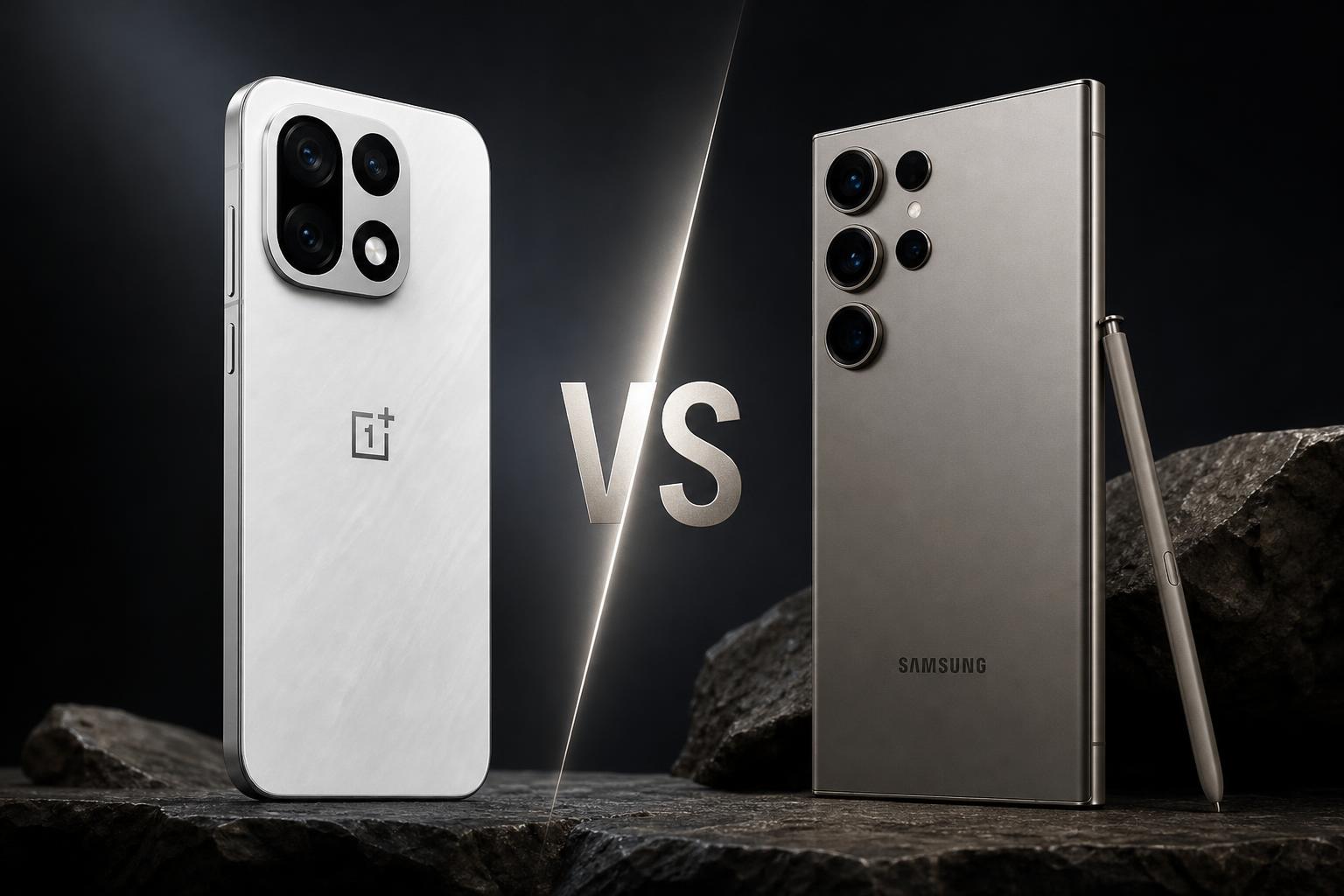
The OnePlus 15 and Samsung Galaxy S26 Ultra are high-end Android phones with broadly similar processor technology, but their priorities are notably different. The OnePlus 15 is built around a very large battery, fast charging and gaming-focused performance features. The Galaxy S26 Ultra costs considerably more, but counters with a sharper display, a more versatile zoom camera system, an integrated S Pen and a longer stated security-support commitment.
This comparison uses the published specifications and prices for both phones. It does not rely on directly comparable benchmark results or imply hands-on testing beyond what is identified in the supplied research.
Quick verdict
The OnePlus 15 is the better value choice for most buyers who want flagship-level processing, a large battery, fast charging and a high-refresh-rate gaming display without spending more than US$1,000. Its starting price is US$400 lower than the Galaxy S26 Ultra, and it offers a 7,300mAh battery compared with Samsung's 5,000mAh unit.
The Samsung Galaxy S26 Ultra is the more complete premium phone. It has the sharper 6.9-inch display, a built-in S Pen, a stronger long-range camera specification, a broad Galaxy AI feature set and seven years of security updates. It is the better choice for photographers, note-takers, creators and buyers who want Samsung's wider ecosystem.
In short, choose the OnePlus 15 for battery, charging, gaming and value. Choose the Galaxy S26 Ultra for zoom photography, pen-based productivity, display resolution and long-term software support.
Key specifications comparison
| Specification | OnePlus 15 | Samsung Galaxy S26 Ultra |
|---|---|---|
| Release date | November 13, 2025 | March 11, 2026 |
| Starting price | US$899.99 for 12GB/256GB | US$1,299.99 for 256GB |
| Display | 6.78-inch LTPO OLED, 2772 × 1272, 1–120Hz; up to 165Hz in select games | 6.9-inch Dynamic AMOLED 2X, 3120 × 1440, 1–120Hz, integrated Privacy Display |
| Processor | Snapdragon 8 Elite Gen 5 | Snapdragon 8 Elite Gen 5 for Galaxy |
| RAM and storage | 12GB/256GB or 16GB/512GB | 12GB/256GB or 512GB; 16GB/1TB |
| Rear cameras | 50MP main with OIS, 50MP autofocus ultrawide, 50MP periscope telephoto | 200MP main, 50MP ultrawide, 10MP 5x telephoto, 50MP 10x optical-quality telephoto |
| Front camera | 32MP | 12MP |
| Battery and charging | 7,300mAh; up to 80W wired and 50W wireless | 5,000mAh; Super Fast Charging 3.0 and Super Fast Wireless Charging |
| Software | OxygenOS 16 based on Android 16 | Android 16 with Samsung One UI |
| Special features | OnePlus AI, Gemini integration, gaming chips and cooling | Integrated S Pen, Galaxy AI, Privacy Display and seven years of security updates |
| Water and dust resistance | IP66, IP68, IP69 and IP69K | IP68 |
| Dimensions and weight | 161.42 × 76.67 × 8.1mm; 211g | 163.6 × 78.1 × 7.9mm; 214g |
Design and build
The two phones are large flagship devices, although Samsung's design is slightly thinner and OnePlus's is slightly lighter. The OnePlus 15 measures 161.42 × 76.67 × 8.1mm and weighs 211g. The Galaxy S26 Ultra measures 163.6 × 78.1 × 7.9mm and weighs 214g. That makes the Samsung 0.2mm thinner, while the OnePlus is 3g lighter.
The Galaxy S26 Ultra's most obvious hardware distinction is its integrated S Pen. This gives the phone a built-in stylus for compatible note-taking, editing and productivity workflows, without requiring a separate accessory. For buyers who regularly annotate documents, write notes or want pen input, this is a meaningful advantage rather than a minor specification difference.
Samsung also lists Gorilla Glass Armor 2 on the front, Gorilla Glass Victus 2 on the back and an Armor Aluminum frame. The OnePlus 15's research highlights a different strength: its extensive protection ratings. It carries IP66, IP68, IP69 and IP69K ratings, while Samsung carries an IP68 rating. These ratings are not directly interchangeable in every use case, but the published specification gives OnePlus broader stated resistance coverage.
The OnePlus 15 supports magnetic-compatible cases for MagSafe accessories. However, the phone itself does not include built-in magnets, so buyers should not confuse case compatibility with integrated magnetic hardware. The Galaxy S26 Ultra's design instead concentrates on the S Pen, its materials and Samsung's ecosystem features.
Display
Samsung has the advantage in resolution and screen size. The Galaxy S26 Ultra uses a 6.9-inch Dynamic AMOLED 2X panel with a 3120 × 1440 resolution. The OnePlus 15 has a 6.78-inch LTPO OLED display with a 2772 × 1272 resolution. Text, detailed images and other fine on-screen content should therefore benefit from Samsung's higher pixel count, although the supplied research does not include a direct visual comparison.
Both displays use adaptive refresh-rate technology and can scale down to 1Hz. That can help each phone adjust display smoothness to the type of content being shown, while potentially avoiding unnecessary high-refresh operation when it is not needed. The Samsung panel reaches 120Hz, whereas the OnePlus display can reach up to 165Hz in select games. This gives OnePlus the more aggressive gaming specification, provided a particular title supports the higher rate.
Samsung adds an integrated Privacy Display. When activated, this is designed to limit viewing from the side, which can be useful for private work in public places. The trade-off is that viewing angles can be reduced for people looking from the side when the feature is active.
The choice here depends on priorities. The Galaxy S26 Ultra is the better fit for buyers who value maximum resolution and built-in privacy controls. The OnePlus 15 is more appealing to gamers who want the option of a refresh rate above 120Hz in supported games.
Performance and gaming
Both phones use Qualcomm's Snapdragon 8 Elite Gen 5 family. The OnePlus 15 lists the Snapdragon 8 Elite Gen 5, while Samsung uses the Snapdragon 8 Elite Gen 5 for Galaxy. This places both devices in the same current flagship processor generation according to the supplied research.
OnePlus puts more emphasis on gaming hardware around the processor. The OnePlus 15 includes dedicated touch-response and Wi-Fi chips, along with a 360-degree Cryo-Velocity cooling system. Its display can also reach up to 165Hz in select games. These features make its stated specification particularly focused on touch responsiveness, wireless connectivity and sustained gaming operation.
Samsung's approach focuses on thermal consistency through a redesigned vapor chamber. The Galaxy S26 Ultra also benefits from the Snapdragon 8 Elite Gen 5 for Galaxy platform and offers up to 16GB of RAM in its 1TB configuration. The OnePlus 15 offers 12GB or 16GB of LPDDR5X RAM, with 16GB available alongside 512GB of storage.
There is no directly comparable benchmark result in the verified research, so it would be inappropriate to declare one phone universally faster. On specifications, however, the OnePlus 15 is the clearer choice for gaming-oriented features, while both should be considered flagship-class options based on their processor platforms.
Storage is another practical consideration. OnePlus offers 256GB or 512GB using UFS 4.1 storage. Samsung offers 256GB and 512GB versions with 12GB of RAM, plus a 1TB version with 16GB of RAM. Buyers who store a large number of videos, photographs or downloaded games may find Samsung's 1TB configuration useful, although it carries a significantly higher price.
Camera and video features
The Galaxy S26 Ultra has the more versatile camera arrangement, especially for long-range photography. Its system includes a 200MP main camera, a 50MP ultrawide camera, a 10MP telephoto camera with 5x optical zoom and a 50MP telephoto camera with 10x optical-quality zoom. It also has a 12MP selfie camera.
The OnePlus 15 uses a balanced triple-50MP setup: a 50MP main camera with optical image stabilisation, a 50MP autofocus ultrawide camera with macro capability and a 50MP periscope telephoto camera with 3.5x optical zoom and 7x high-quality lossless zoom. It has a higher-resolution 32MP selfie camera on paper.
For distant subjects, the Samsung specification is stronger. Its dedicated 5x optical telephoto and 10x optical-quality zoom give it more flexibility for subjects that are far away. The OnePlus 15 still offers a dedicated periscope camera and useful zoom capability, but its listed optical reach is less extensive.
OnePlus has a notable video advantage in its published specifications. The OnePlus 15 supports 4K video at 120 frames per second with Dolby Vision, as well as LOG recording. That combination is relevant to creators who want high-frame-rate capture, Dolby Vision workflows or more flexibility for colour grading.
Samsung counters with enhanced Nightography Video, Super Steady with horizontal lock and the APV professional video codec. Its broader creator appeal also comes from features such as Photo Assist and Creative Studio in the software. This makes the Galaxy S26 Ultra the stronger choice for camera versatility, zoom photography and integrated editing tools, while the OnePlus 15 has a particularly compelling high-frame-rate video specification.
Battery and charging
Battery capacity is the clearest hardware win for OnePlus. The OnePlus 15 contains a 7,300mAh battery, significantly larger than the Galaxy S26 Ultra's 5,000mAh battery. Capacity alone does not guarantee a particular runtime, because usage, display settings, software and network conditions all affect endurance, but the difference is substantial on paper.
The OnePlus 15 also supports up to 80W wired charging in the United States and Canada and up to 50W wireless charging. Samsung lists Super Fast Charging 3.0 and Super Fast Wireless Charging, with Samsung stating that the Galaxy S26 Ultra can reach up to 75% charge in 30 minutes.
These are different ways of describing charging capability, so the published figures should not be treated as a complete real-world charging test. Even so, OnePlus is the clear capacity and charging leader in the verified comparison. It is the better fit for buyers who spend long periods away from a charger, play demanding games or simply prefer to recharge less often.
The Galaxy S26 Ultra remains the more compact battery proposition for buyers who prioritise its other features. Its smaller battery contributes to a phone that is listed as slightly thinner, although it is also 3g heavier than the OnePlus 15.
Software and special features
The OnePlus 15 runs OxygenOS 16 based on Android 16. Its listed AI features include Plus Mind, AI Writer, AI Recorder and AI Portrait Glow, along with Google Gemini integration. The interface is also described in the research as more customisable, which may appeal to users who prefer greater control over the phone's software experience.
The Galaxy S26 Ultra runs Android 16 with Samsung One UI and Galaxy AI. Its feature set includes upgraded Bixby, Gemini integration, Perplexity integration, Now Nudge, Now Brief, Photo Assist and Creative Studio. Samsung also combines these features with the integrated S Pen and the Privacy Display, creating a wider collection of hardware-linked software tools.
Samsung has the stronger stated long-term support position, with seven years of security updates. That is important for buyers who plan to keep a phone for many years or who place a high priority on security maintenance. The supplied research does not state an equivalent security-update period for the OnePlus 15, so no direct promise should be inferred.
OnePlus's software advantage is focus. Plus Mind, AI Writer and AI Recorder give it a clear set of productivity and AI features, while Gemini integration connects it to Google's assistant ecosystem. Samsung offers more named services and a broader ecosystem, but buyers should consider which tools they are likely to use rather than choosing based only on the number of features listed.
Price and value
Price is one of the biggest differences between these phones. The OnePlus 15 starts at US$899.99 for 12GB of RAM and 256GB of storage. Its 16GB/512GB configuration costs US$999.99.
The Galaxy S26 Ultra starts at US$1,299.99 for 256GB. The 512GB model costs US$1,499.99, while the 1TB version costs US$1,799.99. At entry level, that makes the Samsung US$400 more expensive than the OnePlus 15.
The Galaxy S26 Ultra's premium pays for a different set of advantages: its sharper display, integrated S Pen, 200MP main camera, 5x optical and 10x optical-quality zoom, wider software ecosystem and seven years of security updates. For buyers who will use those features, the higher price may be easier to justify.
The OnePlus 15 offers a stronger value proposition for users who want core flagship performance without paying for every premium extra. It has the same Snapdragon 8 Elite Gen 5 processor family, a much larger battery, faster listed charging, a gaming-focused cooling system and a capable triple-50MP camera system. It is therefore the more cost-effective option for performance, gaming and battery-focused buyers.
OnePlus 15: pros and cons
Pros
- Lower starting price of US$899.99.
- Much larger 7,300mAh battery than the Galaxy S26 Ultra.
- Up to 80W wired charging in the United States and Canada and up to 50W wireless charging.
- Up to 165Hz refresh rate in select games.
- Gaming-focused touch and Wi-Fi chips with 360-degree Cryo-Velocity cooling.
- Triple-50MP camera system with a periscope telephoto camera.
- 4K/120fps Dolby Vision video and LOG recording.
- IP66, IP68, IP69 and IP69K ratings.
Cons
- Lower display resolution than the Galaxy S26 Ultra.
- Less extensive optical-zoom hardware than Samsung's system.
- No integrated S Pen.
- The phone itself does not include built-in magnets for magnetic accessories.
- According to the supplied TechRadar research, it is not sold through a carrier with a free-contract offer.
Samsung Galaxy S26 Ultra: pros and cons
Pros
- Higher-resolution 6.9-inch display.
- Integrated Privacy Display.
- More versatile camera system with 5x optical and 10x optical-quality zoom.
- Integrated S Pen for note-taking and productivity workflows.
- Broad Galaxy AI, Bixby, Gemini and Perplexity feature set.
- Seven years of security updates.
- Strong creator-focused video and editing features.
- Slightly thinner body than the OnePlus 15.
Cons
- Much higher starting price of US$1,299.99.
- Smaller 5,000mAh battery.
- Lower maximum refresh rate than the OnePlus 15 in supported gaming scenarios.
- Slower listed charging specifications than the OnePlus 15.
- Slightly heavier than the OnePlus 15.
- Privacy Display can reduce side viewing angles when activated.
Which phone is better for different buyers?
Choose the OnePlus 15 if battery life and charging are your priorities
The OnePlus 15 is the obvious choice between these two for battery-focused buyers. Its 7,300mAh capacity is much larger, and its up-to-80W wired and up-to-50W wireless charging specifications are stronger than Samsung's listed charging offering. This is the most convincing reason to choose OnePlus.
Choose the OnePlus 15 for gaming and performance value
Both phones use the Snapdragon 8 Elite Gen 5 family, but OnePlus adds a dedicated touch-response chip, an independent Wi-Fi chip, a 360-degree cooling system and support for up to 165Hz in select games. It also costs less. The Galaxy S26 Ultra remains a high-end performance phone, but OnePlus is the more targeted gaming option.
Choose the Galaxy S26 Ultra for photography and zoom
Samsung is the better choice for photography buyers who want the broadest camera range. The 200MP main camera, 5x optical telephoto and 10x optical-quality telephoto give it an advantage for distant subjects. Its video and editing features also suit creators who want an integrated camera-focused toolkit.
Choose the Galaxy S26 Ultra for notes, drawing and productivity
The built-in S Pen gives Samsung a clear advantage for buyers who want stylus-based input. It is integrated into the phone rather than requiring a separate accessory, making the Galaxy S26 Ultra the more natural choice for handwritten notes and pen-oriented productivity.
Choose the Galaxy S26 Ultra for long-term ownership
Samsung's seven-year security-update commitment is the strongest stated support policy in this comparison. Buyers who keep phones for many years should give that support advantage serious consideration, particularly if security maintenance is more important than the OnePlus 15's battery and charging benefits.
Choose the OnePlus 15 for high-frame-rate video
The OnePlus 15 supports 4K/120fps Dolby Vision video and LOG recording, making it appealing to users who specifically value high-frame-rate capture and professional-style video flexibility. Samsung has strong creator features too, but OnePlus has the more distinctive published video specification here.
Final verdict
The OnePlus 15 and Samsung Galaxy S26 Ultra are not simply competing on the same checklist. The OnePlus 15 is a performance-value flagship: it delivers a large battery, fast charging, gaming-focused hardware, a high-refresh-rate display and a lower starting price. For many buyers, those benefits matter more than maximum camera reach or a built-in stylus.
The Galaxy S26 Ultra is the more feature-rich premium option. Its sharper display, Privacy Display, versatile zoom cameras, S Pen, extensive Galaxy AI tools and seven years of security updates make it the stronger all-round choice for users who will take advantage of those extras.
For the best overall value, buy the OnePlus 15. For the broadest feature set and the most capable zoom-focused camera system, buy the Samsung Galaxy S26 Ultra. The right choice comes down to whether your priorities are battery and cost, or camera versatility, productivity and long-term Samsung support.
Frequently asked questions
Is the OnePlus 15 cheaper than the Samsung Galaxy S26 Ultra?
Yes. The OnePlus 15 starts at US$899.99 for 12GB of RAM and 256GB of storage. The Galaxy S26 Ultra starts at US$1,299.99 for 256GB, making it US$400 more expensive at entry level.
Which phone has the bigger battery?
The OnePlus 15 has the bigger battery, with a 7,300mAh capacity. The Galaxy S26 Ultra has a 5,000mAh battery. OnePlus also lists up to 80W wired charging in the United States and Canada and up to 50W wireless charging.
Which phone has the better camera?
The Galaxy S26 Ultra has the more versatile camera hardware, particularly for zoom. It includes a 200MP main camera, a 5x optical telephoto and a 10x optical-quality telephoto. The OnePlus 15 has a triple-50MP system and stronger listed high-frame-rate video features, including 4K/120fps Dolby Vision and LOG recording.
Does the OnePlus 15 have an S Pen?
No. The OnePlus 15 does not have an integrated S Pen. The Galaxy S26 Ultra includes one as part of its design.
Which display is sharper?
The Galaxy S26 Ultra has the sharper display on paper, with a 3120 × 1440 resolution compared with 2772 × 1272 on the OnePlus 15. OnePlus has the higher maximum refresh rate in select games, reaching up to 165Hz compared with Samsung's 120Hz.
Which phone is better for long-term software support?
The Galaxy S26 Ultra has the clearer advantage in the supplied research because Samsung states that it will receive seven years of security updates. The research does not provide an equivalent security-support period for the OnePlus 15.