
MacBook Pro with PROLED XDR Display vs Samsung Galaxy Book6 Ultra
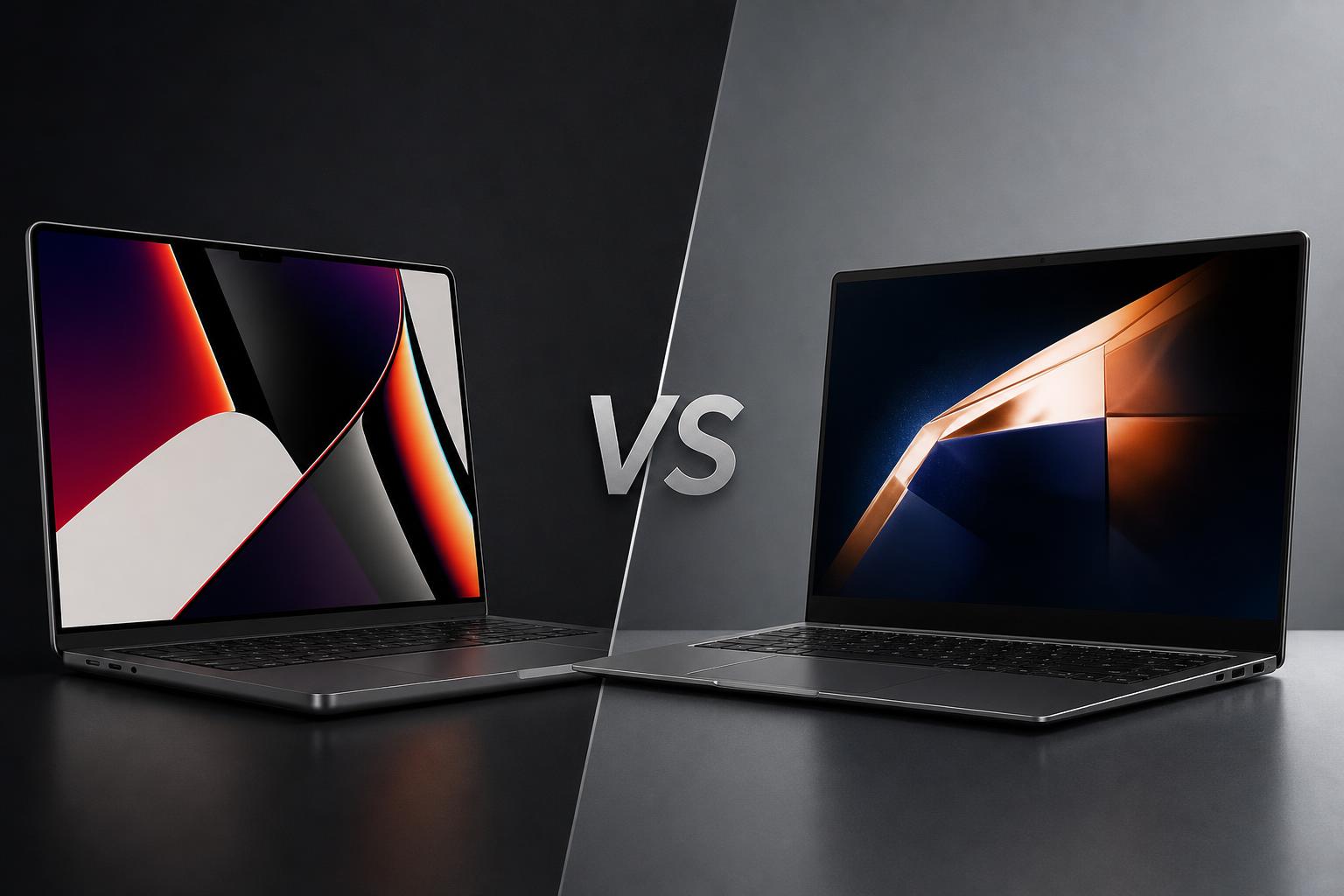
The MacBook Pro with PROLED XDR Display and Samsung Galaxy Book6 Ultra are high-end laptops designed for demanding work, but they take notably different approaches. Apple focuses on a premium professional display, Apple silicon, long rated battery life and macOS workflows. Samsung offers Windows compatibility, a touchscreen, optional NVIDIA RTX graphics and a lower starting price.
Both laptops can be configured for serious creative and productivity work, but the better choice depends heavily on the software you use and the features you value most. The MacBook Pro has the stronger display specification, camera and maximum memory and storage options. The Galaxy Book6 Ultra is more flexible for Windows applications, gaming and GPU-accelerated workloads when configured with an RTX graphics chip.
Quick verdict
The MacBook Pro with PROLED XDR Display is the better fit for buyers who prioritise display quality, macOS, professional media workflows, camera quality, long rated battery life and very high memory or storage capacity. Its tandem OLED PROLED XDR panel offers up to 2,000 nits, a 10,000,000:1 contrast ratio, 120Hz variable refresh and support for both P3 and Adobe RGB colour gamuts.
The Samsung Galaxy Book6 Ultra is the stronger value-oriented choice for buyers who need Windows, touchscreen input or NVIDIA RTX graphics. It starts at $2,449.99 in the U.S., compared with $2,899 for the 14-inch MacBook Pro with M5 Pro. Depending on configuration and market, the Samsung can use integrated Intel Arc graphics or an NVIDIA GeForce RTX 5060 or RTX 5070 Laptop GPU.
There is no universal winner. Choose the MacBook Pro for an Apple-optimised creative workstation and the Galaxy Book6 Ultra for Windows software, gaming, CUDA-compatible tools or a more flexible PC platform.
Key specifications comparison
| Feature | MacBook Pro with PROLED XDR Display | Samsung Galaxy Book6 Ultra |
|---|---|---|
| Screen sizes | 14-inch or 16-inch | 16-inch |
| Display | Tandem OLED PROLED XDR; up to 2,000 nits; 10,000,000:1 contrast; 120Hz variable refresh; P3 and Adobe RGB | 16-inch Dynamic AMOLED 2X touchscreen; 2,880 x 1,800; adaptive 30–120Hz; up to 1,000 nits HDR |
| Processor | Apple M5 Pro or M5 Max; up to 18-core CPU | Intel Core Ultra Series 3, including Core Ultra 7 356H, X7 358H and X9 386H options depending on configuration and market |
| Graphics | Integrated Apple GPU; up to 20-core GPU with M5 Pro or 40-core GPU with M5 Max; hardware ray tracing | Integrated Intel Arc or NVIDIA GeForce RTX 5060/5070 Laptop GPU configurations |
| Memory and storage | Up to 128GB unified memory and 16TB storage | Up to 32GB memory and 1TB storage on Samsung’s U.S. product page; memory is not upgradeable |
| Camera | 12MP Center Stage camera; Desk View; 1080p video recording | 2MP camera |
| Battery claim | Up to 24 hours of video streaming on 16-inch M5 Pro; up to 22 hours on 16-inch M5 Max | Up to 30 hours of video playback; more than 65% charge in 30 minutes |
| Operating system | macOS | Windows 11 Home; Copilot+ PC |
| Starting price | 14-inch M5 Pro from $2,899 | From $2,449.99 |
| Weight | Approximately 1.60–1.62kg for 14-inch; approximately 2.14–2.15kg for 16-inch | Approximately 1.79kg with integrated graphics or 1.89kg with discrete graphics |
Design and build
The MacBook Pro is available in 14-inch and 16-inch aluminium designs, giving buyers a choice between a more compact professional laptop and a larger workstation-style model. The 14-inch versions measure 31.26 x 22.12 x 1.55cm and weigh approximately 1.60kg with M5 Pro or 1.62kg with M5 Max. The 16-inch models measure 35.57 x 24.81 x 1.68cm and weigh approximately 2.14–2.15kg.
The Galaxy Book6 Ultra is a 16-inch aluminium Windows laptop measuring approximately 35.69 x 24.80 x 1.54cm. It is thinner than the 16-inch MacBook Pro and lighter in either configuration listed by Samsung: approximately 1.79kg with integrated graphics or 1.89kg with discrete graphics. The difference is relevant if you want a large screen but regularly carry the laptop between home, office or class.
Samsung’s weight advantage does not apply equally to every MacBook Pro model. The 14-inch MacBook Pro is substantially lighter than the 16-inch Apple model and is also more compact. The Galaxy Book6 Ultra remains the more portable option when comparing the two 16-inch laptops.
Connectivity is strong on both machines, although the selection reflects their different platforms. The MacBook Pro includes three Thunderbolt 5 ports, HDMI, an SDXC card slot, a 3.5mm headphone jack and MagSafe 3. It supports up to three external displays with M5 Pro or four with M5 Max. The Galaxy Book6 Ultra includes an SD card expansion slot, Wi-Fi 7, Bluetooth 5.4, a fingerprint reader and six-speaker Dolby Atmos audio. The specific Galaxy Book6 Ultra configuration can affect graphics hardware and weight, and GPU availability varies by market.
Display
Display quality is one of the clearest areas where the MacBook Pro leads on specification. Its tandem OLED PROLED XDR display is available in 14-inch and 16-inch sizes and offers up to 2,000 nits peak HDR and SDR brightness, a 10,000,000:1 contrast ratio and a 120Hz variable refresh rate. It also supports both P3 and Adobe RGB colour gamuts.
Those specifications are particularly relevant to professional photo, video and design users who need strong contrast, high brightness and broad colour-gamut support. The 120Hz variable refresh rate should also make supported motion appear smoother than on a conventional 60Hz panel, although the research does not establish independent real-world performance.
The Galaxy Book6 Ultra uses a 16-inch Dynamic AMOLED 2X touchscreen with a 2,880 x 1,800 resolution. Its adaptive refresh rate ranges from 30Hz to 120Hz, and Samsung specifies up to 1,000 nits HDR brightness. Corning Gorilla Glass with DXC anti-reflection properties is also included.
The Samsung therefore has two important advantages for certain users: touchscreen input and a larger fixed 16-inch format at a lower starting price. Its AMOLED technology should provide strong contrast, while its 120Hz maximum refresh rate matches the MacBook Pro’s headline refresh figure. However, the MacBook Pro has the more ambitious published brightness, contrast and colour-gamut specification.
For colour-critical creative work, the MacBook Pro is the safer choice based on the stated specifications. For users who want to interact directly with a touchscreen, annotate content or prefer Windows touch features, the Galaxy Book6 Ultra offers capabilities that the MacBook Pro comparison does not list.
Performance
The MacBook Pro is built around Apple’s M5 Pro or M5 Max chips. M5 Pro configurations include up to an 18-core CPU and 20-core GPU, while M5 Max configurations include up to an 18-core CPU and 40-core GPU. The platform supports up to 128GB of unified memory and up to 16TB of storage, depending on configuration. Dedicated media engines are included for supported media workloads.
These high memory and storage ceilings make the MacBook Pro particularly relevant to users working with large media projects, complex creative applications or substantial local libraries. The choice between M5 Pro and M5 Max is important, because the graphics core count, price and overall configuration vary considerably across the range.
The Galaxy Book6 Ultra uses Intel Core Ultra Series 3 processors. Listed options include the Core Ultra 7 356H, Core Ultra X7 358H and Core Ultra 9 386H, depending on configuration and market. It also includes an Intel AI Boost NPU rated at up to 50 TOPS.
Samsung’s laptop can be configured with integrated Intel Arc graphics or an NVIDIA GeForce RTX 50 Series Laptop GPU. Samsung documentation identifies RTX 5060 and RTX 5070 configurations. This makes the Galaxy Book6 Ultra the more directly suitable platform for Windows applications that depend on NVIDIA hardware, CUDA compatibility or RTX acceleration.
Performance cannot be judged only by processor names. Apple-optimised macOS creative workflows may favour the M5 Pro or M5 Max platform, particularly where the integrated media engines are supported. Windows applications, PC games and tools built around NVIDIA features may favour a Galaxy Book6 Ultra with discrete RTX graphics. Buyers should check the exact software requirements before choosing, because the integrated-graphics Samsung model will not offer the same graphics capability as an RTX configuration.
Camera and graphics
The MacBook Pro has the stronger camera specification. It includes a 12MP Center Stage camera with Desk View and 1080p video recording. Center Stage is designed to keep the subject positioned during supported video calls, while Desk View can show the area in front of the laptop. The Galaxy Book6 Ultra has a specified 2MP camera, so Apple has a substantial resolution advantage on paper.
Graphics are more complicated. The MacBook Pro uses an integrated Apple GPU with hardware-accelerated ray tracing and dedicated media engines. M5 Pro configurations reach up to a 20-core GPU, while M5 Max configurations reach up to 40 cores.
The Galaxy Book6 Ultra can use integrated Intel Arc graphics or discrete NVIDIA GeForce RTX 5060 and RTX 5070 Laptop GPUs. The discrete options are a major reason to consider Samsung for Windows gaming, 3D applications and GPU-accelerated workloads that are designed for NVIDIA hardware. They can also change the laptop’s weight, with Samsung documentation listing approximately 1.79kg for integrated graphics and 1.89kg for discrete graphics.
In short, the MacBook Pro is better for camera quality and Apple-oriented media workflows, while the Galaxy Book6 Ultra is more attractive to buyers who specifically need a Windows laptop with discrete NVIDIA graphics.
Battery and charging
Apple rates the 16-inch MacBook Pro with M5 Pro for up to 24 hours of video streaming and the 16-inch M5 Max model for up to 22 hours. The 16-inch models use a 100-watt-hour battery. These figures make the 16-inch M5 Pro especially appealing to users who want a large display without giving up a strong manufacturer-rated battery claim.
Samsung rates the Galaxy Book6 Ultra for up to 30 hours of video playback and says Fast Charging can deliver more than 65% charge in 30 minutes. Samsung documentation lists an 80.20Wh battery.
Samsung’s headline playback figure is higher than Apple’s stated 16-inch M5 Pro video-streaming figure. However, these are manufacturer claims based on different platforms and test methodologies. They should not be treated as a standardised real-world mixed-use comparison. Screen brightness, processor choice, graphics configuration, applications, wireless connectivity and workload can all affect practical battery life.
On the published figures alone, the Galaxy Book6 Ultra has the higher maximum playback claim. The MacBook Pro 16-inch M5 Pro has the stronger Apple-rated figure when considering Apple’s stated video-streaming result, but neither result independently establishes how long either laptop will last during demanding work.
Software and features
The MacBook Pro runs macOS and adds Touch interaction on Mac and a Dynamic Island for Spotlight, Live Activities and Siri AI. Its software environment is the main reason many buyers will choose it, particularly if they already use macOS applications, Apple devices or professional tools optimised for Apple silicon.
The Galaxy Book6 Ultra runs Windows 11 Home and is certified as a Copilot+ PC. It includes Galaxy AI features such as AI Select, AI Cut Out, translation and Intelligent Search. Samsung also lists Multi Control, Second Screen and Quick Share, which are designed to connect the laptop with compatible Samsung phones and tablets.
Windows 11 Home provides broad PC software compatibility, and the option of RTX graphics strengthens the Galaxy Book6 Ultra’s position for Windows gaming and specialist software. The MacBook Pro is the more natural choice for buyers committed to macOS, while Samsung is more suitable for users whose work or entertainment depends on Windows applications.
Samsung’s Galaxy ecosystem features can be useful if you already own compatible Galaxy devices. Apple’s macOS features may be more valuable if your other devices and services are already within Apple’s ecosystem. In both cases, the practical value depends on the devices and software you already use.
Price and value
The Samsung Galaxy Book6 Ultra starts at $2,449.99 in the U.S. That starting price is $449.01 below the 14-inch MacBook Pro with M5 Pro, which starts at $2,899. The MacBook Pro range extends to substantially higher prices: the 16-inch M5 Pro starts at $3,399, the 14-inch M5 Max at $4,499 and the 16-inch M5 Max at $4,799.
These prices are not directly like-for-like because configurations differ. Samsung’s starting model may use integrated graphics, while RTX configurations can cost more and are not necessarily available in every market. Apple’s M5 Pro and M5 Max options also have different performance, graphics, memory and storage limits.
The Galaxy Book6 Ultra offers better starting-price value for buyers who need Windows, touchscreen input or access to NVIDIA RTX graphics. It also includes an SD card expansion slot and a 16-inch AMOLED display as standard. However, Samsung’s U.S. product page specifies up to 32GB of memory and 1TB of storage, and the memory is not upgradeable after purchase.
The MacBook Pro costs more, but it offers up to 128GB of unified memory and up to 16TB of storage, depending on configuration. It also has the more advanced published display specification, a higher-resolution camera, Thunderbolt 5 connectivity and a larger external-display ceiling on M5 Max models. For professional buyers who can use those advantages, the higher price may be easier to justify.
MacBook Pro with PROLED XDR Display: pros and cons
Pros
- More advanced published display specification, including up to 2,000 nits, 10,000,000:1 contrast and P3 and Adobe RGB support.
- 12MP Center Stage camera with Desk View, compared with the Galaxy Book6 Ultra’s specified 2MP camera.
- Up to 128GB unified memory and 16TB storage, depending on configuration.
- Long rated battery life, with up to 24 hours of video streaming on the 16-inch M5 Pro model.
- Thunderbolt 5, HDMI, SDXC, MagSafe 3 and support for up to four external displays with M5 Max.
Cons
- Higher starting price than the Galaxy Book6 Ultra.
- Configuration prices vary substantially between 14-inch, 16-inch, M5 Pro and M5 Max models.
- Integrated Apple graphics may be less suitable for some Windows gaming and CUDA-focused workloads.
- The 16-inch model is heavier than the Galaxy Book6 Ultra.
- There is no touchscreen specification listed for the MacBook Pro.
Samsung Galaxy Book6 Ultra: pros and cons
Pros
- Lower U.S. starting price of $2,449.99.
- 16-inch Dynamic AMOLED 2X touchscreen with adaptive 30–120Hz refresh.
- Optional RTX 5060 and RTX 5070 graphics for compatible Windows games and GPU workloads.
- Windows 11 Home compatibility and Copilot+ PC features.
- Galaxy AI and Samsung ecosystem features such as Multi Control, Second Screen and Quick Share.
- Official rating of up to 30 hours of video playback and more than 65% charging in 30 minutes.
Cons
- The specified 2MP camera is substantially lower resolution than the MacBook Pro’s 12MP camera.
- Discrete-graphics models are heavier than integrated-graphics versions.
- Memory is not upgradeable after purchase.
- The U.S. product page lists up to 1TB storage, below the MacBook Pro’s maximum capacity.
- Battery claims use Samsung’s test methodology and are not directly equivalent to Apple’s figures.
- Graphics and configuration availability varies by market.
Which laptop is better for different buyer types?
Best for professional creative workflows
The MacBook Pro is the stronger choice when your work is built around macOS-optimised creative software, high memory capacity, media engines and a high-specification display. Its 12MP camera is also better suited to buyers who frequently make video calls or record content from the laptop.
Best for Windows users
The Galaxy Book6 Ultra is the straightforward choice if you need Windows 11 Home or rely on Windows-only applications. Its touchscreen and Samsung software features add flexibility that the MacBook Pro does not list.
Best for gaming and NVIDIA workloads
Choose a Galaxy Book6 Ultra configuration with RTX graphics if you need NVIDIA hardware for compatible games, CUDA-dependent tools or other GPU-accelerated applications. The MacBook Pro can be powerful, but its integrated Apple graphics platform is not the same substitute for an NVIDIA-based Windows system in every workflow.
Best for battery-focused buyers
The result is not definitive because Apple and Samsung use different testing methods. Samsung claims up to 30 hours of video playback, while Apple claims up to 24 hours of video streaming for the 16-inch M5 Pro. Buyers who want the MacBook Pro should consider the 16-inch M5 Pro for its stated battery figure; buyers considering Samsung should remember that graphics configuration and workload can affect practical results.
Best for value
The Galaxy Book6 Ultra offers the lower entry price and combines Windows, a touchscreen and the possibility of RTX graphics. It is the better value choice for buyers who need those features. The MacBook Pro is more expensive but offers higher maximum memory and storage, a more advanced display specification and a stronger camera, so its value improves for professional users who can take advantage of those capabilities.
Final verdict
The MacBook Pro with PROLED XDR Display is the more ambitious professional laptop. Its display specification is stronger, its camera is higher resolution, its memory and storage ceilings are much higher, and its M5 Pro and M5 Max configurations are well suited to Apple-optimised media and creative work. The 16-inch M5 Pro also has a particularly strong stated battery rating.
The Samsung Galaxy Book6 Ultra is the more flexible and accessible alternative. It starts at a lower price, provides a touchscreen, runs Windows 11 Home and can be configured with NVIDIA RTX 50 Series graphics. Those characteristics make it the better choice for Windows software, gaming and specialist NVIDIA workloads.
For most professional creators already comfortable with macOS, the MacBook Pro is the stronger overall package. For buyers who value compatibility, touch input, RTX graphics or a lower starting price, the Galaxy Book6 Ultra is the more practical purchase.
FAQs
Is the MacBook Pro with PROLED XDR Display more powerful than the Galaxy Book6 Ultra?
There is no single answer because performance depends on the configuration and software. The MacBook Pro uses M5 Pro or M5 Max chips with up to 128GB unified memory and dedicated media engines. The Galaxy Book6 Ultra uses Intel Core Ultra Series 3 processors and can include integrated Intel Arc or discrete RTX 5060 and RTX 5070 graphics. Apple-optimised media workflows favour the MacBook Pro, while Windows, CUDA and RTX workloads may favour the Samsung configuration with discrete graphics.
Which laptop has the better display?
The MacBook Pro has the stronger published display specification, with tandem OLED PROLED XDR technology, up to 2,000 nits, a 10,000,000:1 contrast ratio, 120Hz variable refresh and P3 and Adobe RGB support. The Galaxy Book6 Ultra has a 16-inch 2,880 x 1,800 Dynamic AMOLED 2X touchscreen with up to 1,000 nits HDR brightness and adaptive 30–120Hz refresh.
Which laptop has the better camera?
The MacBook Pro. It has a 12MP Center Stage camera with Desk View and 1080p video recording. The Galaxy Book6 Ultra’s specified camera is 2MP.
Which is cheaper, the MacBook Pro or Galaxy Book6 Ultra?
The Galaxy Book6 Ultra is cheaper at entry level, starting at $2,449.99 in the U.S. The 14-inch MacBook Pro with M5 Pro starts at $2,899. Higher-end MacBook Pro configurations range from $3,399 for the 16-inch M5 Pro to $4,799 for the 16-inch M5 Max.
Which laptop is better for gaming?
The Galaxy Book6 Ultra is the better option for buyers who need Windows gaming compatibility and choose a configuration with an NVIDIA GeForce RTX 5060 or RTX 5070 Laptop GPU. The MacBook Pro uses integrated Apple graphics, which may be less suitable for some Windows gaming requirements.
Can the Galaxy Book6 Ultra’s memory be upgraded?
No. Samsung’s specifications state that the memory is not upgradeable after purchase. Buyers should select the required memory configuration before ordering. Samsung’s U.S. product page lists up to 32GB of memory and 1TB of storage.