
Apple iPhone Duo vs Samsung Galaxy Z Fold8: Which Foldable Phone Is Better?
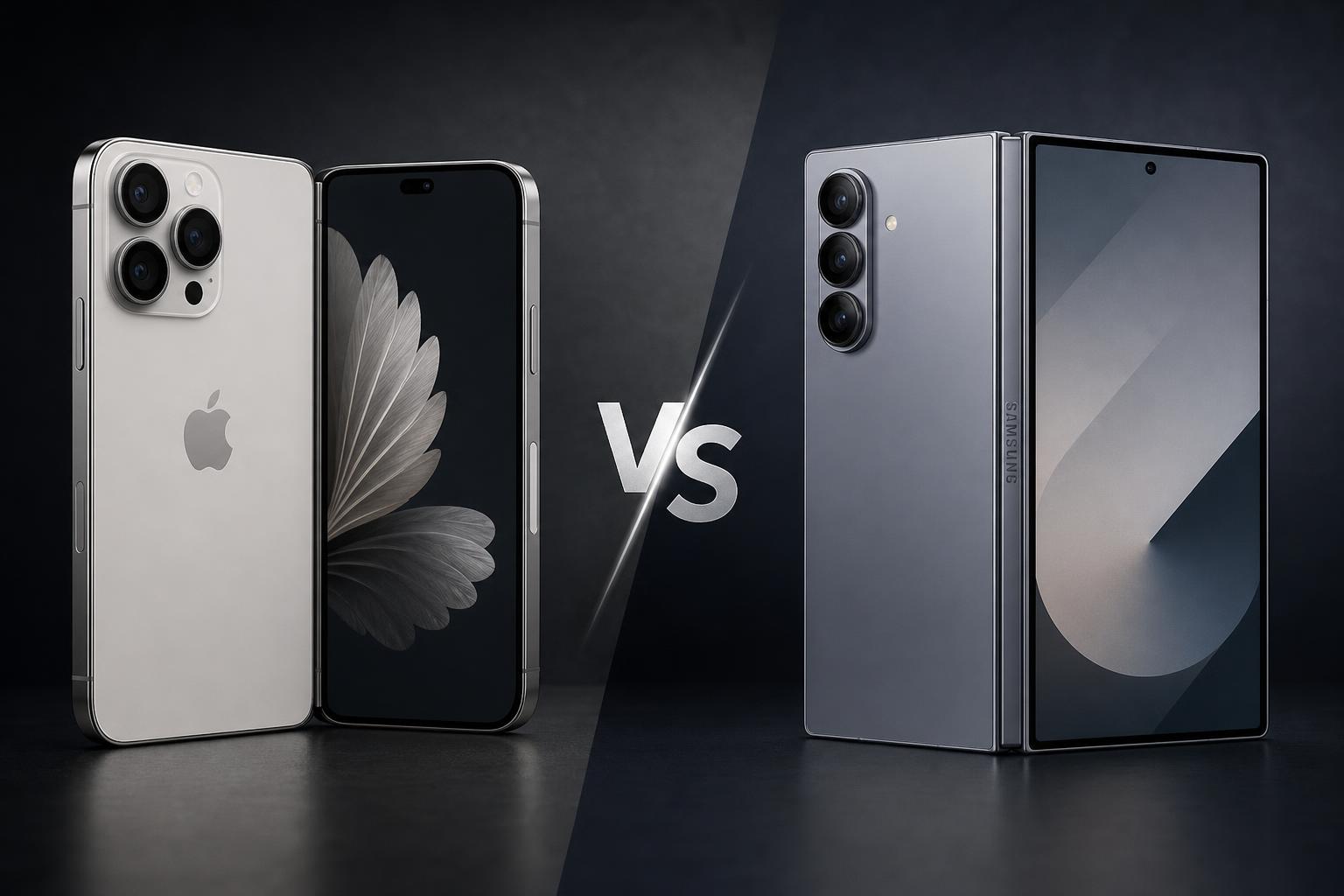
The Apple iPhone Duo and Samsung Galaxy Z Fold8 are both large foldable smartphones, but they are aimed at slightly different priorities. Apple’s model brings iOS 27, a titanium design, a higher maximum storage option and advanced video features. Samsung’s foldable starts at a lower price, weighs considerably less and uses a broad inner display designed around multitasking, reading and productivity.
This comparison uses the manufacturers’ published specifications and pricing. There are no directly comparable independent benchmark results in the available research, and Apple and Samsung publish battery figures using different testing configurations. Those differences matter when comparing performance and battery life.
Quick verdict
The Samsung Galaxy Z Fold8 is the more practical value choice for buyers who want a lighter, thinner foldable with a lower starting price. It also offers 12GB or 16GB of memory, depending on storage configuration, and a 7.6-inch inner display with a 4:3 aspect ratio intended for multitasking and productivity.
The Apple iPhone Duo is the stronger fit for buyers already invested in Apple’s ecosystem or those who prioritise storage capacity, video recording and iOS-specific features. It supports up to 2TB of storage, includes 4K Dolby Vision video recording at up to 120 frames per second, and supports Apple Pencil USB-C. However, it starts at $1,999, is heavier at 254g and measures 11.3mm thick when folded.
There is no clear overall winner for performance or battery life based only on the verified information. The iPhone Duo uses Apple’s A20 Pro, while the Galaxy Z Fold8 uses the Snapdragon 8 Elite Gen 5 for Galaxy, but the available research does not include directly comparable benchmark results.
Key specifications comparison
| Specification | Apple iPhone Duo | Samsung Galaxy Z Fold8 |
|---|---|---|
| Release date | October 23, 2026 | August 7, 2026 |
| Starting price | $1,999 for 256GB | $1,899.99 for 256GB |
| Inner display | 7.6-inch Super Retina XDR OLED, 1878×2670, 430ppi | 7.6-inch foldable Dynamic AMOLED 2X display, 4:3 aspect ratio |
| Outer or cover display | 5.4-inch Super Retina XDR OLED, 1398×2034, 460ppi | 5.5-inch cover display |
| Refresh rate | ProMotion up to 120Hz | 120Hz-class displays |
| Processor | Apple A20 Pro | Snapdragon 8 Elite Gen 5 for Galaxy |
| Memory and storage | 256GB, 512GB, 1TB or 2TB; RAM not specified | 12GB with 256GB or 512GB; 16GB with 1TB; no microSD |
| Rear cameras | 48MP Fusion Main and 48MP Fusion Ultra Wide; optical-quality 2x telephoto | 50MP wide and 50MP ultra-wide |
| Video | 4K Dolby Vision up to 120fps | Up to 10x digital zoom; ProVisual Engine and Nightography processing specified |
| Battery rating | Up to 24 hours typical use; up to 44 hours outer-display video playback | 4,800mAh; up to 26 hours of video playback |
| Folded thickness | 11.3mm | 9.7mm |
| Weight | 254g | 201g |
| Water and dust resistance | IP68 | Not specified in the supplied research |
| Software | iOS 27 | Android 17 with One UI 9 |
Design and build
The iPhone Duo uses a Grade 5 titanium foldable design, with Ceramic Shield 2 on the front and Ceramic Shield on the back. It is rated IP68 for water and dust resistance. When open, it measures 164.6 × 117.8 × 5.2mm. When folded, it measures 84.1 × 117.8 × 11.3mm and weighs 254g.
That construction gives the iPhone Duo a premium materials list and a clearly stated IP68 rating, but it also makes Apple’s phone the heavier and thicker option in this comparison. A 254g phone can still be manageable, but the Galaxy Z Fold8 has a substantial advantage for buyers who regularly carry their phone, use it one-handed when folded or want a less noticeable device in a pocket or bag.
Samsung’s Galaxy Z Fold8 weighs 201g and is 9.7mm thick when folded. Its construction includes Armor Aluminum, Corning Gorilla Glass, an Armor FlexHinge and dual titanium reinforcement beneath the display. The supplied official U.S. specification does not provide the phone’s full width and height dimensions, so a complete dimensional comparison is not possible here.
The difference is significant on paper: the Galaxy Z Fold8 is 53g lighter and 1.6mm thinner when folded. Samsung also offers the phone in Lavender, Graphite, Cream and a Samsung.com-exclusive Pistachio finish. The iPhone Duo’s verified research does not list colour options.
Which design is better?
The iPhone Duo is the more compelling option if titanium, Ceramic Shield materials and IP68 protection are high priorities. The Galaxy Z Fold8 is the better choice for portability. Its lower weight and folded thickness are among its clearest advantages over Apple’s foldable.
Display
Both phones provide a 7.6-inch inner foldable display, so each can offer a substantially larger workspace than a conventional smartphone when opened. The execution is different, however.
The iPhone Duo’s inner screen is a 7.6-inch Super Retina XDR OLED panel with a 1878×2670 resolution and 430 pixels per inch. It supports ProMotion up to 120Hz, HDR and an Always-On display, and has a nano-texture inner finish. Apple also supplies a 5.4-inch outer Super Retina XDR OLED display with a 1398×2034 resolution and 460ppi. That outer display is smaller than Samsung’s cover screen, but the iPhone Duo’s published specifications give it a higher pixel density.
Apple’s foldable-specific software includes Split View multitasking and flexible viewing angles. Those features are intended to make better use of the large inner panel and the phone’s ability to remain open at different angles. The available information does not establish how these features compare in day-to-day use with Samsung’s interface.
The Galaxy Z Fold8 combines a 7.6-inch main foldable display with a 5.5-inch cover display. Samsung specifies a 4:3 unfolded aspect ratio and a 10:16 folded aspect ratio. The inner screen uses a wide 4:3 format that Samsung positions for multitasking, reading and productivity. Both displays are described as 120Hz-class Dynamic AMOLED 2X panels, while the main display is rated for up to 3,000 nits of brightness.
For reading and working across multiple apps, the Galaxy Z Fold8’s wider 4:3 inner format may appeal to buyers who want a tablet-like workspace. The iPhone Duo offers Apple’s ProMotion branding, HDR, Always-On functionality and a nano-texture inner display. Without independent display testing, it is not possible to declare one screen universally better.
Performance and storage
Apple equips the iPhone Duo with the A20 Pro. Its published specification lists a six-core CPU, a seven-core GPU with Neural Accelerators, a dual 16-core Neural Engine and hardware-accelerated ray tracing. These components give the iPhone Duo a feature-rich platform for demanding applications, graphics and AI-related workloads, but the supplied research does not include cross-platform benchmark results.
The Galaxy Z Fold8 uses Qualcomm’s Snapdragon 8 Elite Gen 5 for Galaxy. Samsung’s memory configurations are clearer than Apple’s: the 256GB and 512GB versions include 12GB of memory, while the 1TB version includes 16GB. There is no microSD card support.
Apple lists 256GB, 512GB, 1TB and 2TB storage capacities, but does not specify RAM capacity on the cited official pages. That makes the iPhone Duo the more flexible phone for buyers who need the maximum built-in storage, while Samsung gives buyers more explicit information about memory capacity.
Storage is particularly important on a foldable phone intended for video, multitasking and productivity. The iPhone Duo’s 2TB maximum is twice the Galaxy Z Fold8’s 1TB maximum. However, the lower starting configurations are both 256GB, so the initial capacity is the same.
Performance verdict
There is no verified basis for naming a performance winner. The iPhone Duo has Apple’s A20 Pro and advanced graphics and Neural Engine features, while Samsung has a current high-end Snapdragon platform and up to 16GB of specified memory. Buyers should choose based on operating system, storage needs and ecosystem rather than an unsupported assumption about benchmark leadership.
Camera and graphics features
The iPhone Duo has a 48MP Dual Fusion camera system consisting of a 48MP Fusion Main camera and a 48MP Fusion Ultra Wide camera. It also provides optical-quality 2x telephoto capability and up to 10x digital zoom. On the front, there is a 12MP Center Stage camera and an under-display FaceTime camera.
Apple’s video specifications are a notable advantage on paper. The iPhone Duo can record 4K Dolby Vision video at up to 120fps. It also includes foldable-specific camera features such as Duo Preview and Dual Capture. These capabilities make it the stronger candidate for creators and people who want advanced video tools, based on the specified features.
The Galaxy Z Fold8 uses a 50MP wide camera and a 50MP ultra-wide camera. It has a 10MP cover-screen camera and a 10MP main-screen camera. Samsung specifies up to 10x digital zoom, along with its ProVisual Engine and Nightography processing. The supplied specification does not list a dedicated telephoto camera for the standard Galaxy Z Fold8.
That does not establish that the Samsung camera system will produce worse photographs in every situation, because the available research does not include image-quality testing. It does mean Apple has the stronger set of explicitly listed video and foldable-camera features, while Samsung highlights image processing and low-light photography tools.
Battery and charging
Apple rates the iPhone Duo for up to 24 hours of typical use. Video playback is rated at up to 44 hours when using the outer display and up to 31 hours when using the inner display. The phone uses two built-in rechargeable lithium-ion batteries and supports fast charging up to 50% in approximately 20 minutes with a 60W-capable adapter or higher.
Samsung gives the Galaxy Z Fold8 a 4,800mAh battery and rates it for up to 26 hours of video playback. The two manufacturers are not describing exactly the same test conditions, so these numbers should not be used as a direct battery-life ranking. Apple separates its video result by display, while Samsung publishes a single video-playback figure in the supplied research.
The iPhone Duo has the more detailed published charging claim, including the approximate time and adapter requirement. The Galaxy Z Fold8’s verified information here does not include a charging-speed figure.
Software and special features
The iPhone Duo runs iOS 27 and adds foldable-specific experiences including Split View multitasking and flexible viewing angles. It also supports Apple Intelligence, Siri AI and Apple Pencil USB-C. Apple ecosystem integration is another important part of the buying decision for users who already own Apple devices or rely on Apple services.
The Galaxy Z Fold8 runs Android 17 with One UI 9. Its listed AI tools include Galaxy AI features such as Now Nudge and Photo Assist. Samsung also supports dual SIM use through nanoSIM and eSIM.
There are two notable omissions in Samsung’s published software information: the Galaxy Z Fold8 does not support S Pen, and Samsung states that it does not support FlexMode. That may matter to buyers who associate the Fold range with stylus input or angle-specific software features.
The choice between iOS 27 and Android 17 with One UI 9 is likely to be more important than individual processor specifications for many buyers. The iPhone Duo is the natural fit for existing Apple users, while the Galaxy Z Fold8 is better suited to people who prefer Android, One UI and Samsung’s Galaxy AI tools.
Price and value
The Apple iPhone Duo starts at $1,999 in the United States for 256GB. The Samsung Galaxy Z Fold8 starts at $1,899.99 for 256GB. That gives Samsung a $99.01 lower starting price.
At the entry level, both phones provide 256GB of storage, so the Galaxy Z Fold8 offers the lower upfront cost without reducing the listed starting storage capacity. It is also lighter and thinner, which strengthens its value proposition for buyers who want the advantages of a foldable without as much weight or bulk.
The iPhone Duo justifies its higher price through a different combination of features: storage options up to 2TB, a titanium construction, IP68 water and dust resistance, Apple ecosystem integration, Apple Pencil USB-C support and more advanced specified video recording. Whether those advantages are worth $99.01 depends largely on the buyer’s existing devices and priorities.
Samsung is the better value choice based on the official starting prices and lower weight. Apple becomes more compelling for buyers who will use the additional storage, iOS foldable features or advanced video capabilities.
Apple iPhone Duo: pros and cons
Pros
- Storage options extend to 2TB, exceeding the Galaxy Z Fold8’s 1TB maximum.
- 4K Dolby Vision video recording is available at up to 120fps.
- Apple ecosystem integration and iOS 27 foldable-specific features.
- IP68 water and dust resistance is specified.
- Supports Apple Pencil USB-C.
- Includes a 5.4-inch outer display and a 7.6-inch inner display with ProMotion up to 120Hz.
Cons
- Higher starting price at $1,999.
- Heavier at 254g.
- Thicker when folded at 11.3mm.
- Apple does not specify RAM capacity on the cited official specification page.
- The supplied research does not include comparable benchmark results.
Samsung Galaxy Z Fold8: pros and cons
Pros
- Lower starting price of $1,899.99 for 256GB.
- Significantly lighter at 201g and thinner at 9.7mm when folded.
- 12GB or 16GB memory options are specified by storage capacity.
- Large 7.6-inch 4:3 inner display is designed for multitasking, reading and productivity.
- Runs Android 17 with One UI 9 and Galaxy AI features.
- Offers a 4,800mAh battery rated for up to 26 hours of video playback.
Cons
- Maximum storage is limited to 1TB, below the iPhone Duo’s 2TB option.
- No S Pen support.
- No FlexMode support according to Samsung.
- No dedicated telephoto camera is specified for the standard model.
- Samsung’s battery figure is not directly comparable with Apple’s published results.
Which phone is better for different buyers?
Best for Apple ecosystem users
The iPhone Duo is the better fit for buyers already using Apple devices and services. Its iOS 27 software, Apple Intelligence, Siri AI, Apple Pencil USB-C support and foldable-specific multitasking are more useful when they fit into an existing Apple setup.
Best for value and portability
The Galaxy Z Fold8 is the stronger choice for buyers focused on price, thickness and weight. It costs $99.01 less at entry level, weighs 53g less and is 1.6mm thinner when folded.
Best for storage-heavy users
The iPhone Duo is the clear choice for maximum built-in storage. Its range reaches 2TB, while the Galaxy Z Fold8 tops out at 1TB and does not support microSD cards.
Best for video creators
The iPhone Duo is the better-supported choice on paper for creators. Its listed features include 4K Dolby Vision recording at up to 120fps, Dual Capture, Duo Preview and a 12MP Center Stage camera. This conclusion is based on the published feature sets rather than hands-on image or video testing.
Best for Android productivity users
The Galaxy Z Fold8 is the more suitable option for buyers who prefer Android 17 and One UI 9. Its 4:3 inner display is designed for multitasking, reading and productivity, and it includes Galaxy AI features such as Now Nudge and Photo Assist.
Best for performance
There is no verified winner. The iPhone Duo uses the A20 Pro and the Galaxy Z Fold8 uses the Snapdragon 8 Elite Gen 5 for Galaxy, but no directly comparable benchmark results are included in the research. Operating-system preference and software compatibility should guide this decision.
Final verdict
The Samsung Galaxy Z Fold8 is the better all-round value proposition. It has the lower starting price, a much lighter body and a thinner folded profile, while still offering a 7.6-inch inner display, high-end Snapdragon processing, up to 16GB of specified memory and Android 17 with One UI 9.
The Apple iPhone Duo is the more feature-focused alternative. It costs more and is less portable, but it offers a 2TB storage option, IP68 protection, Apple ecosystem integration, Apple Pencil USB-C support and a more advanced set of specified video features. It is particularly attractive to Apple users and creators who will benefit from its Dolby Vision recording and foldable camera tools.
Choose the Galaxy Z Fold8 if price, portability and Android productivity are your priorities. Choose the iPhone Duo if you want iOS on a foldable, need the highest storage capacity or place a premium on Apple’s video and ecosystem features.
Frequently asked questions
Is the Apple iPhone Duo cheaper than the Galaxy Z Fold8?
No. The iPhone Duo starts at $1,999 for 256GB in the U.S., while the Galaxy Z Fold8 starts at $1,899.99 for 256GB. Samsung is therefore $99.01 cheaper at the starting level.
Which phone is lighter, the iPhone Duo or Galaxy Z Fold8?
The Galaxy Z Fold8 is lighter. It weighs 201g, compared with 254g for the iPhone Duo. Samsung’s phone is also thinner when folded at 9.7mm, compared with 11.3mm for Apple’s model.
Which foldable has more storage?
The iPhone Duo has more maximum storage. It is available with up to 2TB, while the Galaxy Z Fold8 is available with up to 1TB. Samsung does not provide microSD card support.
Does the Galaxy Z Fold8 support an S Pen?
No. Samsung states that the Galaxy Z Fold8 does not support S Pen. It also states that the device does not support FlexMode.
Which phone has the better camera?
The answer depends on the type of camera use. The iPhone Duo has the stronger published video specification, including 4K Dolby Vision at up to 120fps, optical-quality 2x telephoto capability, Dual Capture and Duo Preview. The Galaxy Z Fold8 has 50MP wide and ultra-wide cameras, up to 10x digital zoom, ProVisual Engine and Nightography processing. The supplied research does not include hands-on image-quality testing.
Which phone has better battery life?
It cannot be determined directly from the published figures. Apple rates the iPhone Duo for up to 24 hours of typical use, with up to 31 hours of inner-display video playback and up to 44 hours using the outer display. Samsung rates the Galaxy Z Fold8’s 4,800mAh battery for up to 26 hours of video playback. The manufacturers use different testing configurations.
Sources
- iPhone Duo - Technical Specifications — Apple
- Apple unveils iPhone Duo — Apple
- Shop iPhone Duo — Apple
- Explore Galaxy Z Fold8 — Samsung
- Samsung Galaxy Z Fold8 Ultra, Fold8 and Flip8: Foldables, Perfected for Every Way of Living — Samsung Newsroom
- Samsung Officially Launches Galaxy Z Fold8 Ultra, Fold8, Flip8, Watch Ultra2 and Watch9 — Samsung Global Newsroom