
Apple iPhone Duo vs Google Pixel 11 Pro Fold: Which Foldable Should You Buy?
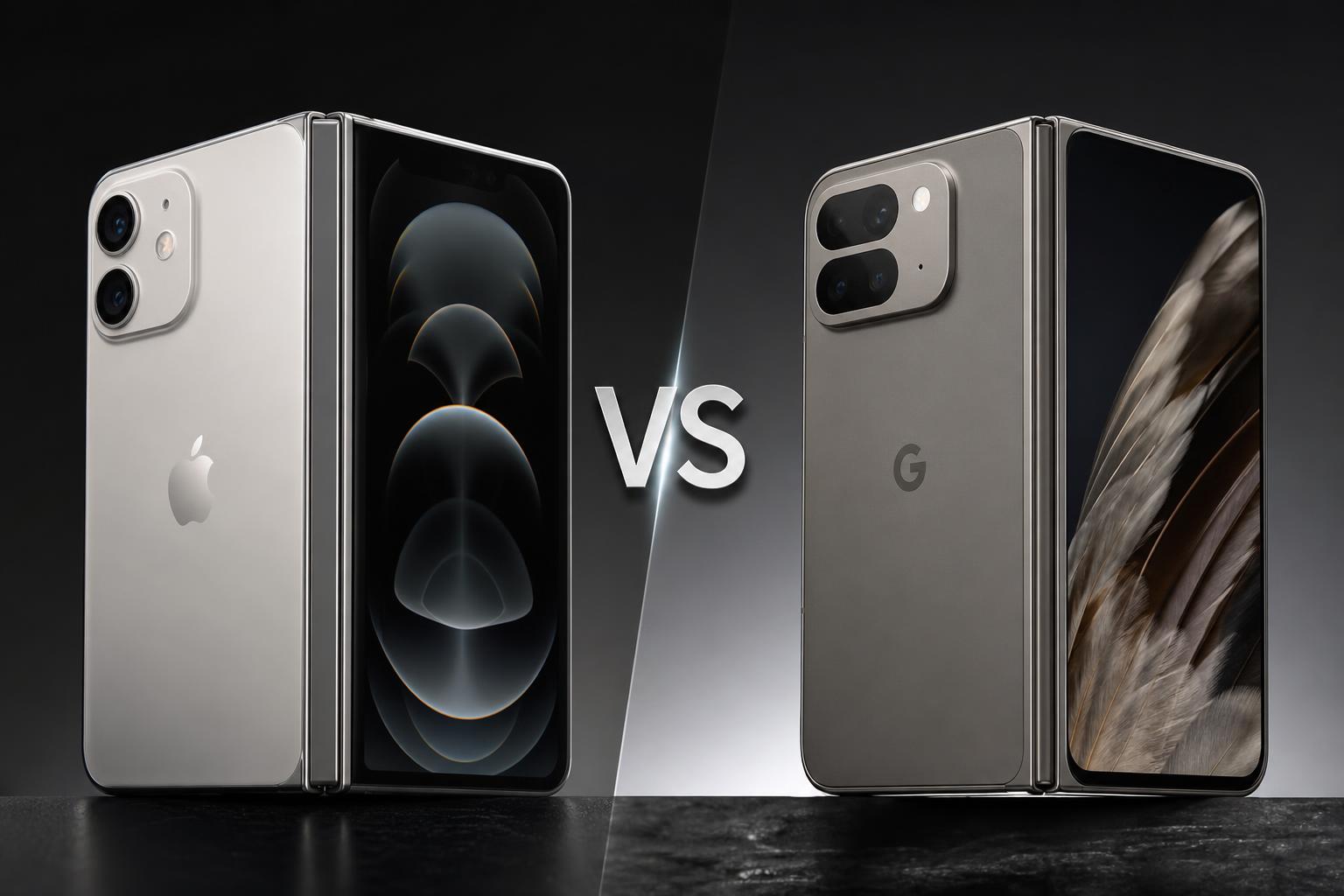
The Apple iPhone Duo and Google Pixel 11 Pro Fold represent two different approaches to premium foldable phones. Apple’s model focuses on iOS 27 features, titanium construction, Apple Intelligence, high-frame-rate Dolby Vision video and storage options reaching 2TB. Google’s foldable counters with larger displays, a dedicated 5x optical telephoto camera, 16GB of RAM and a seven-year software update commitment.
There is also an important availability difference. The Pixel 11 Pro Fold was released on August 20, 2026, while the iPhone Duo is announced for October 23, 2026. The Pixel starts at $1,899 in the U.S., making it $100 less expensive than the iPhone Duo’s $1,999 starting price for 256GB.
Quick verdict
For most buyers who want a foldable phone today, the Google Pixel 11 Pro Fold is the stronger overall value. It costs less, has larger inner and outer displays, includes a dedicated 5x optical telephoto camera, supports a physical nano-SIM as well as eSIM, and promises seven years of OS, security and Pixel Drop updates.
The Apple iPhone Duo is the more compelling choice for buyers already invested in Apple’s ecosystem, users who want up to 2TB of storage, people interested in Apple Pencil USB-C support, and creators who prioritise 4K Dolby Vision video recording at up to 120 frames per second on the main camera. It also offers a titanium design and detailed display-specific video-playback claims, although it is heavier and more expensive.
Neither phone can be declared the definitive performance winner from the verified specifications alone. The iPhone Duo uses Apple’s A20 Pro chip, while the Pixel 11 Pro Fold combines Google’s Tensor G6 with 16GB of RAM. Directly comparable official benchmark results were not verified.
Key specifications compared
| Specification | Apple iPhone Duo | Google Pixel 11 Pro Fold |
|---|---|---|
| Availability | Announced; scheduled for October 23, 2026 | Released August 20, 2026 |
| Starting price | $1,999 in the U.S. for 256GB | $1,899 in the U.S. |
| Inner display | 7.6-inch Super Retina XDR OLED, 1878 x 2670, 430 ppi, up to 120Hz | 8-inch Super Actua Flex OLED, 2076 x 2152, 372 ppi, 1-120Hz |
| Outer display | 5.4-inch Super Retina XDR OLED, 1398 x 2034, 460 ppi, up to 120Hz | 6.5-inch Super Actua OLED, 1080 x 2342, 399 ppi, 1-120Hz |
| Peak brightness | Up to 3000 nits outdoor peak brightness | Up to 3600 nits peak brightness |
| Processor | Apple A20 Pro | Google Tensor G6 with Titan M3 security coprocessor |
| RAM and storage | RAM not officially specified; 256GB, 512GB, 1TB or 2TB | 16GB RAM; 256GB, 512GB or 1TB |
| Rear cameras | 48MP Fusion Main and 48MP Fusion Ultra Wide; up to 2x optical-quality telephoto | 48MP wide, 10.5MP ultrawide with Macro Focus and 10.8MP 5x telephoto with OIS |
| Rear video | Up to 4K Dolby Vision at 120fps on the Fusion Main camera | Up to 4K at 60fps |
| Battery claims | Up to 31 hours inner-display video playback, 44 hours outer-display playback and 24 hours with both displays used equally | 4806mAh typical capacity; Google claims 24+ hours |
| Charging | Up to 50% in around 20 minutes wired; around 30 minutes with MagSafe or Qi2 | Up to 50% in about 30 minutes with a 30W USB-C PPS charger or higher; up to 25W Qi2.2 |
| Weight | 8.96 ounces, or 254 grams | 8.4 ounces |
| Water and dust resistance | IP68 | IP68 |
| SIM support | eSIM only | One nano-SIM and eSIM |
Design and build
Both phones use a book-style folding design and carry an IP68 rating for dust and water resistance. That gives them broadly similar protection credentials on paper, although the materials and physical proportions differ.
The iPhone Duo uses a titanium foldable design, with Ceramic Shield 2 on the front and Ceramic Shield on the back. It measures 6.48 x 4.64 x 0.21 inches when open and 3.31 x 4.64 x 0.44 inches when folded. Its weight is 8.96 ounces, or 254 grams. Apple’s specifications therefore position it as a phone that is particularly thin when open, but it is heavier than the Pixel 11 Pro Fold.
The Pixel 11 Pro Fold uses an aerospace-inspired material mix described in its specifications as a spacecraft-grade aluminium frame, ultra-durable ceramic cover glass and a composite matte back. It measures 6.1 x 5.9 x 0.2 inches unfolded and 6.1 x 3.0 x 0.4 inches folded, and weighs 8.4 ounces. That makes it lighter than the iPhone Duo.
Google also has a practical advantage for some users because the Pixel supports both a physical nano-SIM and eSIM. The iPhone Duo is eSIM-only and does not support a physical SIM card. That distinction may matter if you regularly move a SIM between phones, use a carrier that relies on physical SIMs, or travel with a local SIM.
Independent reviews of the Pixel 11 Pro Fold have criticised its thicker feel, wider bezels and deeper crease. Those comments come from published reviews rather than from our own hands-on testing, and they are worth considering alongside the official dimensions. The iPhone Duo’s titanium construction and thinner open profile may appeal more to buyers who place greater emphasis on materials and slimness when unfolded.
Display
The Pixel 11 Pro Fold wins on screen size. Its inner display measures 8 inches, compared with 7.6 inches on the iPhone Duo. Its outer display is also substantially larger at 6.5 inches, while Apple’s cover display measures 5.4 inches.
The Pixel’s inner Super Actua Flex OLED display has a 2076 x 2152 resolution and 372 pixels per inch. Its outer Super Actua OLED display has a 1080 x 2342 resolution and 399 pixels per inch. Both displays support a variable refresh rate from 1Hz to 120Hz, along with HDR.
Apple’s inner Super Retina XDR OLED panel has a 1878 x 2670 resolution and 430 pixels per inch. The outer Super Retina XDR OLED panel has a 1398 x 2034 resolution and 460 pixels per inch. Both support ProMotion up to 120Hz, HDR and an Always-On display.
Although the iPhone Duo has smaller screens, its listed pixel densities are higher on both panels. That could make fine text and detailed content appear more defined, based on the specifications. The Pixel’s larger panels should provide more room for split-screen work, reading and viewing content, particularly on the inner display.
Brightness also favours Google on the listed figures. The Pixel 11 Pro Fold is rated for up to 3600 nits peak brightness, while Apple lists up to 3000 nits outdoor peak brightness. These figures are not necessarily measured under identical conditions, so they should not be treated as a direct real-world brightness test. Both phones support HDR and refresh rates up to 120Hz.
The choice is therefore less about one display being universally better and more about priorities. Choose the Pixel if maximum screen area is important. Choose the iPhone Duo if you prefer higher listed pixel density, Always-On display support and Apple’s Super Retina XDR presentation.
Performance
The iPhone Duo is powered by Apple’s A20 Pro, with a six-core CPU, seven-core GPU and dual 16-core Neural Engine. The Pixel 11 Pro Fold uses Google’s Tensor G6 alongside a Titan M3 security coprocessor and includes 16GB of RAM.
There is no directly comparable official benchmark data in the verified research, so it would be misleading to name a clear performance winner. The A20 Pro is the newer Apple processor in this comparison, while the Pixel provides a clearly specified 16GB of RAM. Those specifications point to different potential strengths, but they do not establish how the phones compare in apps, games, multitasking or sustained workloads.
Storage flexibility is another meaningful difference. The iPhone Duo comes in 256GB, 512GB, 1TB and 2TB capacities. The Pixel 11 Pro Fold is offered with 256GB, 512GB or 1TB, and the 512GB and 1TB versions use Zoned UFS. Buyers who keep large video libraries, high-resolution photos or downloaded content on their phone have more headroom with Apple’s 2TB option.
For everyday multitasking, both operating systems include foldable-specific tools. Apple lists Split View and foldable-specific multitasking in iOS 27, while Google includes split-screen multitasking in Android 17. The larger Pixel inner display may make side-by-side applications more comfortable, but the available specifications do not verify a definitive advantage in application performance.
Camera and graphics
The Pixel 11 Pro Fold has the more versatile rear camera arrangement. Its triple-camera system consists of a 48MP wide camera, a 10.5MP ultrawide camera with Macro Focus and a 10.8MP 5x telephoto camera with optical image stabilisation. Google also lists Super Zoom up to 30x. The front and inner cameras are both 10MP.
The iPhone Duo uses a 48MP Dual Fusion rear camera system. It includes a 48MP Fusion Main camera with 2x optical-quality telephoto and a 48MP Fusion Ultra Wide camera. Digital zoom reaches up to 10x. For selfies and video calls, the phone has an outer 12MP Center Stage camera and an under-display FaceTime camera.
For distant subjects, the Pixel has the clearer hardware advantage because it includes a dedicated 5x optical telephoto lens. That should make it the more natural choice for users who frequently photograph concerts, travel details, sports or other subjects that benefit from optical reach. Its Macro Focus support also adds flexibility for close-up photography.
Apple’s advantage is video specification. The iPhone Duo supports up to 4K Dolby Vision video at 120 frames per second on the Fusion Main camera. The Pixel 11 Pro Fold’s listed rear video specification reaches 4K at 60 frames per second, and the verified information does not list 4K recording at 120fps.
That makes the Pixel the better fit for zoom flexibility and camera-focused AI tools, while the iPhone Duo is more attractive to creators who specifically value high-frame-rate 4K Dolby Vision recording. Apple Pencil USB-C support may also matter to people who want to annotate, sketch or work with compatible content on the larger inner display.
Battery and charging
Apple provides more detailed display-specific battery claims. The iPhone Duo is rated for up to 31 hours of video playback using the inner display, up to 44 hours using the outer display, and up to 24 hours of usage when both displays are used equally. Apple also states that the phone can reach up to 50% charge in around 20 minutes using a wired connection, or around 30 minutes with MagSafe or Qi2 wireless charging.
The Pixel 11 Pro Fold has a typical battery capacity of 4806mAh and a minimum capacity of 4658mAh. Google claims 24-plus hours of battery life. It supports up to 50% charge in about 30 minutes when using a 30W USB-C PPS charger or higher, as well as up to 25W Qi2.2 wireless charging.
These figures are not directly equivalent. Apple is giving display-specific video-playback and mixed-display usage figures, while Google provides battery capacity and a broader 24-plus-hour claim. As a result, no definitive battery winner can be established from the verified information alone.
The iPhone Duo offers the more detailed published picture, particularly for users who switch between the inner and outer screens. The Pixel provides a clearly stated battery capacity and broadly similar fast-charging expectations, but its official claim is less specific.
Software and features
The iPhone Duo launches with iOS 27 and includes foldable-specific multitasking, Split View, redesigned interface behaviour and an upgraded StandBy experience. It also supports Apple Intelligence and Siri AI. Apple Pencil USB-C support gives the iPhone Duo an additional productivity and creative feature that is not listed for the Pixel in the verified specifications.
The Pixel 11 Pro Fold launches with Android 17 and comes with seven years of OS, security and Pixel Drop updates. Its software features include Gemini Intelligence, Gemini Live, Gemini Nano, split-screen multitasking, Circle to Search, Live Translate and sign-to-text support.
The update commitment is a major Pixel advantage for buyers who intend to keep their phone for many years. Google states that the seven-year period covers operating-system updates, security updates and Pixel Drop updates. Apple’s verified specifications list iOS 27 and its AI and foldable features, but the research does not provide a comparable specific support-period figure for the iPhone Duo.
Security and connectivity features also differ. The Pixel includes fingerprint and face unlock, Wi-Fi 7 and Bluetooth 6, while the iPhone Duo includes USB-C with USB 3 transfer speeds up to 10Gbps, MagSafe and Qi2 wireless charging up to 25W. Both use USB-C, and both support IP68 water and dust resistance.
Price and value
The Google Pixel 11 Pro Fold starts at $1,899 in the U.S. The Apple iPhone Duo starts at $1,999 in the U.S. for 256GB, making the Pixel $100 cheaper at the entry level. The Pixel was released on August 20, 2026, and is available as of September 22, 2026, according to the verified comparison information. The iPhone Duo is not scheduled to become available until October 23, 2026.
The Pixel’s lower price is supported by a broad hardware package: larger inner and outer displays, 16GB of RAM, a dedicated 5x telephoto camera, physical SIM support and a seven-year update commitment. Those features make it the easier recommendation for shoppers focused on specification-to-price value.
The iPhone Duo justifies its higher starting point in different ways. It offers a titanium design, storage configurations up to 2TB, Apple Pencil USB-C support, Apple’s ecosystem and 4K Dolby Vision recording at up to 120fps. Buyers who specifically want those features may consider the $100 difference reasonable, but the iPhone is not the value leader on the verified figures.
Apple iPhone Duo: pros and cons
Pros
- Higher maximum storage capacity, with an option reaching 2TB.
- 4K Dolby Vision video recording at up to 120fps on the main camera.
- Titanium construction and a thinner open profile.
- Apple Pencil USB-C support.
- Foldable-specific iOS 27 features including Split View and upgraded StandBy.
- Detailed display-specific video-playback claims, including up to 44 hours using the outer display.
Cons
- Higher starting price than the Pixel 11 Pro Fold.
- Not scheduled to be available until October 23, 2026.
- No dedicated rear telephoto camera; optical-quality telephoto reaches 2x.
- eSIM-only, with no physical SIM card support.
- Heavier than the Pixel 11 Pro Fold.
Google Pixel 11 Pro Fold: pros and cons
Pros
- Lower starting price of $1,899 in the U.S.
- Larger 8-inch inner and 6.5-inch outer displays.
- Dedicated 5x optical telephoto camera with optical image stabilisation.
- Super Zoom up to 30x and Macro Focus on the ultrawide camera.
- 16GB of RAM and storage options up to 1TB.
- Seven years of OS, security and Pixel Drop updates.
- Lighter than the iPhone Duo.
- Supports a physical nano-SIM as well as eSIM.
Cons
- Lower maximum storage capacity than the iPhone Duo.
- The listed video specification does not include 4K recording at 120fps.
- Google’s battery claim is less specific than Apple’s display-based playback figures.
- The inner display has lower pixel density than the iPhone Duo’s inner display.
- Independent reviews have criticised its thicker feel, wider bezels, deeper crease and performance relative to some competing foldables.
Which phone is better for different buyers?
Choose the Google Pixel 11 Pro Fold if value is your priority
The Pixel is the better value choice based on its $100 lower starting price, larger displays, dedicated 5x telephoto camera, physical SIM support and seven-year update commitment. It also has 16GB of RAM and is already released, which matters to shoppers who do not want to wait for Apple’s October availability date.
Choose the Pixel 11 Pro Fold for zoom photography
Its dedicated 5x optical telephoto camera and up to 30x Super Zoom give it a clear specification advantage for distant subjects. The Macro Focus ultrawide camera adds another useful shooting option.
Choose the iPhone Duo for video creators
The iPhone Duo is the better fit for buyers who specifically want 4K Dolby Vision recording at up to 120fps on the main camera. Its 48MP Fusion Main and Fusion Ultra Wide cameras also offer high-resolution rear sensors, although it does not have a dedicated 5x telephoto camera.
Choose the iPhone Duo for Apple ecosystem users
Apple’s foldable-specific iOS 27 tools, Apple Intelligence, Siri AI, Apple Pencil USB-C support and MagSafe charging will be particularly relevant to people already using Apple devices and services. The verified specifications do not quantify the benefits of ecosystem integration, but these are the Apple-specific features that separate the two phones.
Choose the Pixel for long-term software support
Google’s seven-year commitment to OS, security and Pixel Drop updates makes the Pixel 11 Pro Fold the clearer choice for buyers who expect to keep their foldable for many years. Apple’s verified information does not provide a matching support-period figure for the iPhone Duo.
Which is better for performance?
There is no definitive verified winner. The iPhone Duo uses the A20 Pro, while the Pixel 11 Pro Fold uses Tensor G6 and includes 16GB of RAM. Without directly comparable official benchmark results, buyers should choose based on operating system, software needs and ecosystem preference rather than assuming one is conclusively faster.
Final verdict
The Google Pixel 11 Pro Fold is the better overall recommendation for most shoppers. Its lower price, larger displays, dedicated 5x telephoto camera, seven-year update promise, lighter body and physical SIM support give it a strong practical advantage. It is also already available.
The Apple iPhone Duo is not simply a more expensive alternative without a purpose. It offers a titanium design, higher maximum storage, Apple Pencil USB-C support, foldable-specific iOS 27 features and a particularly ambitious video specification. It is the better fit for Apple users, high-storage buyers and creators who value 4K Dolby Vision recording at up to 120fps.
In short, choose the Pixel 11 Pro Fold for value, screen size, zoom photography and long-term Android support. Choose the iPhone Duo for Apple’s software ecosystem, 2TB storage, Pencil support and high-frame-rate Dolby Vision video.
FAQs
Is the iPhone Duo cheaper than the Pixel 11 Pro Fold?
No. The iPhone Duo starts at $1,999 in the U.S. for 256GB, while the Pixel 11 Pro Fold starts at $1,899. The Pixel is therefore $100 cheaper at the starting level.
Which phone has the larger displays?
The Google Pixel 11 Pro Fold has the larger displays. Its inner screen measures 8 inches and its outer screen measures 6.5 inches. The iPhone Duo has a 7.6-inch inner display and a 5.4-inch outer display.
Which foldable has the better zoom camera?
The Pixel 11 Pro Fold has the more flexible zoom hardware. It includes a dedicated 10.8MP 5x telephoto camera with optical image stabilisation and supports Super Zoom up to 30x. The iPhone Duo reaches 2x optical-quality telephoto and up to 10x digital zoom.
Which phone records better video?
The iPhone Duo has the stronger listed video specification because its Fusion Main camera can record up to 4K Dolby Vision at 120fps. The Pixel 11 Pro Fold’s verified rear video specification reaches 4K at 60fps.
Which phone has longer battery life?
A definitive winner cannot be established because Apple and Google use different published metrics. Apple lists up to 31 hours of inner-display video playback, 44 hours of outer-display playback and 24 hours with both displays used equally. Google lists a 4806mAh typical battery and claims 24-plus hours of battery life.
Does the iPhone Duo support a physical SIM?
No. The iPhone Duo is eSIM-only. The Pixel 11 Pro Fold supports one physical nano-SIM alongside eSIM.
Sources
- iPhone Duo - Technical Specifications — Apple
- Apple unveils iPhone Duo — Apple
- Shop iPhone Duo — Apple
- Google Pixel 11 Pro Fold Full Technical Specs & Dimensions — Google Store
- Introducing Pixel 11 Pro Fold — Google
- Buy the new Pixel 11 phones and Pixel Watch 5 today — Google
- Google Pixel 11 Pro Fold review: Falling behind the foldable curve — Tom’s Guide
- Google Pixel 11 Pro Fold review: This year’s best Pixel — Android Central