
Apple iPhone 18 Pro vs Samsung Galaxy S26+: Which Flagship Is Better?
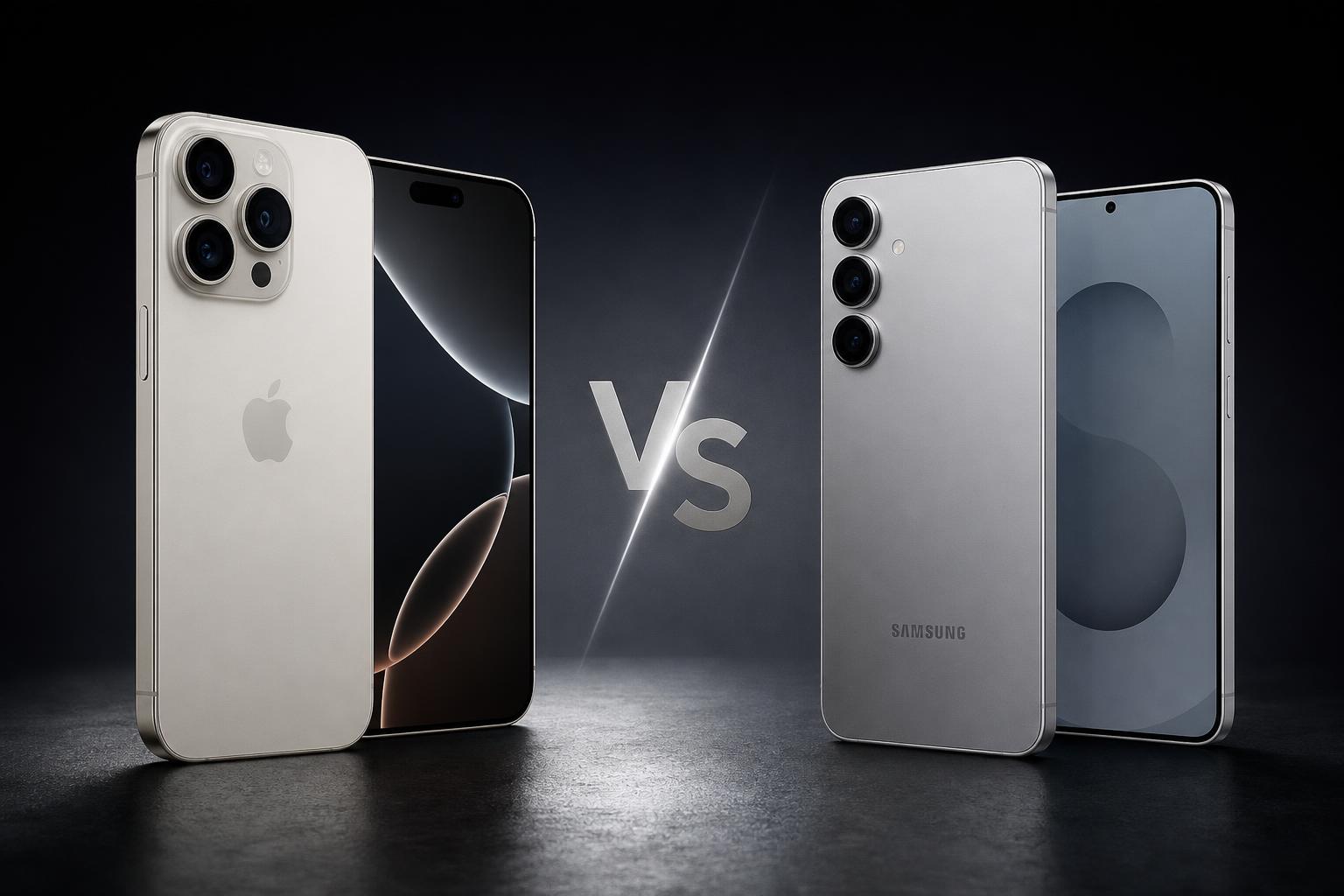
The Apple iPhone 18 Pro and Samsung Galaxy S26+ are premium smartphones aimed at different kinds of buyer. Apple’s phone puts particular emphasis on camera flexibility, professional video recording, iOS integration and a high-brightness display. Samsung counters with a larger QHD+ screen, 12GB of RAM, a 4,900mAh battery, Android multitasking and DeX, while also starting at a lower official US price.
This comparison is based on the published specifications and product information supplied by Apple and Samsung. It does not claim hands-on testing or establish a definitive benchmark winner.
Quick verdict
The iPhone 18 Pro is the better fit for creators, serious mobile photographers, professional video users and people already invested in Apple services. Its camera system includes a variable-aperture main camera, 48MP ultra-wide and telephoto cameras, ProRes, ProRes RAW, Apple Log 2 and Dolby Vision recording. It also has the higher listed outdoor peak brightness and a broader storage range extending to 2TB.
The Samsung Galaxy S26+ is the stronger choice for buyers who want a bigger and sharper screen, Android flexibility, Samsung DeX and a lower entry price. Its 6.7-inch QHD+ panel, 12GB RAM and 4,900mAh battery make it an appealing all-rounder, while Samsung’s stated seven generations of OS upgrades and seven years of security updates add long-term value.
There is no verified overall performance winner from the published specifications alone. The iPhone uses Apple’s A20 Pro, while the Galaxy uses a Snapdragon 8 Elite Gen 5 or Exynos 2600 platform depending on market.
Key specifications comparison
| Specification | Apple iPhone 18 Pro | Samsung Galaxy S26+ |
|---|---|---|
| US starting price | $1,199 for 256GB | $1,099.99 for 256GB unlocked |
| Release date | September 18, 2026 | March 10, 2026 in the US |
| Display | 6.3-inch Super Retina XDR OLED, 2622 x 1206, up to 120Hz | 6.7-inch Dynamic AMOLED 2X, 3120 x 1440, up to 120Hz |
| Peak brightness | Up to 3000 nits outdoors | Up to 2600 nits |
| Processor | Apple A20 Pro, six-core CPU and seven-core GPU | Deca-core platform; Snapdragon 8 Elite Gen 5 or Exynos 2600 depending on market |
| RAM and storage | RAM not specified by Apple on the cited page; 256GB, 512GB, 1TB or 2TB | 12GB RAM; 256GB or 512GB |
| Rear cameras | 48MP main with variable aperture, 48MP ultra-wide, 48MP telephoto | 50MP main, 12MP ultra-wide, 10MP telephoto |
| Zoom | 4x optical telephoto and up to 8x optical-quality zoom | 3x optical, optical-quality 2x and up to 30x digital zoom |
| Video | 4K Dolby Vision and ProRes; ProRes RAW and Apple Log 2 listed among professional features | Up to 8K at 30fps |
| Battery information | Up to 24 hours typical use, 36 hours video playback or 33 hours streamed video playback | 4,900mAh; up to 31 hours video playback |
| Charging | Up to 50% in around 15 minutes with a 60W-capable adapter or higher | Charging specification not stated in the supplied research |
| Software | iOS 27, Apple Intelligence and Siri AI | Android 16, One UI 8.5 and Galaxy AI |
| Dimensions and weight | 150.0 x 71.9 x 8.75mm; 211g | 158.4 x 75.8 x 7.3mm; 190g |
| Durability and connectivity | IP68, USB-C, Wi-Fi 7, Bluetooth 6; US models are eSIM-only | IP68, USB-C, Wi-Fi 7, Bluetooth 6.0, UWB; SIM plus eSIM or dual eSIM |
Design and build
The iPhone 18 Pro is the more compact phone of the two, measuring 150.0 x 71.9 x 8.75mm. However, it is also heavier at 211g. Apple lists an aluminium unibody, Ceramic Shield 2 on the front and a Ceramic Shield back. The phone has an IP68 rating for water and dust resistance and uses USB-C.
The Galaxy S26+ is larger but lighter. It measures 158.4 x 75.8 x 7.3mm and weighs 190g, making it 21g lighter than the iPhone 18 Pro despite its bigger display. Samsung also lists IP68 protection and USB-C connectivity. The lighter body may appeal to people who want a large-screen phone without as much weight, while the iPhone’s narrower dimensions may be preferable for buyers who prioritise a more compact footprint.
Both phones support Wi-Fi 7 and Bluetooth 6-class connectivity. The Galaxy S26+ also lists UWB, which is not included in the supplied iPhone 18 Pro specification summary. SIM support is another practical difference: US iPhone 18 Pro models are eSIM-only, while the Galaxy S26+ supports a SIM plus eSIM or dual eSIM.
Neither phone should be treated as a small device. The choice is therefore less about compact versus large in absolute terms and more about whether you prefer the iPhone’s smaller screen and heavier construction or Samsung’s larger, thinner and lighter design.
Display
The Galaxy S26+ has the larger display. Its 6.7-inch Dynamic AMOLED 2X panel offers a 3120 x 1440 QHD+ resolution and a maximum refresh rate of 120Hz. That gives Samsung the advantage for buyers who value screen size and pixel resolution, such as people who read documents, watch video or use split-screen applications frequently.
The iPhone 18 Pro has a 6.3-inch Super Retina XDR OLED display with a 2622 x 1206 resolution, 460 pixels per inch, ProMotion adaptive refresh up to 120Hz and an Always-On display. It is smaller than Samsung’s panel but still includes a high refresh rate for supported content and interfaces.
Apple has the higher listed outdoor peak brightness at up to 3000 nits, compared with Samsung’s stated peak brightness of up to 2600 nits. On the published numbers, the iPhone has the advantage for maximum outdoor brightness. These figures should not be read as a complete assessment of screen quality, since brightness claims can depend on measurement conditions and display content.
In short, choose the Galaxy S26+ if size and QHD+ resolution are the priority. Choose the iPhone 18 Pro if you prefer a smaller flagship panel, Always-On functionality and the higher listed outdoor peak brightness.
Performance
Apple equips the iPhone 18 Pro with the A20 Pro. The published specification identifies a six-core CPU, a seven-core GPU with Neural Accelerators, a dual 16-core Neural Engine and hardware-accelerated ray tracing. Apple’s phone therefore has a clearly specified platform designed around its own hardware and software environment.
Samsung lists a deca-core processor for the Galaxy S26+, with published clock speeds of 3.8GHz, 3.26GHz and 2.76GHz. Samsung’s global platform documentation identifies either the Snapdragon 8 Elite Gen 5 or Exynos 2600 depending on market. That regional variation is important for buyers who are comparing imported models or checking a phone’s exact local configuration.
Published specifications alone do not establish a definitive performance winner. There are no controlled benchmark results in the supplied research, and processor performance can depend on software, thermal management, workloads and regional hardware. Both phones are positioned as flagship devices, but their strengths are expressed differently.
The iPhone may be the more natural fit for buyers who want Apple’s A20 Pro platform and the close integration of iOS, Apple Intelligence and Apple services. The Galaxy is the more flexible choice for Android multitasking, customisation and desktop-style use through Samsung DeX. Buyers should not select one solely on core counts or clock speeds without comparable testing.
Camera and graphics
The camera system is one of the clearest reasons to consider the iPhone 18 Pro. Its rear cameras include a 48MP Fusion main camera with variable aperture, a 48MP Fusion ultra-wide and a 48MP Fusion telephoto. The telephoto offers 4x optical telephoto and up to 8x optical-quality zoom. On the front is an 18MP Center Stage camera.
Apple’s video specifications are particularly extensive. The iPhone 18 Pro supports 4K Dolby Vision and ProRes recording, with ProRes RAW, Apple Log 2 and additional professional video controls included in the published feature information. That combination gives the iPhone a strong specification-led case for filmmakers, content creators and photographers who want more control over capture and post-production.
The Galaxy S26+ uses a 50MP main camera, a 12MP ultra-wide and a 10MP telephoto. It offers 3x optical zoom, optical-quality 2x zoom and up to 30x digital zoom. Its front camera is 12MP, and it can record video at up to 8K resolution and 30 frames per second.
Samsung’s higher stated digital zoom range and 8K recording may appeal to users who want headline-grabbing resolution or flexible long-distance framing. However, the iPhone’s variable aperture, higher-resolution ultra-wide and telephoto cameras, ProRes options, Apple Log 2 and Dolby Vision features make it the more specialised camera and video system on paper.
This is a specifications comparison rather than a photo test. The supplied research does not prove which phone produces better images in daylight, low light, portraits or moving subjects. The most defensible conclusion is that the iPhone offers more advanced professional capture tools, while the Galaxy provides a capable multi-camera setup with strong zoom and 8K recording specifications.
Battery and charging
Samsung states that the Galaxy S26+ has a 4,900mAh battery and can provide up to 31 hours of video playback. The battery is non-removable. The stated capacity is larger than the figure published for the iPhone, because Apple does not publish a battery capacity figure in the cited specifications.
Apple instead gives usage and playback ratings for the iPhone 18 Pro: up to 24 hours of typical use, up to 36 hours of video playback or up to 33 hours of streamed video playback. Apple also says the phone can reach up to 50% charge in around 15 minutes when paired with a 60W-capable adapter or higher.
The manufacturer ratings are not directly equivalent because Apple and Samsung use different testing methods. The Galaxy has the larger stated battery capacity, while the iPhone has the higher manufacturer-rated video playback figure in the supplied information. For buyers focused on capacity, Samsung has the clearer advantage. For buyers who prioritise the published playback rating, Apple’s figure is higher.
The supplied Galaxy research does not state a charging speed or whether a charger is included as a technical charging specification. It does state that no charger is included in the box, so buyers should account for a compatible charger if they do not already have one.
Software and features
The iPhone 18 Pro runs iOS 27 and includes Apple Intelligence and Siri AI. It also supports Face ID and satellite emergency features. Apple’s software advantage is less about a single hardware feature and more about the integration between iPhone hardware, iOS and Apple’s wider services ecosystem. That makes it a natural option for people who already use Apple services or other Apple devices.
The Galaxy S26+ runs Android 16 with Samsung’s One UI 8.5 interface and Galaxy AI features. It also supports Samsung DeX, allowing a compatible setup to provide a more desktop-oriented experience. DeX gives the Galaxy a distinct productivity angle for users who want to connect the phone to a larger display and use a more computer-like interface.
Samsung states that the Galaxy S26+ will receive seven generations of OS upgrades and seven years of security updates. This is a significant part of its long-term value proposition and gives buyers a clearly stated support policy. The supplied iPhone research highlights Apple’s hardware, software and services integration but does not provide a comparable number of years for iPhone 18 Pro software support.
The Galaxy also provides dual-SIM flexibility through SIM plus eSIM or dual eSIM. The iPhone 18 Pro is eSIM-only in the United States. Neither phone supports the S Pen, so the Galaxy S26+ should not be selected by buyers specifically looking for Samsung’s stylus experience.
Price and value
In the United States, the iPhone 18 Pro starts at $1,199 for 256GB. The Galaxy S26+ starts at $1,099.99 for 256GB unlocked. That makes the Samsung $99.01 cheaper at the entry storage tier.
The two phones justify their prices in different ways. Samsung includes 12GB of RAM and a 4,900mAh battery, while also offering the larger QHD+ display, Android flexibility and DeX. Its seven generations of OS upgrades and seven years of security updates are further reasons to consider it as a long-term purchase.
Apple’s premium is tied to the iPhone 18 Pro’s camera and video system, including variable aperture, ProRes, ProRes RAW, Apple Log 2 and Dolby Vision recording. It also offers a wider storage range, from 256GB to 2TB, and has the higher listed outdoor peak display brightness. Buyers who will use those features may find the extra cost easier to justify; buyers who mainly want a large premium phone may get better specification value from Samsung.
Storage pricing is not directly comparable beyond the stated entry prices. Apple lists 256GB, 512GB, 1TB and 2TB capacities, while Samsung lists 256GB and 512GB. The supplied research states that the Galaxy’s official US price is higher for the 512GB model than for the 256GB model, but it does not provide the exact 512GB price.
Apple iPhone 18 Pro: pros and cons
Pros
- Advanced camera system with a variable-aperture main camera.
- 48MP ultra-wide and telephoto cameras.
- Extensive professional video options, including ProRes, ProRes RAW, Apple Log 2 and Dolby Vision.
- Higher listed outdoor peak brightness of up to 3000 nits.
- Storage options extend from 256GB to 2TB.
- Strong manufacturer-rated video playback endurance.
- Integration with iOS, Apple Intelligence, Siri AI and Apple services.
Cons
- Costs $99.01 more than the Galaxy S26+ at the 256GB US entry tier.
- Apple does not publish a RAM figure on the cited technical-specifications page.
- US models use eSIM rather than a physical SIM.
- Apple does not publish a battery capacity figure in the cited specifications.
- The display is smaller and lower resolution than Samsung’s panel.
Samsung Galaxy S26+: pros and cons
Pros
- Larger 6.7-inch QHD+ display with a maximum 120Hz refresh rate.
- Lower official US starting price than the iPhone 18 Pro.
- 12GB RAM and a stated 4,900mAh battery.
- Android multitasking, Galaxy AI and Samsung DeX.
- Seven generations of OS upgrades and seven years of security updates.
- SIM plus eSIM or dual eSIM support.
- Lighter and thinner than the iPhone 18 Pro.
Cons
- Camera hardware is less specialised for professional video than the iPhone’s system.
- Processor availability varies by market.
- The 512GB model costs more than the 256GB model, although the supplied research does not give the exact price.
- It does not support the S Pen.
- No charger is included in the box.
Which phone is better for different buyers?
Choose the iPhone 18 Pro for camera and video work
The iPhone 18 Pro is the better match for creators who value variable aperture, multiple 48MP cameras, ProRes, ProRes RAW, Apple Log 2 and Dolby Vision recording. Its professional controls are the strongest differentiator in this comparison.
Choose the Galaxy S26+ for the biggest and sharpest display
The Galaxy S26+ is the obvious choice if screen size and resolution matter most. Its 6.7-inch QHD+ panel is larger and has a higher resolution than the iPhone 18 Pro’s 6.3-inch display.
Choose the Galaxy S26+ for value
At 256GB, Samsung’s official US price is $99.01 lower. The Galaxy also provides 12GB RAM, a 4,900mAh battery, DeX and a long stated software-support policy, making it the better value choice for buyers who do not need Apple’s specialised camera features.
Choose the iPhone 18 Pro for Apple ecosystem integration
People already invested in Apple’s services and devices may prefer the iPhone’s combination of iOS 27, Apple Intelligence, Siri AI, Face ID and satellite emergency features. The supplied research identifies Apple’s hardware, software and services integration as a key strength.
Choose based on battery priorities
The Galaxy S26+ is better for buyers who prioritise a stated battery capacity, thanks to its 4,900mAh cell. The iPhone 18 Pro is better for those who prioritise Apple’s published video-playback rating, which reaches up to 36 hours. These figures use different testing methods and should not be treated as a direct laboratory comparison.
Final verdict
The iPhone 18 Pro and Samsung Galaxy S26+ are both high-end options, but they are not interchangeable in emphasis. The iPhone 18 Pro earns its higher starting price through a more specialised camera and video system, a wider storage range, Apple ecosystem integration and a higher listed outdoor peak brightness. It is the better choice for creators, professional video users and committed Apple customers.
The Galaxy S26+ is the more practical value proposition for many mainstream flagship buyers. It costs less at 256GB, has the larger and sharper display, includes 12GB RAM and a 4,900mAh battery, and adds Android multitasking, DeX and a clearly stated long-term update policy. It is the better choice for people who want a large-screen Android phone and do not need the iPhone’s professional camera controls.
There is no verified overall performance winner without controlled testing. For most buyers, the decision should therefore come down to ecosystem, display size, camera ambitions and price rather than processor specifications alone.
FAQs
Is the iPhone 18 Pro more expensive than the Galaxy S26+?
Yes. The iPhone 18 Pro starts at $1,199 in the US for 256GB, while the Galaxy S26+ starts at $1,099.99 for 256GB unlocked. The iPhone is therefore $99.01 more expensive at the entry storage tier.
Which phone has the better display?
It depends on the priority. The Galaxy S26+ has the larger 6.7-inch QHD+ display with a 3120 x 1440 resolution. The iPhone 18 Pro has a smaller 6.3-inch display but lists a higher outdoor peak brightness of up to 3000 nits, compared with Samsung’s 2600 nits.
Which phone is better for cameras?
The iPhone 18 Pro has the more advanced professional camera specification. It includes a variable-aperture main camera, 48MP ultra-wide and telephoto cameras, ProRes, ProRes RAW, Apple Log 2 and Dolby Vision recording. The Galaxy S26+ has a 50MP main camera, a 12MP ultra-wide, a 10MP telephoto, up to 30x digital zoom and 8K recording.
Which phone has the bigger battery?
The Galaxy S26+ has the larger stated battery capacity at 4,900mAh. Apple does not publish a battery capacity figure in the cited iPhone specifications. Apple does, however, rate the iPhone 18 Pro for up to 36 hours of video playback, compared with Samsung’s up to 31 hours. The testing methods differ.
Does the Galaxy S26+ support the S Pen?
No. The supplied specifications state that the Galaxy S26+ does not support the S Pen.
Which phone has longer software support?
Samsung states that the Galaxy S26+ will receive seven generations of OS upgrades and seven years of security updates. The supplied iPhone research does not provide a specific comparable support duration for the iPhone 18 Pro.
Sources
- Apple: iPhone 18 Pro and iPhone 18 Pro Max Technical Specifications
- Apple Newsroom: Apple debuts iPhone 18 Pro and iPhone 18 Pro Max
- Samsung: Buy Unlocked Galaxy S26+ 256GB Smartphone
- Samsung: Galaxy S26 and S26+ Specifications
- Samsung Newsroom: Galaxy S26 Series and Galaxy Buds4 Series Now Available Worldwide
- WIRED: Samsung Galaxy S26 and Galaxy S26+ Review