
Apple iPhone 18 Pro vs OnePlus 15: Which Flagship Phone Is Better?
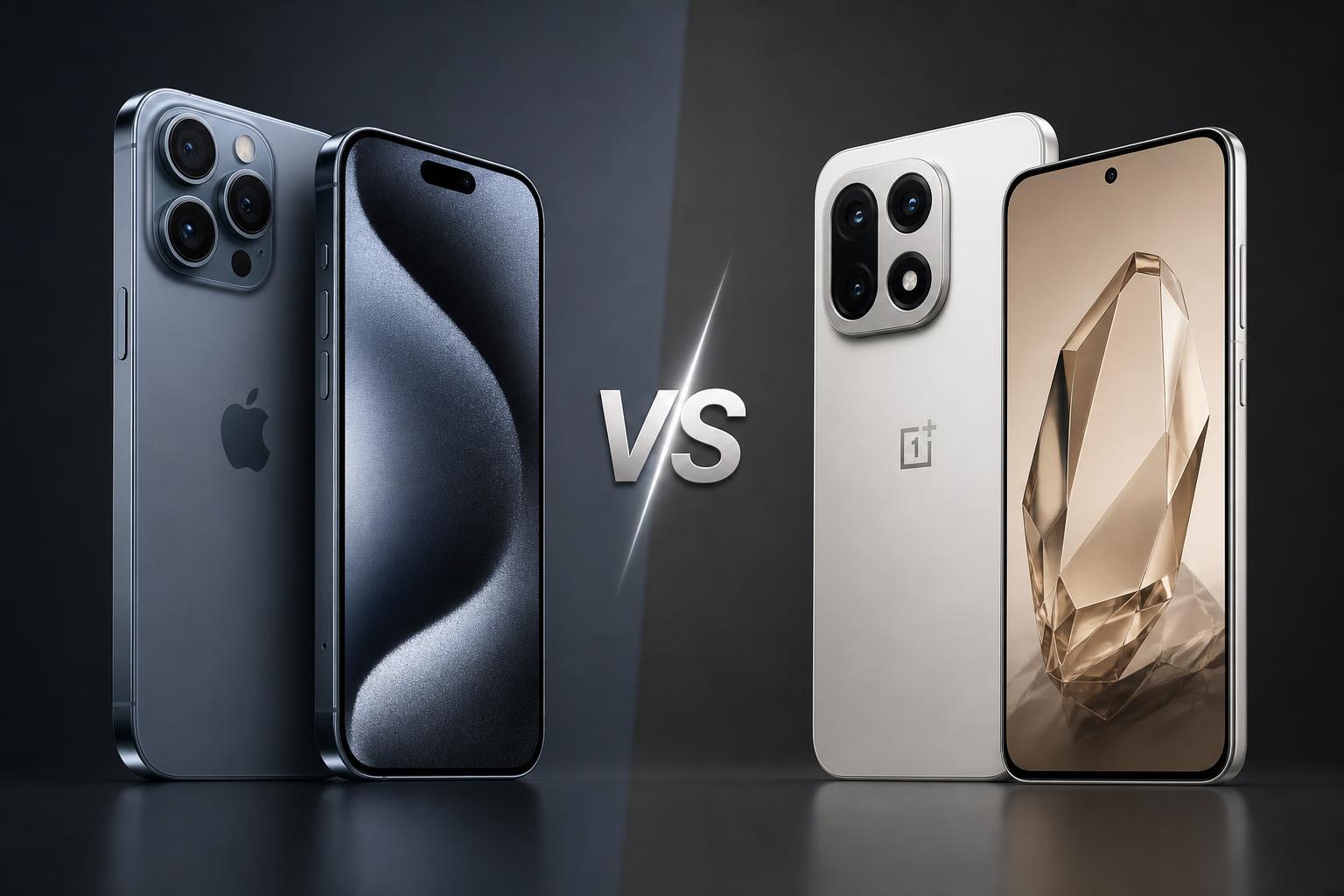
The Apple iPhone 18 Pro and OnePlus 15 take noticeably different approaches to the flagship smartphone. Apple’s model is the smaller and more compact option, with a strong emphasis on professional video tools, iOS 27 and integration with Apple services. OnePlus goes in a different direction with a larger display, a 165Hz gaming refresh rate, a 7,300mAh battery and faster charging.
Both phones use current-generation flagship processors, offer 5G and Wi-Fi 7, and include advanced multi-camera systems. However, the better choice depends on what matters most to you: camera formats and ecosystem features, or battery capacity, charging speed, gaming hardware and upfront value.
Quick verdict
The Apple iPhone 18 Pro is the better choice for buyers who want a compact flagship with advanced video-production features, Apple Intelligence, satellite safety features and close integration with the wider Apple ecosystem. Its variable-aperture main camera, ProRes RAW, Apple Log 2, LiDAR Scanner and 4K Dolby Vision support give it the more clearly specified professional video toolkit.
The OnePlus 15 is the stronger value option for most performance-focused buyers. It starts at $899.99 in the U.S., compared with $1,199 for the iPhone 18 Pro, while offering more RAM at the entry level, a much larger battery, faster wired and wireless charging, and a display that can reach 165Hz in gaming.
There is no single winner across every category. Choose the iPhone 18 Pro for compact size, iOS and creator-focused camera features. Choose the OnePlus 15 for battery endurance potential, charging convenience, gaming-oriented hardware and a lower starting price.
Key specifications comparison
| Specification | Apple iPhone 18 Pro | OnePlus 15 |
|---|---|---|
| U.S. starting price | $1,199 for 256GB | $899.99 for 12GB RAM and 256GB |
| Release date | September 18, 2026 | November 13, 2025 |
| Display | 6.3-inch Super Retina XDR all-screen OLED | 6.78-inch LTPO display |
| Resolution and refresh rate | 2622 x 1206, 460 ppi, up to 120Hz | 2772 x 1272, 450 ppi, up to 165Hz in gaming |
| Peak brightness specification | Up to 3,000 nits outdoor peak | 1,800-nit high-brightness mode |
| Processor | Apple A20 Pro | Qualcomm Snapdragon 8 Elite Gen 5 |
| RAM and storage | 256GB, 512GB, 1TB or 2TB; RAM not specified by Apple | 12GB or 16GB RAM; 256GB or 512GB storage |
| Rear cameras | 48MP variable-aperture main, 48MP ultrawide, 48MP 4x telephoto | 50MP main with OIS, 50MP ultrawide, 50MP 3.5x periscope telephoto |
| Front camera | 18MP Center Stage | 32MP autofocus |
| Battery | Official capacity not specified; up to 24 hours typical use | 7,300mAh |
| Charging | Up to 50% in around 15 minutes with a compatible 60W-capable adapter or higher; MagSafe and Qi2 up to 25W | 80W wired and 50W wireless in North America |
| Software | iOS 27 with Apple Intelligence and Siri AI | OxygenOS 16 based on Android 16 |
| Dimensions and weight | 150.0 x 71.9 x 8.75mm; 211g | 161.42 x 76.67 x 8.10mm or 8.20mm; 211g to 215g |
Design and build
The iPhone 18 Pro is the more compact phone of the two. It measures 150.0 x 71.9 x 8.75mm and weighs 211g. The OnePlus 15 is substantially taller and wider, measuring 161.42 x 76.67mm, although its thickness ranges from 8.10mm to 8.20mm depending on the finish. Its weight is 211g for the Sand Storm version and 215g for the Infinite Black or Ultra Violet versions.
That difference matters in everyday handling. The iPhone’s shorter and narrower body should be easier to manage for buyers who prefer a smaller flagship, while the OnePlus 15’s larger frame provides room for its 6.78-inch screen and very large battery. Despite the OnePlus phone being considerably bigger, the two are close in weight, with the heaviest OnePlus finishes weighing 4g more than the iPhone.
Apple uses an aluminum unibody with Ceramic Shield 2 on the front and a Ceramic Shield back. The iPhone 18 Pro also has IP68 water and dust resistance. Other hardware features include Face ID, USB-C, 5G, Wi-Fi 7 and Bluetooth 6. The U.S. model is dual eSIM only and does not support physical SIM cards, which is an important consideration for anyone who regularly changes physical SIMs or travels with them.
The OnePlus 15 has a flat-frame design and Gorilla Glass Victus 2. OnePlus describes the phone as offering water and dust resistance under normal usage conditions. It also includes USB-C, 5G, Wi-Fi 7 and Bluetooth 6.0. The practical design choice is therefore fairly clear: the iPhone prioritizes a smaller body and Apple’s Ceramic Shield materials, while the OnePlus prioritizes a large-screen format without becoming dramatically heavier.
Display
The OnePlus 15 wins on screen size. Its 6.78-inch LTPO display is much larger than the iPhone 18 Pro’s 6.3-inch Super Retina XDR all-screen OLED. That makes the OnePlus the more natural option for buyers who watch video, read, browse or play games on a large panel.
The iPhone has the higher stated pixel density, at 460 pixels per inch compared with 450ppi for the OnePlus. It also specifies a 2622 x 1206 resolution, Always-On display and Dynamic Island. ProMotion provides an adaptive refresh rate of up to 120Hz. Apple also lists up to 3,000 nits of outdoor peak brightness.
The OnePlus 15 uses an LTPO panel with an adaptive refresh rate from 1Hz to 120Hz and up to 165Hz in gaming. Its listed high-brightness mode reaches 1,800 nits, and the display can go as low as 1 nit. The 165Hz mode is the key distinction for gaming-focused buyers, although the iPhone’s 120Hz ProMotion display remains a high-refresh-rate panel for general use.
In short, the OnePlus 15 provides the larger canvas and higher gaming refresh rate, while the iPhone 18 Pro has the higher pixel density and higher stated outdoor peak brightness. Buyers who prioritize compact viewing and outdoor brightness may prefer Apple; those who want the biggest screen and gaming refresh rate should look closely at OnePlus.
Performance and gaming
The iPhone 18 Pro uses Apple’s A20 Pro processor. Its specification includes a six-core CPU, a seven-core GPU with Neural Accelerators, a dual 16-core Neural Engine and hardware-accelerated ray tracing. Apple does not specify the iPhone’s RAM on its official technical-specifications page, so it is not possible to make a verified RAM comparison beyond the OnePlus figures.
The OnePlus 15 uses Qualcomm’s Snapdragon 8 Elite Gen 5 Mobile Platform and an Adreno 840 GPU. It also includes a dedicated touch-response chip, an independent Wi-Fi chip and a 360° Cryo-Velocity cooling system. These features give the OnePlus a more explicitly gaming-oriented hardware specification, particularly when combined with the 165Hz gaming refresh rate.
OnePlus offers 12GB or 16GB of LPDDR5X Ultra or Ultra+ RAM, with 256GB or 512GB of UFS 4.1 storage. The iPhone offers 256GB, 512GB, 1TB or 2TB storage capacities. The iPhone therefore provides more maximum storage flexibility, while the OnePlus gives buyers clearer memory choices at its two configurations.
Both phones are positioned as flagship performance devices, but directly comparable benchmark superiority should not be claimed here because no directly comparable official benchmark results were verified. For gaming, the OnePlus has the more clearly specified advantages: a 165Hz mode, dedicated touch-response hardware, an independent Wi-Fi chip and an active cooling system. For graphics-heavy workloads more broadly, the iPhone adds hardware-accelerated ray tracing and Apple’s Neural Engine architecture.
Camera and video features
The iPhone 18 Pro has a 48MP Pro Fusion camera system comprising a variable-aperture 48MP main camera, a 48MP ultrawide camera and a 48MP 4x telephoto camera with 8x optical-quality zoom. It also includes an 18MP Center Stage front camera and a LiDAR Scanner.
Apple’s camera advantage is especially clear in its documented video-production formats. The iPhone supports ProRes, ProRes RAW, Apple Log 2 and 4K Dolby Vision video. Those features make it the more clearly specified phone for creators who want advanced recording formats and a workflow built around Apple’s professional video tools.
The OnePlus 15 takes a high-resolution approach with three 50MP rear cameras. The main camera includes optical image stabilization, the ultrawide camera has a 112-degree field of view, and the periscope telephoto offers 3.5x optical zoom and 7x optical-quality zoom. Its front camera is a 32MP autofocus camera.
OnePlus also includes the DetailMax Engine and supports up to 4K 120fps Dolby Vision video. That gives the phone a strong specification for users who want a versatile triple-camera system and high-frame-rate video. The difference is not simply a matter of megapixel counts: the iPhone brings variable aperture, LiDAR and professional recording formats, while the OnePlus emphasizes three 50MP cameras, a periscope design and 4K 120fps capture.
For professional video workflows, the iPhone 18 Pro is the more compelling choice based on the verified feature list. For buyers who prefer a high-resolution camera system with a periscope telephoto and high-frame-rate Dolby Vision recording, the OnePlus 15 remains a capable alternative on paper.
Battery and charging
The OnePlus 15 has a clear advantage in stated battery capacity. It uses a 7,300mAh non-removable Silicon NanoStack battery. In North America, it supports 80W SUPERVOOC wired charging and 50W AIRVOOC wireless charging.
The iPhone 18 Pro’s official specifications do not publish a battery-capacity figure. Apple instead rates it for up to 24 hours of typical use, up to 36 hours of video playback and up to 33 hours of streamed video playback. It supports up to 50% charge in around 15 minutes when used with a compatible 60W-capable adapter or higher. MagSafe and Qi2 wireless charging are supported at up to 25W.
This gives OnePlus the straightforward advantage for charging speed and battery capacity. Its 80W wired charging is rated higher than the iPhone’s charging specification, and its 50W wireless charging is twice the iPhone’s 25W MagSafe or Qi2 figure. The iPhone does, however, have a substantial official video-playback rating, so buyers should distinguish between Apple’s usage estimates and the OnePlus capacity figure rather than treating them as directly interchangeable tests.
Software and features
The iPhone 18 Pro runs iOS 27 and includes Apple Intelligence and Siri AI. It also offers Face ID, satellite emergency and messaging features, and the broader integration associated with Apple’s hardware and services. Buyers already using Apple devices may value the continuity between the iPhone and the wider ecosystem, although the specific benefit will depend on the products and services they already own.
The OnePlus 15 runs OxygenOS 16 based on Android 16. Its listed AI features include Plus Mind and Gemini-connected features, as well as AI Scan, AI Portrait Glow and AI Perfect Shot. OnePlus notes that the availability of some AI features varies by country or region, so buyers should check local availability before making a decision based on a particular tool.
The software choice is therefore more than a simple Android-versus-iOS preference. The iPhone offers Apple Intelligence, Siri AI, satellite features and Apple ecosystem integration. The OnePlus offers OxygenOS, Android 16, Google-connected AI features and a set of OnePlus-branded AI tools. Buyers should also consider whether their existing apps, accessories and cloud services are tied more closely to Apple or Android.
Price and value
The Apple iPhone 18 Pro starts at $1,199 in the U.S. for 256GB. Storage options extend through 512GB, 1TB and 2TB. Apple does not specify RAM on the official technical-specifications page, so the purchase decision is primarily presented around storage capacity rather than a published memory tier.
The OnePlus 15 starts at $899.99 in the U.S. with 12GB RAM and 256GB storage. The 16GB RAM and 512GB storage version costs $999.99. That means the OnePlus starts $299.01 below the iPhone 18 Pro, while its higher configuration remains $199.01 below Apple’s entry price.
On specifications alone, the OnePlus 15 offers more hardware for less money in several areas: a 7,300mAh battery, 80W wired charging, 50W wireless charging, 12GB RAM at the base configuration and a 165Hz gaming display. The iPhone 18 Pro justifies its higher price through its compact design, greater storage range, professional video formats, satellite features and iOS ecosystem.
The best value therefore depends on the type of value you want. The OnePlus is the better value for battery, charging, gaming and everyday flagship hardware. The iPhone may be worth the extra cost for creators who specifically need ProRes RAW or Apple Log 2, users who want Apple’s ecosystem integration, or buyers who prefer its smaller body.
Apple iPhone 18 Pro: pros and cons
Pros
- Compact dimensions compared with the OnePlus 15, while weighing 211g.
- Variable-aperture 48MP main camera and 48MP telephoto system.
- Professional video features including ProRes RAW and Apple Log 2.
- LiDAR Scanner and 4K Dolby Vision video support.
- Up to 2TB storage option.
- Up to 3,000 nits outdoor peak brightness.
- iOS 27, Apple Intelligence, Siri AI and satellite emergency and messaging features.
- Official rating of up to 36 hours of video playback.
Cons
- Higher starting price than the OnePlus 15.
- Refresh rate is capped at 120Hz, below the OnePlus 15’s 165Hz gaming mode.
- Apple does not publish a battery-capacity figure on its official specifications page.
- Lower rated wireless and wired charging speeds than the OnePlus 15.
- The U.S. model is eSIM only and has no physical SIM-card compatibility.
OnePlus 15: pros and cons
Pros
- Lower U.S. starting price of $899.99.
- 12GB RAM at the base configuration and 16GB available in the higher model.
- Large 6.78-inch display with up to 165Hz for gaming.
- 7,300mAh battery.
- 80W wired and 50W wireless charging in North America.
- Dedicated touch-response and Wi-Fi chips plus a 360° cooling system.
- Triple 50MP rear camera system with a periscope telephoto.
- Up to 4K 120fps Dolby Vision video.
Cons
- Much larger physical footprint than the iPhone 18 Pro.
- Some finishes weigh 215g, despite the larger body and screen.
- Lower display resolution than some previous OnePlus flagship models.
- AI feature availability varies by country or region.
- The official U.S. specification lists 80W charging rather than the 100W charging supported in some markets.
Which phone is better for different buyers?
Best for compact-phone buyers: Apple iPhone 18 Pro
The iPhone 18 Pro is substantially shorter and narrower, making it the better fit for people who want flagship hardware without a large-screen phone. Its 6.3-inch display is still sizeable, but the overall dimensions are more compact than the OnePlus 15.
Best for battery and charging: OnePlus 15
The OnePlus 15 is the clear choice for buyers who place battery capacity and charging speed first. Its 7,300mAh battery, 80W wired charging and 50W wireless charging give it the stronger specification in this category.
Best for gaming: OnePlus 15
The OnePlus 15 is better suited to gaming-focused use because it combines a 165Hz gaming refresh rate with dedicated touch-response and Wi-Fi chips and a 360° Cryo-Velocity cooling system. No directly comparable official benchmark results were verified, so this conclusion is based on the documented gaming hardware rather than an unsupported performance claim.
Best for professional video: Apple iPhone 18 Pro
The iPhone 18 Pro is the more clearly specified choice for professional video workflows. ProRes RAW, Apple Log 2, ProRes, 4K Dolby Vision, a variable-aperture main camera and LiDAR provide a broader set of documented creator features.
Best for camera hardware variety: It depends
The iPhone brings a variable-aperture main camera, a 48MP telephoto, LiDAR and advanced Apple video formats. The OnePlus counters with three 50MP cameras, a 3.5x periscope telephoto, 7x optical-quality zoom and 4K 120fps Dolby Vision. Choose the iPhone for Apple’s production features; choose the OnePlus if the triple-50MP setup and periscope approach are more important.
Best for value: OnePlus 15
The OnePlus 15 offers the lower starting price and a substantial hardware package, including more specified RAM, a larger battery, faster charging and a higher gaming refresh rate. It is the stronger value choice unless you specifically need the iPhone’s software ecosystem or creator-focused formats.
Final verdict
The Apple iPhone 18 Pro and OnePlus 15 are both high-end smartphones, but their priorities are different. The iPhone 18 Pro is the more compact, creator-oriented and ecosystem-focused option. It has the stronger documented professional video feature set, a wider storage range, satellite features and a higher stated outdoor peak brightness.
The OnePlus 15 is the more practical value choice for many buyers. Its $899.99 starting price is considerably lower, while the phone offers a 7,300mAh battery, 80W wired charging, 50W wireless charging, a 165Hz gaming display and dedicated gaming hardware. Its larger body is the main trade-off.
Choose the iPhone 18 Pro if you want iOS 27, a compact design, advanced Apple video formats and deep Apple ecosystem integration. Choose the OnePlus 15 if you want the largest display, the fastest charging, a much larger battery, gaming-focused features and better value for the money.
FAQs
Is the iPhone 18 Pro cheaper than the OnePlus 15?
No. The iPhone 18 Pro starts at $1,199 in the U.S. for 256GB, while the OnePlus 15 starts at $899.99 for 12GB RAM and 256GB storage. The OnePlus 15 therefore has the lower starting price by $299.01.
Which phone has the larger battery?
The OnePlus 15 has the larger stated battery, with a 7,300mAh non-removable Silicon NanoStack battery. Apple does not publish a battery-capacity figure for the iPhone 18 Pro, but it rates the phone for up to 36 hours of video playback.
Which phone charges faster?
The OnePlus 15 has the higher rated charging speeds, with 80W wired charging and 50W wireless charging in North America. The iPhone 18 Pro supports up to 50% charge in around 15 minutes with a compatible 60W-capable adapter or higher, plus MagSafe and Qi2 wireless charging up to 25W.
Which phone is better for gaming?
The OnePlus 15 is the better fit for gaming based on its documented hardware. It has a gaming refresh rate of up to 165Hz, a dedicated touch-response chip, an independent Wi-Fi chip and a 360° cooling system. Directly comparable benchmark results were not verified.
Which phone is better for video recording?
The iPhone 18 Pro is the more clearly specified choice for professional video. It supports ProRes RAW, Apple Log 2, ProRes and 4K Dolby Vision, and includes a variable-aperture main camera and LiDAR Scanner. The OnePlus 15 supports up to 4K 120fps Dolby Vision and offers a triple-50MP rear camera system.
Sources
- iPhone 18 Pro - Tech Specs — Apple Support
- Apple debuts iPhone 18 Pro and iPhone 18 Pro Max — Apple Newsroom
- iPhone 18 Pro and iPhone 18 Pro Max — Apple
- OnePlus 15 — OnePlus
- OnePlus 15 Specifications — OnePlus
- OnePlus Launches the OnePlus 15 — The Ultimate Performance Flagship Smartphone for North America — OnePlus