
Apple iPhone 17e vs Samsung Galaxy S26: Which Phone Should You Buy?
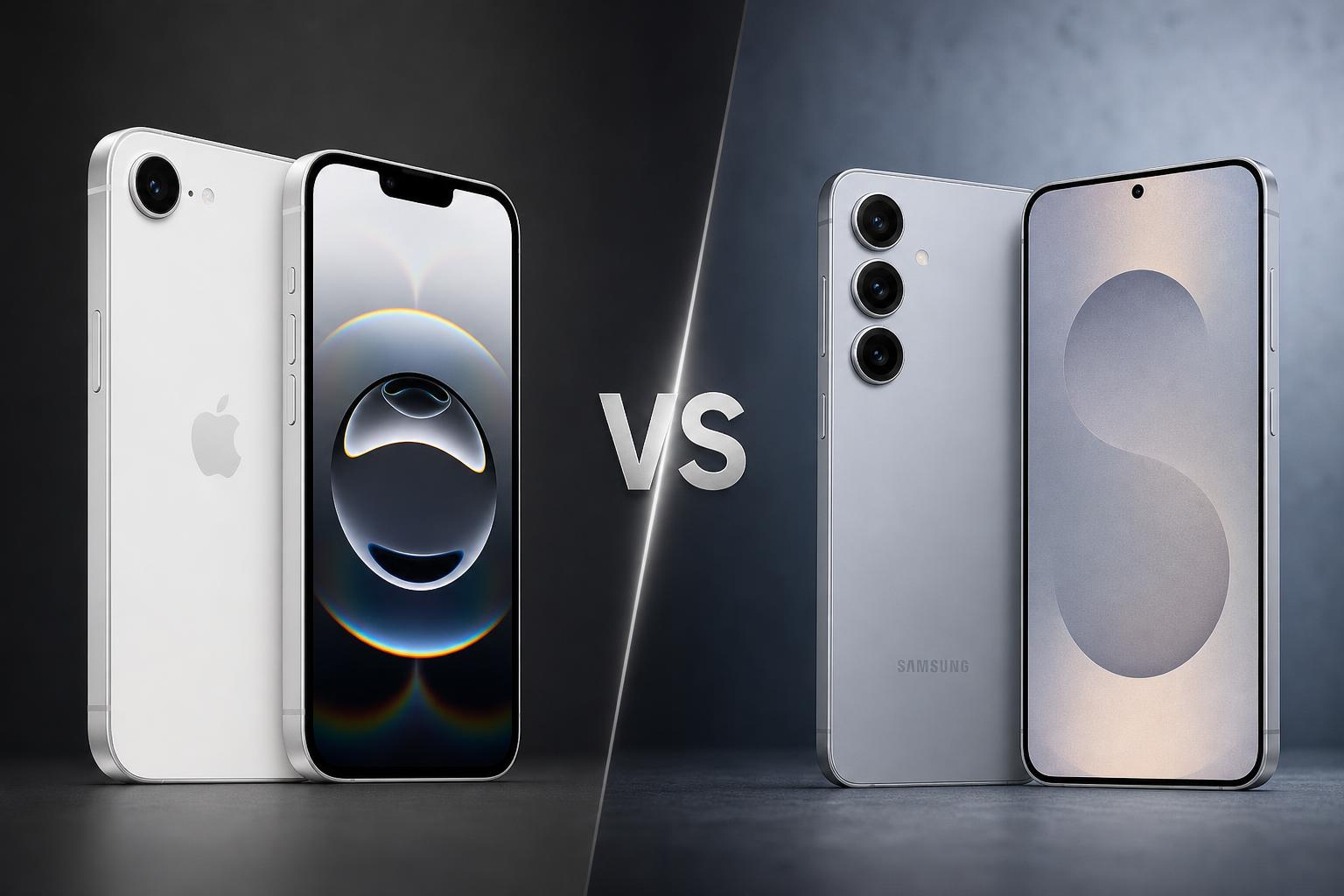
The Apple iPhone 17e and Samsung Galaxy S26 are compact flagship-format smartphones released on the same day, March 11, 2026. They take different approaches to the premium phone market: Apple focuses on a lower entry price, its A19 processor and close integration with iOS, while Samsung offers a more advanced display, a triple-camera system and extensive Android customisation.
Both phones have aluminum frames, glass backs, IP68 water and dust resistance, USB-C connectivity and similar lightweight designs. However, the Galaxy S26 has a clear hardware advantage for screen smoothness and camera flexibility, while the iPhone 17e is the more affordable option at current U.S. manufacturer pricing and includes 256GB of storage as standard.
Quick verdict
The Samsung Galaxy S26 is the stronger all-round hardware package. Its adaptive 120Hz display, higher peak brightness, 12GB of RAM and dedicated ultrawide and 3x telephoto cameras give it more flexibility than the iPhone 17e. Samsung also promises seven generations of OS upgrades and seven years of security updates.
The Apple iPhone 17e is the better value choice at current official U.S. prices. It starts at $699 for 256GB, compared with $849.99 currently shown by Samsung for the 256GB Galaxy S26. The iPhone also has Apple's A19 chip, 4K Dolby Vision video, MagSafe charging and satellite safety features. It is the better fit for buyers who already use Apple devices or prefer iOS and do not need a 120Hz display, ultrawide camera or dedicated telephoto lens.
| Feature | Apple iPhone 17e | Samsung Galaxy S26 |
|---|---|---|
| Release date | March 11, 2026 | March 11, 2026 |
| Current U.S. price | From $699 for 256GB | From $849.99 for 256GB unlocked |
| Display | 6.1-inch Super Retina XDR OLED, 2532×1170, 60Hz | 6.3-inch Dynamic AMOLED 2X, 2340×1080, adaptive 120Hz |
| Peak brightness | Up to 1,200 nits HDR brightness | Up to 2,600 nits |
| Processor | Apple A19 | Snapdragon 8 Elite Gen 5 in the U.S.; Exynos 2600 in some markets |
| RAM and storage | RAM not officially specified; 256GB or 512GB | 12GB RAM; 256GB or 512GB |
| Rear cameras | 48MP Fusion main camera with optical-quality 2x telephoto | 50MP main, 12MP ultrawide and 10MP 3x telephoto |
| Front camera | 12MP TrueDepth | 12MP |
| Video | 4K Dolby Vision up to 60fps | Camera system includes main, ultrawide and telephoto cameras |
| Battery information | Up to 26 hours video playback | 4,300mAh rated capacity |
| Wired charging | Up to 50% in approximately 30 minutes with a 20W-or-higher adapter | 25W |
| Wireless charging | MagSafe and Qi2 up to 15W | 15W wireless, Qi2 support and reverse wireless charging up to 4.5W |
| Software | iOS 27 with Apple Intelligence | Android 16 with One UI 8.5 and Galaxy AI |
| Dimensions and weight | 146.7 × 71.5 × 7.8mm; 169g | 149.6 × 71.7 × 7.2mm; 167g |
| Protection and extras | IP68, Ceramic Shield 2, Face ID, satellite safety features, Action button | IP68, USB-C, Qi2 support, charger not included |
Design and build
The iPhone 17e and Galaxy S26 are both designed for people who want flagship-level phones without moving to a much larger handset. The iPhone 17e measures 146.7 × 71.5 × 7.8mm and weighs 169g. The Galaxy S26 is 149.6 × 71.7 × 7.2mm and weighs 167g.
That makes the iPhone slightly shorter, while the Galaxy is thinner and slightly lighter. The difference is small enough that dimensions alone are unlikely to decide the purchase, but the two phones do offer subtly different physical priorities. Apple keeps the iPhone compact, while Samsung makes the Galaxy slimmer despite its larger display.
Both models use aluminum frames and glass backs, and both carry IP68 water and dust resistance. The iPhone 17e adds a Ceramic Shield 2 front, while Samsung's listed specifications include USB-C connectivity and support for Qi2 charging accessories. The Galaxy S26 does not have built-in magnets, so Qi2 requires a compatible magnetic case. The iPhone 17e supports MagSafe as well as Qi2 wireless charging, which gives it a more direct fit with compatible magnetic accessories.
U.S. buyers should also note that the iPhone 17e is eSIM-only, with no physical SIM card slot. That will be straightforward for people whose carrier supports eSIM, but it may be a consideration for anyone who frequently swaps physical SIM cards. Samsung's cited specifications do not identify the Galaxy S26 as eSIM-only.
Display
The Galaxy S26 wins the display comparison on the available specifications. It has a 6.3-inch Dynamic AMOLED 2X panel with an adaptive 120Hz refresh rate, HDR10+ and peak brightness of up to 2,600 nits. The adaptive refresh rate should make supported scrolling and animations appear smoother than on a conventional 60Hz panel, while the higher brightness gives Samsung more headroom in bright conditions.
The iPhone 17e has a 6.1-inch Super Retina XDR OLED display with a 2532×1170 resolution at 460 pixels per inch. It supports HDR and reaches up to 1,200 nits of HDR brightness. OLED technology should provide the strong contrast and deep blacks associated with this type of panel, but the 60Hz refresh rate is the main compromise.
For everyday messaging, browsing and video, the iPhone's screen remains well specified in terms of resolution and HDR support. However, buyers comparing the two directly are likely to notice the Galaxy S26's smoother 120Hz presentation, especially while scrolling through websites, feeds and menus. Samsung is also the better choice for users who frequently view their phone outdoors or place a high value on peak brightness.
This is one of the clearest differences between the phones. If a high-refresh-rate display is a priority, the Galaxy S26 is the obvious choice. If a compact OLED screen and Apple's display ecosystem matter more than 120Hz smoothness, the iPhone 17e remains credible, but it is not the display leader in this comparison.
Performance
The iPhone 17e uses Apple's A19 chip. The specification includes a six-core CPU, a four-core GPU with Neural Accelerators and a 16-core Neural Engine. The phone also supports hardware-accelerated ray tracing, which is relevant to compatible games and graphics workloads.
In the United States, the Galaxy S26 uses Qualcomm's Snapdragon 8 Elite Gen 5. Samsung lists the Exynos 2600 for some other markets, so the exact processor depends on where the phone is purchased. Samsung gives the Galaxy S26 12GB of RAM, while Apple has not officially specified a RAM figure in the cited materials.
Both are current-generation, high-end smartphone platforms, and either should be positioned for demanding everyday use, gaming and advanced software features. However, the supplied research does not include directly comparable benchmark testing for both phones. It would therefore be misleading to declare a definitive performance winner based only on the processor names.
The practical decision is more about each platform's wider strengths. The iPhone 17e combines the A19 with Apple's iOS ecosystem and hardware-accelerated ray tracing. The Galaxy S26 offers 12GB of RAM, Android multitasking and Samsung's Galaxy AI tools. Buyers who prioritise Apple devices and iOS continuity may prefer the iPhone, while people who want greater Android customisation and more visible memory headroom may prefer Samsung.
Camera and graphics
iPhone 17e cameras
The iPhone 17e has a 48MP Fusion main camera with optical-quality 2x telephoto framing. It also has a 12MP TrueDepth front camera. The rear system is deliberately simpler than Samsung's, with no separate ultrawide camera listed in the verified specifications.
Apple gives the iPhone a notable video feature: it can record 4K Dolby Vision video at up to 60 frames per second. That makes the iPhone particularly interesting for buyers who record a lot of video or already use Apple's video-processing and device ecosystem. The A19's four-core GPU with Neural Accelerators and hardware-accelerated ray tracing also gives the phone a relevant graphics feature set.
Galaxy S26 cameras
The Galaxy S26 has a more versatile rear-camera arrangement. It includes a 50MP main camera, a 12MP ultrawide camera and a 10MP telephoto camera with 3x optical zoom. Its front camera is 12MP.
The dedicated ultrawide camera gives the Galaxy an advantage for architecture, landscapes, group photos and other situations where a wider field of view is useful. The 3x optical telephoto camera also provides a more direct option for distant subjects than the iPhone's optical-quality 2x framing.
For still photography, the Galaxy S26 is the more flexible choice because it offers three distinct rear-camera perspectives. The iPhone 17e is more compact and simpler to use, but its single rear-camera system limits framing options. For video, the iPhone's 4K Dolby Vision support is a significant reason to choose Apple, particularly for creators who value that format and Apple's wider video ecosystem.
Battery and charging
The Galaxy S26 has a 4,300mAh battery and supports 25W wired charging, 15W wireless charging, Qi2 and reverse wireless charging up to 4.5W. Reverse wireless charging lets the phone share power with compatible accessories, although the supplied research does not provide a standardised battery test result for the Galaxy.
Apple does not list a battery capacity for the iPhone 17e in the supplied specifications, but it does state up to 26 hours of video playback and up to 21 hours of streamed video playback. The phone can reach up to 50% charge in approximately 30 minutes when used with a 20W-or-higher adapter. It supports MagSafe and Qi2 wireless charging up to 15W.
The Galaxy has the larger explicitly stated battery capacity and the faster rated wired charging, so it is the more appealing option for buyers who focus on charging hardware, battery sharing or recharge speed. Apple provides a useful official video-playback figure for the iPhone, but the figures are not directly comparable with Samsung's listed capacity. There is no directly comparable standardised battery test in the cited research.
Neither phone should be bought on battery capacity alone. The operating system, display refresh rate, brightness and individual usage patterns all affect endurance. For a buyer who values the longest stated video-playback figure, the iPhone 17e has the clearer official claim. For charging flexibility and battery hardware, the Galaxy S26 has more to offer.
Software and features
The iPhone 17e runs iOS 27 and includes Apple Intelligence. It also has Face ID, an Action button and a set of satellite features: Emergency SOS, Messages, Find My and Roadside Assistance. Crash Detection is also included. These safety features and Apple's ecosystem integration are important differentiators for existing iPhone, Apple Watch, Mac or AirPods users.
The Galaxy S26 runs Android 16 with Samsung's One UI 8.5 interface and Galaxy AI features. One UI offers broad customisation, while Android gives buyers more flexibility in how they arrange and use the phone. Samsung states that the Galaxy S26 will receive seven generations of OS upgrades and seven years of security updates, giving the phone a clearly stated long-term support policy.
Apple's cited materials do not provide a directly matching number of software-support years for the iPhone 17e, so this comparison should not invent one. Apple's long-running software ecosystem is a strength, but Samsung is more explicit in the supplied research about the duration of its update commitment.
Feature priorities will depend heavily on the buyer. The iPhone is better suited to people who want Face ID, satellite safety tools, MagSafe and close integration with Apple products. The Galaxy is better for those who want Galaxy AI, One UI customisation and a clearly stated seven-year update commitment.
Price and value
At the time covered by the verified research, Apple lists the iPhone 17e from $699 in the U.S. for 256GB on Apple.com. Its launch MSRP was $599, so the current official price is higher than the launch figure. Apple also offers a 512GB configuration.
Samsung currently lists the unlocked 256GB Galaxy S26 from $849.99 in the U.S., while its regular MSRP is $999.99. A 512GB model is also available. That makes the current manufacturer-price difference approximately $150 in favour of the iPhone 17e at the 256GB entry level.
Both phones start with 256GB, which is useful for buyers who store photos, video, games and apps locally. Samsung adds 12GB of RAM and a more versatile camera system, while Apple offers the lower current price, A19 performance and stronger cited video features. Samsung also does not include a charger, according to the verified specifications.
The iPhone 17e is the better value if you prefer iOS and can accept a 60Hz display and a simpler camera system. The Galaxy S26 is worth the extra cost for buyers who will use its 120Hz screen, ultrawide camera, 3x telephoto camera, 12GB of RAM and Android customisation. Neither is universally better value; the right choice depends on which features you will use most often.
Apple iPhone 17e: pros and cons
Pros
- Lower current official U.S. price than the Galaxy S26.
- 256GB of storage at the entry level.
- Apple A19 chip with hardware-accelerated ray tracing.
- Compact, lightweight design with IP68 protection.
- Strong 4K Dolby Vision video recording up to 60fps.
- MagSafe and Qi2 wireless charging up to 15W.
- Apple Intelligence, Face ID and satellite safety features.
Cons
- 60Hz display is less smooth than the Galaxy's adaptive 120Hz panel.
- No dedicated ultrawide rear camera.
- No dedicated rear telephoto camera; it uses optical-quality 2x telephoto framing.
- RAM is not officially specified in the cited Apple materials.
- Slower rated wired charging than the Galaxy S26.
- U.S. models are eSIM-only.
Samsung Galaxy S26: pros and cons
Pros
- Adaptive 120Hz AMOLED display with peak brightness up to 2,600 nits.
- More flexible triple-camera system with ultrawide and 3x telephoto cameras.
- 12GB of RAM and storage options up to 512GB.
- 4,300mAh battery with reverse wireless charging.
- Galaxy AI and broad One UI customisation.
- Samsung states seven generations of OS upgrades and seven years of security updates.
- Thinner and slightly lighter than the iPhone 17e.
Cons
- Higher current official price than the iPhone 17e.
- 25W wired charging is only modestly faster than the iPhone's supported charging setup.
- No built-in magnetic attachment system for Qi2 accessories.
- Processor varies by market.
- Charger is not included.
Which phone is better for different buyers?
Buy the iPhone 17e if you want the best value
The iPhone 17e is the value choice at current U.S. manufacturer pricing. It costs approximately $150 less than the 256GB Galaxy S26 and still provides a current-generation A19 chip, 256GB of storage, an OLED display and strong video features. It is especially compelling if you already use Apple products or want iOS rather than Android.
Buy the Galaxy S26 if the display matters most
The Galaxy S26 is the clear pick for buyers who want a smooth 120Hz experience and higher peak brightness. Its adaptive refresh rate and 2,600-nit peak brightness give it a stronger display specification than the iPhone 17e.
Buy the Galaxy S26 for photography flexibility
Samsung is better for still-photo versatility. Its ultrawide and dedicated 3x telephoto cameras provide more framing options than the iPhone 17e's 48MP main camera with optical-quality 2x telephoto framing.
Buy the iPhone 17e for video and Apple ecosystem integration
The iPhone 17e is particularly attractive to video-focused buyers because it supports 4K Dolby Vision recording up to 60fps. It is also the natural choice for people who value Face ID, MagSafe, satellite safety features and continuity with other Apple devices.
Buy the Galaxy S26 for long-term Android support
Samsung is the stronger choice for buyers who want a clearly stated support policy alongside Android flexibility. Samsung lists seven generations of OS upgrades and seven years of security updates for the Galaxy S26.
Performance buyers should choose their ecosystem
There is no definitive performance winner from the directly comparable evidence supplied for this comparison. The iPhone 17e uses Apple's A19, while the U.S. Galaxy S26 uses Snapdragon 8 Elite Gen 5. Both are current-generation high-end platforms, so ecosystem, display, camera and software preferences should decide the purchase rather than an unsupported benchmark claim.
Final verdict
The Samsung Galaxy S26 is the better all-round hardware package. It has the superior display specification, a more versatile camera system, 12GB of RAM, a larger rated battery and a comprehensive Android feature set. It is the phone to buy if you want the most complete hardware experience and are willing to pay more.
The Apple iPhone 17e is the smarter value purchase at current official U.S. pricing. It costs less, starts with 256GB, uses the A19 chip and offers impressive video capabilities, MagSafe and Apple's ecosystem and safety features. Its compromises are clear: a 60Hz display, no ultrawide camera, no dedicated telephoto lens and slower rated wired charging.
In short, choose the Galaxy S26 for display quality, camera versatility and Android customisation. Choose the iPhone 17e for lower cost, iOS, Apple integration and Dolby Vision video.
FAQs
Is the iPhone 17e cheaper than the Galaxy S26?
Yes. The iPhone 17e currently starts at $699 in the U.S. for 256GB on Apple.com. Samsung currently lists the unlocked 256GB Galaxy S26 from $849.99, making the iPhone approximately $150 cheaper at the current manufacturer prices.
Which has the better display, the iPhone 17e or Galaxy S26?
The Galaxy S26 has the stronger display specification. It offers a 6.3-inch AMOLED panel with an adaptive 120Hz refresh rate and peak brightness up to 2,600 nits. The iPhone 17e has a sharp 6.1-inch OLED display, but its refresh rate is limited to 60Hz and its HDR brightness is listed at up to 1,200 nits.
Which phone has better cameras?
The Galaxy S26 is more versatile because it has a 50MP main camera, a 12MP ultrawide and a 10MP 3x telephoto camera. The iPhone 17e has a 48MP main camera with optical-quality 2x telephoto framing and no listed ultrawide camera. The iPhone is especially appealing for video because it supports 4K Dolby Vision recording up to 60fps.
Does the iPhone 17e have a 120Hz display?
No. The iPhone 17e has a 60Hz refresh rate. The Galaxy S26 has an adaptive 120Hz refresh rate.
Which has faster charging?
The Galaxy S26 supports 25W wired charging, while the iPhone 17e can reach up to 50% in approximately 30 minutes with a 20W-or-higher adapter. Based on the listed charging specifications, the Galaxy has the faster rated wired charging. The iPhone supports MagSafe and Qi2 charging up to 15W, while the Galaxy supports 15W wireless charging, Qi2 and reverse wireless charging up to 4.5W.
Which should I buy for long-term software support?
Samsung provides the clearer stated commitment in the supplied research: seven generations of OS upgrades and seven years of security updates for the Galaxy S26. The iPhone 17e runs iOS 27 and benefits from Apple's software ecosystem, but the cited Apple materials do not provide a directly matching number of support years.
Sources
- iPhone 17e - Technical Specifications — Apple
- Apple introduces iPhone 17e — Apple Newsroom
- Buy iPhone — Apple
- Samsung Unveils Galaxy S26 Series — Samsung Newsroom
- Galaxy S26 and S26+ — Samsung
- Buy Unlocked Galaxy S26 256GB — Samsung
- Samsung Galaxy S26 review — TechRadar
- Samsung Galaxy S26 review: Lab tests — GSMArena