Apple iPad Pro M5 vs Samsung Galaxy Tab S12 Ultra: Which Premium Tablet Is Better?
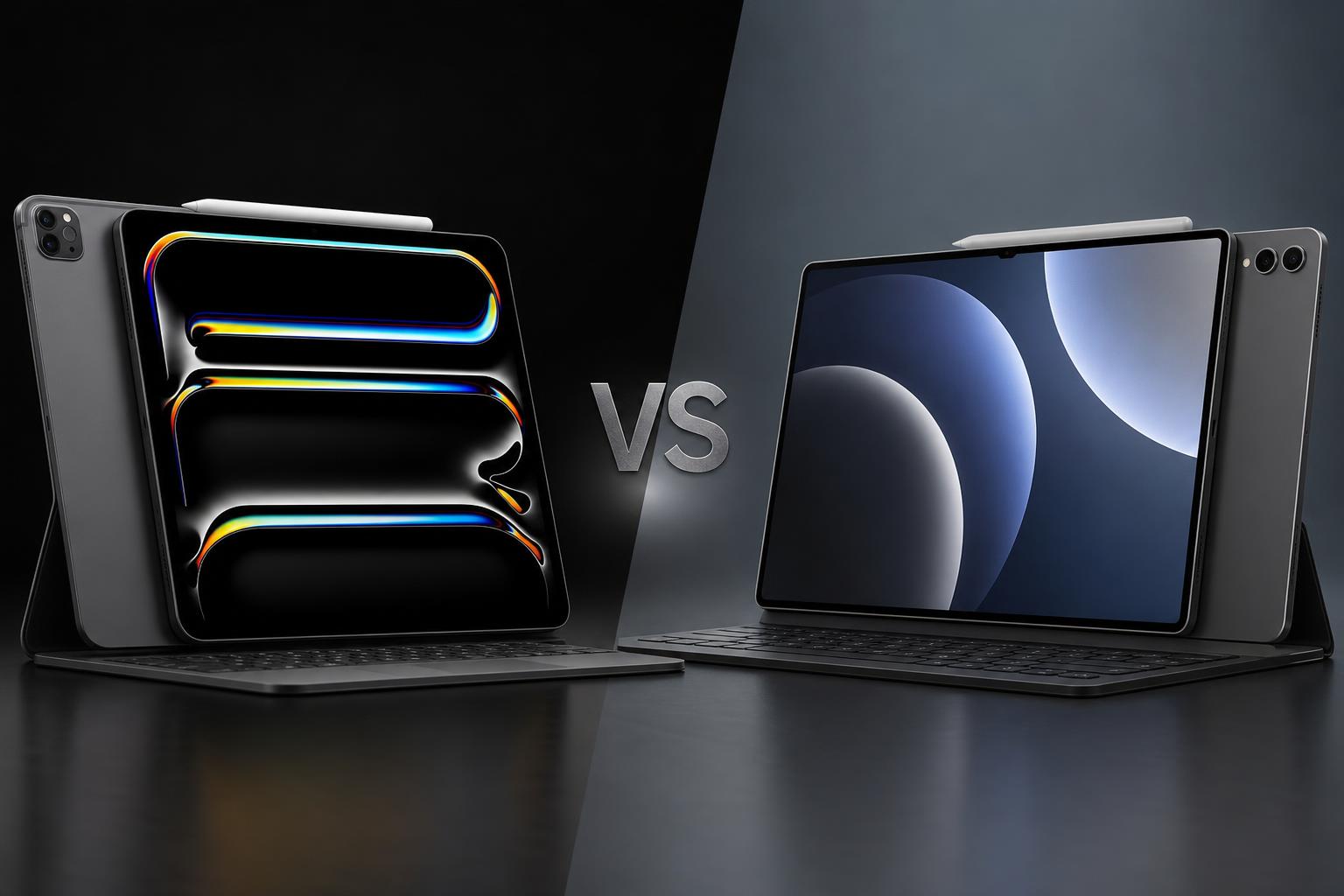
Apple's iPad Pro with M5 and Samsung's Galaxy Tab S12 Ultra target buyers who want more than a basic tablet. Both offer high-end OLED displays, 120Hz-class refresh rates, premium thin designs and hardware aimed at productivity, creative work and entertainment. However, they take very different approaches.
The iPad Pro M5 is available in more compact 11-inch and 13-inch sizes, uses Apple's M5 chip and supports features such as Thunderbolt/USB 4 and 4K ProRes recording. The Galaxy Tab S12 Ultra is a much larger 14.6-inch Android tablet with an 11,600mAh battery, microSD expansion, IP68 resistance, DeX and an S Pen included in the box.
One important qualification is timing: the iPad Pro M5 is released, while the Galaxy Tab S12 Ultra is listed as announced with U.S. retail availability beginning on October 7, 2026. That means buyers should check availability before making a purchase decision.
Quick verdict
The Apple iPad Pro M5 is the safer overall choice for buyers who value portability, Apple's pro-app ecosystem, advanced video recording, Thunderbolt connectivity and a lower starting price. Its 11-inch version is considerably easier to carry than Samsung's ultra-large tablet, while the 13-inch model provides a larger workspace without reaching the Galaxy Tab's weight.
The Samsung Galaxy Tab S12 Ultra is the better fit for buyers who specifically want a 14.6-inch screen, an included stylus, expandable storage, IP68 water and dust resistance and a larger battery. It also brings Android 17, One UI 9, Galaxy AI and DeX, making it a strong option for users already invested in Samsung's ecosystem.
There is no definitive performance winner based on the verified specifications alone. Apple uses the M5 with a 9-core or 10-core CPU and a 10-core GPU, while Samsung uses the MediaTek Dimensity 9500. Directly comparable official benchmark results were not provided, so performance should not be decided by an unsupported specification-only claim.
Key specifications comparison
| Specification | Apple iPad Pro with M5 | Samsung Galaxy Tab S12 Ultra |
|---|---|---|
| Availability | Released October 22, 2025 | Announced; U.S. retail availability begins October 7, 2026 |
| Display | 11-inch or 13-inch Ultra Retina XDR tandem OLED; 264ppi; 10Hz–120Hz ProMotion | 14.6-inch Dynamic AMOLED 2X; 2960×1848; 120Hz |
| Peak brightness | Up to 1,600 nits HDR | Up to 1,600 nits; up to 1,000 nits HBM |
| Processor | Apple M5 | MediaTek Dimensity 9500 |
| Memory and storage | 12GB unified memory with 256GB/512GB; 16GB with 1TB/2TB | 12GB RAM with 256GB/512GB; 16GB with 1TB |
| Rear cameras | 12MP wide; up to 5x digital zoom; 4K and ProRes recording | 13MP wide plus 8MP ultra-wide |
| Front camera | 12MP landscape Center Stage camera | 12MP ultra-wide camera |
| Battery | 31.29Wh for 11-inch; 38.99Wh for 13-inch; up to 10 hours Wi-Fi use | 11,600mAh; 45W charging; up to 23 hours video playback |
| Software | iPadOS 26 with Apple Intelligence | Android 17 with One UI 9 and Galaxy AI |
| Stylus | Supports Apple Pencil Pro and Apple Pencil USB-C; sold separately | New S Pen included |
| Weight | 444g/446g for 11-inch; 579g/582g for 13-inch | 692g Wi-Fi; 695g 5G |
| Starting price | $999 for 11-inch Wi-Fi; $1,299 for 13-inch Wi-Fi | $1,399.99 |
Design and build
The two tablets are slim, but their physical priorities are different. Apple's iPad Pro M5 comes in 11-inch and 13-inch versions, giving buyers a choice between maximum portability and a larger working area. The 11-inch Wi-Fi model weighs 444g, while the cellular version weighs 446g. The 13-inch version weighs 579g for Wi-Fi or 582g with cellular connectivity.
The 11-inch iPad Pro measures 249.7 by 177.5 by 5.3mm. The 13-inch version measures 281.6 by 215.5 by 5.1mm. This makes the larger iPad Pro thinner than the 11-inch version, although both are designed as very slim tablets. Apple also provides a Thunderbolt/USB 4 port with support for transfer speeds of up to 40Gbps, along with four-speaker audio.
Samsung's Galaxy Tab S12 Ultra measures 208.5 by 326.3 by 5.1mm and weighs 692g for Wi-Fi or 695g for 5G. It is therefore substantially heavier than either iPad Pro size, but that extra physical scale supports its much larger 14.6-inch display and bigger battery. Samsung adds IP68 water and dust resistance, an on-display fingerprint reader and quad speakers with four-channel spatial audio.
Portability is consequently a clear iPad advantage, especially if the tablet will be carried regularly or used handheld. Samsung's design makes more sense for desk work, split-screen multitasking, drawing on a large canvas or watching video on the biggest possible panel. The Galaxy Tab also has a practical out-of-the-box advantage because the new S Pen is included. Apple's Apple Pencil Pro and Apple Pencil USB-C are supported but are not included with the standard iPad Pro package.
Display
Both tablets use premium OLED display technology and support a 120Hz-class experience, but the screen sizes are not directly comparable. The iPad Pro M5 offers an 11-inch or 13-inch Ultra Retina XDR tandem OLED display. Both sizes have 264 pixels per inch, P3 wide color, True Tone and ProMotion adaptive refresh from 10Hz to 120Hz. Apple lists peak HDR brightness of up to 1,600 nits.
The 11-inch model has a 2420×1668 resolution, while the 13-inch model has a 2752×2064 resolution. This gives Apple a useful advantage in choice: buyers can select the smaller model for travel or the 13-inch model for a broader workspace without moving all the way to Samsung's large-tablet dimensions.
The Galaxy Tab S12 Ultra has a 14.6-inch Dynamic AMOLED 2X display with a 2960×1848 resolution and a 120Hz refresh rate. Samsung lists peak brightness of up to 1,600 nits and HBM brightness of up to 1,000 nits. Its main advantage is simply area. The 14.6-inch panel provides more room for side-by-side applications, timelines, large documents and handwritten notes.
For media and creative work, both displays have strong paper specifications. The iPad's tandem OLED design, ProMotion range and Apple Pencil hover support make it particularly appealing to users who want a responsive drawing and editing surface. Samsung's panel is the more spacious option and should appeal to anyone who prefers a laptop-like amount of screen area in a tablet form.
The decision here is less about a simple quality winner and more about working style. Choose the iPad Pro if you want a premium OLED display in a manageable size. Choose the Galaxy Tab if screen real estate is more important than weight and compactness.
Performance
The iPad Pro M5 uses Apple's M5 processor. The 256GB and 512GB configurations have a 9-core CPU, 10-core GPU, 16-core Neural Engine and 12GB of unified memory. The 1TB and 2TB configurations increase this to a 10-core CPU and 16GB of unified memory. Hardware-accelerated ray tracing and Neural Accelerators are included.
This gives the iPad a clearly specified graphics and media foundation, particularly for demanding creative applications, advanced video workflows and supported games. Apple also benefits from an established iPadOS pro-app ecosystem, although the suitability of particular applications will depend on each user's workflow.
Samsung uses the MediaTek Dimensity 9500. The tablet is offered with 12GB of RAM and either 256GB or 512GB of storage, or 16GB of RAM with 1TB of storage. Samsung's specifications do not state a separate GPU model, so it would be inappropriate to declare a graphics winner from the published specifications alone.
There are also no directly comparable official benchmark results in the verified research. The M5 name may be attractive to buyers who want Apple's silicon platform, while the Dimensity 9500 and Android 17 combination will suit users who prefer Samsung's software environment. For multitasking, Samsung's DeX and Android features are important differentiators, while Apple's iPadOS ecosystem and Thunderbolt support are central to the iPad's professional appeal.
Camera and graphics features
The iPad Pro M5 has a 12MP f/1.8 wide rear camera with up to 5x digital zoom, 4K video recording and ProRes recording up to 4K. It also has a landscape-oriented 12MP Center Stage front camera. These features make it the more clearly specified choice for tablet-based video work, video calls that benefit from automatic framing and workflows involving ProRes capture.
Apple also publishes more detail about the iPad's graphics hardware, including a 10-core integrated GPU, hardware-accelerated ray tracing and Neural Accelerators. That does not establish real-world superiority without comparable testing, but it does provide useful information for buyers evaluating creative and graphics-focused applications.
The Galaxy Tab S12 Ultra has a 13MP rear camera and an 8MP rear ultra-wide camera, plus a 12MP front ultra-wide camera. The rear ultra-wide camera gives Samsung a different type of flexibility, especially for capturing a broader scene. However, the verified Samsung specifications do not provide an equivalent ProRes recording claim or a separate GPU model.
For creators, the iPad Pro is the more obvious choice when 4K ProRes, Apple Pencil Pro support, Thunderbolt/USB 4 and published GPU capabilities matter. The Galaxy Tab is more attractive if the priority is a large drawing or viewing canvas, an included S Pen and a rear ultra-wide camera.
Battery and charging
Apple rates both iPad Pro sizes for up to 10 hours of web browsing on Wi-Fi or video playback. The 11-inch model has a 31.29Wh battery, while the 13-inch model has a 38.99Wh battery. Cellular models are rated for up to 9 hours.
Samsung lists a substantially larger 11,600mAh battery and 45W charging for the Galaxy Tab S12 Ultra. Samsung rates it for up to 23 hours of video playback. On the stated figures, the Galaxy Tab has the battery advantage, particularly for users who spend long periods watching video or working away from a power outlet.
These manufacturer ratings should not be treated as a direct laboratory comparison. Apple and Samsung use different test methods, and battery life varies with brightness, connectivity, applications and workload. Even so, the capacity and claimed playback figures point toward Samsung as the stronger choice for endurance-focused buyers. The iPad's advantage is that its smaller 11-inch model is easier to carry, while the 13-inch model remains lighter than the Galaxy Tab S12 Ultra.
Software and features
The iPad Pro M5 runs iPadOS 26 with Apple Intelligence and supports Apple Pencil Pro and Apple Pencil USB-C. It also supports one external display up to 6K at 60Hz or 5K at 120Hz. Wi-Fi 7 is available on supported models, and buyers can choose optional cellular connectivity.
Apple's biggest software advantage is the established iPadOS tablet-app ecosystem, particularly for buyers already using Apple hardware or professional applications designed around the iPad. Thunderbolt/USB 4 support is also useful for users connecting high-speed storage, displays or other compatible accessories. The main limitation is that the tablet has only one physical USB-C/Thunderbolt port, and there is no microSD expansion.
The Galaxy Tab S12 Ultra runs Android 17 with One UI 9 and Galaxy AI features. It supports DeX and Android multitasking, includes the new S Pen and offers microSD expansion up to 2TB. Samsung also states that the tablet will receive up to seven generations of OS upgrades and seven years of security updates.
Samsung's feature set is therefore particularly attractive to buyers who want a tablet that can switch between conventional Android use and a more desktop-like DeX environment. The microSD slot can also reduce the need to choose a higher internal-storage configuration immediately. Optional Samsung accessories include the Pro Keyboard, Book Cover Keyboard Slim and Book Cover.
Price and value
The iPad Pro M5 starts at $999 for the 11-inch Wi-Fi model and $1,299 for the 13-inch Wi-Fi model. Cellular models start at $1,199 for the 11-inch version and $1,499 for the 13-inch version. Storage options are 256GB, 512GB, 1TB and 2TB.
The Galaxy Tab S12 Ultra starts at $1,399.99. That is $400.99 more than the 11-inch iPad Pro M5 and $100.99 more than the 13-inch iPad Pro M5. Samsung's price needs to be considered alongside its larger 14.6-inch screen, included S Pen, 11,600mAh battery, IP68 rating and microSD expansion.
Apple therefore offers the lower entry price, especially for buyers who want a compact premium tablet. Samsung may offer stronger feature value for someone who would otherwise need to buy a stylus separately and who specifically wants a very large display, expandable storage and water and dust resistance. Neither product includes a keyboard in the standard box, so a laptop-style setup will cost extra with either model.
Apple iPad Pro M5: pros and cons
Pros
- M5 processor with 12GB or 16GB unified memory depending on configuration.
- 11-inch and 13-inch sizes provide more choice than Samsung's single display size.
- Tandem OLED display with ProMotion up to 120Hz and up to 1,600 nits peak HDR brightness.
- Advanced camera features including 4K and ProRes recording.
- Very thin and lighter than the Galaxy Tab S12 Ultra in both sizes.
- Thunderbolt/USB 4 connectivity with support for high-resolution external displays.
- Established iPadOS and Apple pro-app ecosystem.
Cons
- Apple Pencil accessories and keyboards cost extra.
- Only one physical USB-C/Thunderbolt port.
- No microSD storage expansion.
- The 13-inch model has a smaller screen than Samsung's 14.6-inch tablet while costing more than the iPad's 11-inch entry model.
Samsung Galaxy Tab S12 Ultra: pros and cons
Pros
- Very large 14.6-inch 120Hz Dynamic AMOLED 2X display.
- New S Pen included in the box.
- 11,600mAh battery, 45W charging and a stated video-playback rating of up to 23 hours.
- MicroSD expansion up to 2TB.
- IP68 water and dust resistance.
- DeX and Android multitasking features.
- Samsung states up to seven generations of OS upgrades and seven years of security updates.
Cons
- U.S. retail availability begins October 7, 2026, after the iPad Pro M5 release.
- Heavier than both iPad Pro sizes.
- Higher starting price than the 11-inch and 13-inch Wi-Fi iPad Pro M5.
- Keyboard accessories are sold separately.
- Samsung has not published a separate GPU model in the cited official specifications.
Which tablet is better for different buyers?
For portability
The iPad Pro M5 is the clear choice. The 11-inch model weighs 444g for Wi-Fi, and even the 13-inch model weighs 579g. Both are lighter than the Galaxy Tab S12 Ultra, which weighs 692g for Wi-Fi. The 11-inch iPad is especially suitable for travel, handheld reading and use in smaller spaces.
For the largest possible workspace
The Galaxy Tab S12 Ultra is better suited to this buyer. Its 14.6-inch display is larger than either iPad Pro panel and provides more room for multitasking, document work, drawing and video playback.
For creative professionals and video work
The iPad Pro M5 has the stronger specification-led case. It supports 4K ProRes recording, Apple Pencil Pro, Thunderbolt/USB 4 and an integrated GPU with hardware-accelerated ray tracing. Buyers should still confirm that their preferred applications are available and suitable on iPadOS.
For note-taking and handwriting
The Galaxy Tab S12 Ultra offers better out-of-the-box value because the S Pen is included. The iPad Pro supports Apple Pencil Pro and Apple Pencil USB-C, but either must be purchased separately. Apple may be preferable for buyers already committed to the Apple Pencil and iPadOS ecosystem.
For battery-focused use
The Galaxy Tab S12 Ultra is the stronger choice based on stated capacity and manufacturer ratings. It has an 11,600mAh battery and is rated for up to 23 hours of video playback, compared with Apple's up-to-10-hour Wi-Fi web-browsing or video-playback rating. The test methods differ, so the figures are directional rather than directly equivalent.
For expandable storage
Samsung wins because the Galaxy Tab S12 Ultra supports microSD expansion up to 2TB. The iPad Pro is available with up to 2TB of internal storage, but it cannot be expanded with a microSD card.
For the lowest starting price
The 11-inch iPad Pro M5 is the winner at $999 for Wi-Fi. The 13-inch iPad Pro starts at $1,299, still below the Galaxy Tab S12 Ultra's $1,399.99 starting price. Samsung's included S Pen and additional hardware features may change the value calculation for particular buyers.
Final verdict
The iPad Pro M5 and Galaxy Tab S12 Ultra are premium tablets aimed at different priorities. Apple's tablet is more portable, starts at a lower price, offers two size options and has a particularly strong set of pro-oriented specifications, including M5 hardware, 4K ProRes recording, Thunderbolt/USB 4 and Apple Pencil Pro support.
Samsung's tablet is the more expansive device. Its 14.6-inch AMOLED screen, included S Pen, microSD slot, IP68 rating, DeX features and larger battery make it compelling for buyers who want a tablet to function as a large mobile workstation and entertainment screen. Its weight and higher starting price are the main trade-offs.
For most buyers, the Apple iPad Pro M5 is the safer overall recommendation, particularly if portability, Apple software or creative video features are priorities. The Samsung Galaxy Tab S12 Ultra is the better specialist choice for anyone who values maximum screen size, Android and DeX, included pen support, expandable storage and battery capacity more highly. Performance should remain an open question until directly comparable benchmark testing is available.
Frequently asked questions
Is the iPad Pro M5 cheaper than the Galaxy Tab S12 Ultra?
Yes. The iPad Pro M5 starts at $999 for the 11-inch Wi-Fi model and $1,299 for the 13-inch Wi-Fi model. The Galaxy Tab S12 Ultra starts at $1,399.99. The Samsung tablet does include the S Pen, while Apple Pencil accessories are sold separately.
Which has the larger display?
The Galaxy Tab S12 Ultra has the larger display at 14.6 inches. The iPad Pro M5 is available with an 11-inch or 13-inch display, so it offers more size flexibility but does not match Samsung's screen area.
Does the iPad Pro M5 include a stylus?
No. The iPad Pro M5 supports Apple Pencil Pro and Apple Pencil USB-C, but these accessories are not included in the standard box. Samsung includes a new S Pen with the Galaxy Tab S12 Ultra.
Which tablet has better battery life?
Samsung has the stronger stated battery figures, with an 11,600mAh battery and up to 23 hours of video playback. Apple rates the iPad Pro for up to 10 hours of Wi-Fi web browsing or video playback. Because the companies use different testing methods, these figures are not directly equivalent.
Which is better for professional video recording?
The iPad Pro M5 has the stronger published video specification. Its 12MP rear camera supports 4K video and ProRes recording up to 4K. The Galaxy Tab S12 Ultra has 13MP wide and 8MP ultra-wide rear cameras, but the verified specifications do not list an equivalent ProRes feature.
Can either tablet use expandable storage?
The Galaxy Tab S12 Ultra supports microSD expansion up to 2TB. The iPad Pro M5 has fixed internal storage options from 256GB to 2TB and does not include a microSD slot.
Sources
- iPad Pro with M5 technical specifications — Apple
- Apple introduces the powerful new iPad Pro with the M5 chip — Apple Newsroom
- Galaxy Tab S12 Series official product page — Samsung
- Samsung introduces Galaxy Tab S12 Series — Samsung Newsroom
- Apple iPad Pro M5 review — WIRED
- Samsung Galaxy Tab S12 Ultra review — Tom's Guide