Apple iPad Air M4 vs Samsung Galaxy Tab S12 Ultra: Which Tablet Should You Buy?
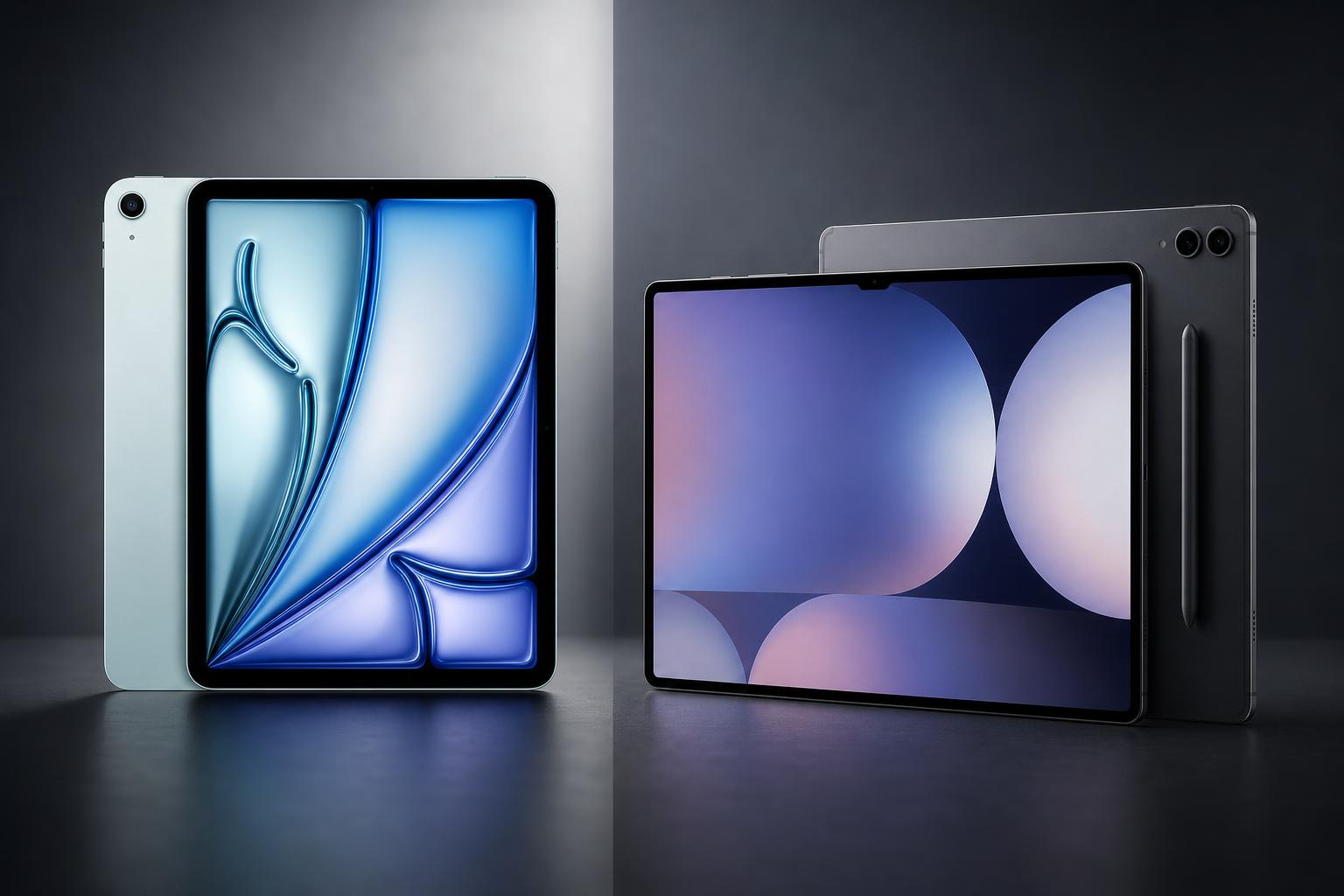
The Apple iPad Air (M4) and Samsung Galaxy Tab S12 Ultra are high-end tablets aimed at different types of buyer. Apple's latest iPad Air combines the M4 processor with a choice of 11-inch or 13-inch displays, while Samsung's flagship tablet focuses on a huge 14.6-inch AMOLED screen, Android multitasking and included S Pen support.
The price difference is substantial. The iPad Air starts at $599 for the 11-inch Wi-Fi model, while the Galaxy Tab S12 Ultra starts at $1,399.99 for 256GB of Wi-Fi storage. Samsung counters with a more advanced display specification, IP68 protection, microSD expansion and a larger battery.
Quick verdict
For most buyers, the Apple iPad Air (M4) is the better choice. It costs considerably less, offers high-end M4 hardware, comes in two useful sizes and benefits from a mature tablet-optimised app ecosystem. The 11-inch version is especially appealing for everyday portability, while the 13-inch model provides more workspace.
The Samsung Galaxy Tab S12 Ultra is the stronger specialist option. Its 14.6-inch Dynamic AMOLED 2X display has a 120Hz refresh rate and much higher rated brightness, and the tablet includes an S Pen. It also offers Samsung DeX, microSD storage, IP68 water and dust resistance and a larger battery. Those features make it attractive for users who want an expansive screen for creative work, multitasking or media consumption and are comfortable paying a premium.
There is no verified, directly comparable benchmark set for these exact tablets, so it would be misleading to name an absolute performance winner. The iPad is better positioned for Apple's pro-app ecosystem, while the Samsung is designed around Android multitasking, DeX and Galaxy AI features.
Key specifications comparison
| Specification | Apple iPad Air (M4) | Samsung Galaxy Tab S12 Ultra |
|---|---|---|
| Sizes | 11-inch or 13-inch | 14.6-inch |
| Display | Liquid Retina IPS; 2360×1640 or 2732×2048; 264ppi; 500 or 600 nits | Dynamic AMOLED 2X; 2960×1848; up to 120Hz; up to 1600 nits peak |
| Processor | Apple M4; 8-core CPU; 9-core GPU; 16-core Neural Engine | 3nm MediaTek Dimensity 9500 |
| Memory and storage | 12GB unified memory; 128GB to 1TB | 12GB or 16GB memory; 256GB to 1TB; microSD up to 2TB |
| Rear cameras | 12MP Wide; up to 5× digital zoom; 4K video up to 60fps | 13MP autofocus plus 8MP ultrawide |
| Front camera | Landscape 12MP Center Stage camera | 12MP ultrawide |
| Battery | 28.93Wh or 36.59Wh; up to 10 hours of Wi-Fi browsing or video playback | 11,600mAh; 45W charging; up to 23 hours of local video playback under Samsung's stated conditions |
| Software | iPadOS with Apple Intelligence support | Android 17 with One UI 9, Samsung DeX and Galaxy AI |
| Stylus | Apple Pencil Pro and Apple Pencil USB-C support; sold separately | S Pen included |
| Starting U.S. Wi-Fi price | $599 for 11-inch; $799 for 13-inch | $1,399.99 for 256GB |
| Weight | 464g for 11-inch Wi-Fi; 616g for 13-inch Wi-Fi | Approximately 692g for Wi-Fi |
Design and build
The iPad Air gives buyers a choice that Samsung does not: an 11-inch model for easier portability or a 13-inch model for a larger working area. Both are 6.1mm thick. The 11-inch Wi-Fi version weighs 464g, while the 13-inch Wi-Fi version weighs 616g. Cellular versions add only a small amount, weighing 465g and 617g respectively.
That size range makes the iPad Air easier to match to a particular use case. The 11-inch version is the more convenient option for reading, travel and general handheld use. The 13-inch model is better suited to users who want more room for documents, creative applications or split-screen work without moving to Samsung's much larger chassis.
Apple offers the iPad Air in blue, purple, starlight and space gray. The tablet includes USB-C with USB 3 transfer speeds up to 10Gb/s, DisplayPort, Touch ID, landscape stereo speakers and dual microphones. Wi-Fi 7 is standard, and optional 5G cellular connectivity is available.
The Galaxy Tab S12 Ultra measures 326.3 × 208.5 × 5.1mm and weighs approximately 692g in its Wi-Fi configuration, or 695g for 5G. It is exceptionally thin for a tablet of this size, but its 14.6-inch body remains considerably less convenient for handheld use than either iPad Air model.
Samsung adds an enhanced Armor Aluminum body and IP68 water and dust resistance. The tablet also has four-speaker spatial audio, USB-C and Wi-Fi 7. Its S Pen is included, which gives it an immediate advantage for buyers who expect to write or draw. The optional Pro Keyboard or Book Cover Keyboard can extend its productivity features, although those accessories are sold separately and can add weight and cost.
Display
The Galaxy Tab S12 Ultra has the stronger display specification. Its 14.6-inch Dynamic AMOLED 2X panel has a 2960 × 1848 resolution, supports refresh rates up to 120Hz and reaches up to 1600 nits peak brightness. Samsung also specifies up to 1000 nits in High Brightness Mode. The combination of AMOLED technology, high brightness and a 120Hz refresh rate gives the Samsung a clear advantage on paper for contrast, motion and large-format viewing.
The iPad Air uses Liquid Retina IPS displays. The 11-inch version has a 2360 × 1640 resolution and 500 nits brightness, while the 13-inch model has a 2732 × 2048 resolution and 600 nits. Both have 264 pixels per inch, P3 wide colour, True Tone, full lamination, an anti-reflective coating and Apple Pencil hover support.
Apple does not specify a 120Hz refresh rate for the iPad Air on the official technical specifications pages provided for this comparison. That means the Samsung has the clearer advantage for buyers who specifically want a high-refresh-rate tablet display.
There are different strengths to the two display approaches. Samsung's panel is much larger and has the more advanced core specification, making it appealing for films, games, multitasking and creative work where a broad canvas matters. Apple's 13-inch iPad Air offers a more manageable alternative with wide colour, True Tone, full lamination and an anti-reflective coating. The 11-inch iPad Air is the better fit when portability matters more than workspace.
Samsung's display should not automatically be treated as better in every environment. Independent review reporting stated that the anti-reflective coating used on the prior generation was not retained, so the AMOLED panel may be more reflective outdoors. This is an important consideration for users who frequently work in bright surroundings.
Performance
The iPad Air is powered by Apple's M4 chip. It has an 8-core CPU, a 9-core GPU, hardware-accelerated ray tracing, a 16-core Neural Engine and 120GB/s memory bandwidth. Every configuration also has 12GB of unified memory. Storage starts at 128GB and extends through 256GB and 512GB options to 1TB.
This is high-end tablet hardware, and it is particularly relevant to buyers who want access to Apple's tablet-optimised creative and professional applications. Apple also includes media engines and hardware-accelerated graphics, giving the iPad documented support for demanding graphics and video workflows.
Samsung uses a 3nm MediaTek Dimensity 9500 processor and an upgraded 3D vapor-chamber cooling system. The tablet is offered with 12GB or 16GB of memory and 256GB, 512GB or 1TB of internal storage. Unlike the iPad Air, it supports microSD expansion up to 2TB.
The Samsung configuration is well suited to users who want Android multitasking, DeX and Galaxy AI features. Its larger memory options and expandable storage are also useful for buyers who keep substantial media libraries or creative files on the tablet.
However, the available research does not provide a directly comparable benchmark set for the M4 iPad Air and Galaxy Tab S12 Ultra. The safest conclusion is therefore use-case based rather than a definitive ranking. Choose the iPad for Apple's pro-app ecosystem and M4-based workflows; choose the Samsung for Android multitasking, DeX and its expandable storage approach.
Camera and graphics features
The iPad Air has a single 12MP f/1.8 Wide rear camera with up to 5× digital zoom. It can record 4K video at up to 60 frames per second. On the front is a landscape 12MP Center Stage camera, which is designed around video calls and keeps the camera position suited to landscape tablet use.
Apple's hardware media engines and hardware-accelerated graphics are relevant to users working with video and other media. The iPad also supports Apple Pencil Pro, which is sold separately and adds a more advanced stylus option to compatible creative workflows.
Samsung takes a more flexible rear-camera approach, with a 13MP autofocus main camera and an 8MP ultrawide camera. The front camera is a 12MP ultrawide unit. This gives the Galaxy Tab S12 Ultra more rear-camera coverage than the iPad Air, particularly for users who value an ultrawide perspective.
Samsung positions the tablet for gaming, 3D rendering, creative work and AI-enabled experiences. The included S Pen is a major practical advantage for sketching, handwritten notes and other stylus-led tasks, because buyers do not need to purchase a separate pen before getting started.
Battery and charging
Apple rates both iPad Air sizes for up to 10 hours of Wi-Fi web browsing or video playback. The 11-inch model has a 28.93Wh battery, while the 13-inch version has a 36.59Wh battery. Apple rates both for up to nine hours when using cellular data.
Samsung equips the Galaxy Tab S12 Ultra with a much larger 11,600mAh battery and support for 45W charging. Samsung rates it for up to 23 hours of local video playback under specified test conditions.
Samsung therefore has the advantage in official battery capacity and in its stated local-video figure. The numbers should not be treated as a direct head-to-head endurance result, however, because Samsung's test conditions differ from Apple's Wi-Fi browsing or video-playback ratings. Actual battery life will also depend on brightness, applications, connectivity and workload.
One cost to factor into the Samsung purchase is that the charger is sold separately. The iPad Air research confirms the battery ratings but does not specify a bundled charger in the supplied information, so buyers should check the relevant configuration before purchase.
Software and features
The iPad Air runs iPadOS and supports Apple Intelligence, subject to language, region and feature availability. It also supports Apple Pencil Pro, Apple Pencil USB-C and Magic Keyboard accessories. Apple offers one external display connection up to 6K at 60Hz, which can be useful for desk-based workflows.
iPadOS remains a central reason to choose the iPad Air. The tablet benefits from a strong tablet-optimised app ecosystem and integration with other Apple devices. That makes it particularly attractive to buyers who already use Apple hardware or who want access to iPad-specific professional and creative applications.
The Galaxy Tab S12 Ultra runs Android 17 with One UI 9. It includes Samsung DeX, Multi Window, Galaxy AI features and S Pen support. Samsung also promises up to seven OS upgrades and seven years of security updates, giving the tablet a clearly stated long-term software support commitment.
DeX is useful for users who want a more desktop-style interface and extensive multitasking. It does not turn Android applications into full desktop equivalents, and some functionality benefits from an external monitor. That distinction matters if the tablet is intended to replace a laptop rather than supplement one.
The Samsung's microSD slot is another practical difference. The iPad Air has fixed internal storage and no expandable microSD option, while the Galaxy Tab S12 Ultra can accept a card of up to 2TB. Buyers with large video, photo or document collections may therefore find Samsung's storage design more flexible.
Price and value
The iPad Air has the most accessible pricing. In the U.S., the 11-inch Wi-Fi model starts at $599 and the 13-inch Wi-Fi model starts at $799. Wi-Fi + Cellular versions start at $749 for 11 inches and $949 for 13 inches. Storage options are 128GB, 256GB, 512GB and 1TB.
The Galaxy Tab S12 Ultra starts at $1,399.99 for the 256GB Wi-Fi model. The 512GB Wi-Fi version costs $1,599.99, while the 1TB Wi-Fi version costs $1,999.99. The charger is sold separately, and the optional keyboard accessories also add to the total cost.
Samsung's premium is not without justification. It buys a 14.6-inch 120Hz AMOLED display, included S Pen, IP68 protection, microSD expansion, four-speaker spatial audio, DeX and the tablet's larger battery. It is a compelling specification for a particular audience, but it is difficult to recommend as the default choice when the iPad Air starts hundreds of dollars lower and includes M4 hardware.
The iPad Air's accessories also require budgeting. Apple Pencil Pro and Magic Keyboard are additional purchases, so the entry price does not represent a complete stylus-and-keyboard workstation. Even so, the iPad remains the better value for most buyers, especially in its $599 11-inch Wi-Fi configuration.
Apple iPad Air (M4): pros and cons
Pros
- M4 processor and 12GB unified memory provide high-end tablet hardware.
- Considerably lower starting price than the Galaxy Tab S12 Ultra.
- Choice of portable 11-inch and roomier 13-inch formats.
- Strong tablet-optimised app ecosystem.
- Supports Apple Pencil Pro, Magic Keyboard, Wi-Fi 7 and one external display up to 6K at 60Hz.
- Apple Intelligence support, subject to language, region and feature availability.
Cons
- IPS display is less contrast-rich than Samsung's AMOLED panel.
- Apple does not specify a 120Hz refresh rate for the display in the supplied technical specifications.
- Apple Pencil Pro and Magic Keyboard cost extra.
- No expandable microSD storage.
- The 11-inch model provides less workspace and lower rated brightness than the 13-inch model.
Samsung Galaxy Tab S12 Ultra: pros and cons
Pros
- Large 14.6-inch AMOLED display with up to 120Hz refresh rate.
- Higher official peak brightness than the iPad Air.
- S Pen included.
- microSD expansion up to 2TB.
- IP68 water and dust resistance.
- Samsung DeX, Multi Window and Galaxy AI features.
- Large 11,600mAh battery and up to 23 hours of local video playback under Samsung's stated conditions.
- Up to seven OS upgrades and seven years of security updates.
Cons
- Much higher starting price than the iPad Air.
- Its 14.6-inch body is cumbersome for handheld use and casual tablet use.
- Keyboard accessories are sold separately and can add weight and cost.
- Charger is sold separately.
- The display may be more reflective outdoors because independent testing reported that the previous generation's anti-reflective coating was not retained.
- DeX does not make Android applications full desktop equivalents, and some functionality benefits from an external monitor.
Which tablet is better for different buyers?
Best for most users: Apple iPad Air (M4)
The iPad Air is the sensible default for most buyers. Its lower price, M4 processor, two size options and mature tablet app ecosystem make it easier to recommend across a wide range of uses. The 11-inch model is the best fit for portability, while the 13-inch model is better for documents, creative applications and a larger working area.
Best for a large-screen media or creative setup: Samsung Galaxy Tab S12 Ultra
The Galaxy Tab S12 Ultra is the better fit for buyers who specifically want a 14.6-inch AMOLED screen, 120Hz refresh rate and high rated brightness. Its included S Pen, dual rear cameras and expandable storage further suit users who want a broad creative canvas without immediately buying a stylus.
Best for Apple pro apps and M4 workflows: Apple iPad Air (M4)
For users invested in Apple's applications and devices, the iPad Air has the stronger platform fit. Its M4 chip, media engines, Apple Pencil Pro support and external-display capability provide a well-defined route into demanding tablet workflows. A definitive benchmark winner over Samsung's processor cannot be verified from the available research, but Apple's app ecosystem is a clear reason to select the iPad.
Best for Android multitasking and DeX: Samsung Galaxy Tab S12 Ultra
Samsung is the better choice for users who prefer Android, want DeX and value Multi Window multitasking. Its microSD slot and higher memory options also make the storage configuration more flexible. Buyers should remember that DeX improves the interface but does not turn every Android application into a full desktop program.
Best for battery claims: Samsung Galaxy Tab S12 Ultra
Samsung wins on the stated battery figures, with an 11,600mAh battery and up to 23 hours of local video playback under its specified conditions. Apple's iPad Air is rated for up to 10 hours of Wi-Fi browsing or video playback. Because the tests differ, this is an indication rather than a directly comparable laboratory result.
Best value: Apple iPad Air (M4)
The 11-inch Wi-Fi iPad Air at $599 is the clear value choice in this comparison. The Galaxy Tab S12 Ultra offers more display technology and several useful extras, but its $1,399.99 starting price places it in a different category. The Samsung makes most sense when its AMOLED display, S Pen, IP68 protection and DeX features are priorities rather than optional extras.
Final verdict
The Apple iPad Air (M4) is the better all-round purchase. It delivers high-end hardware at a far lower starting price, gives buyers two size options and offers the benefits of iPadOS and Apple's tablet app ecosystem. Its main compromises are the IPS display, the lack of expandable storage and the additional cost of the Apple Pencil Pro and Magic Keyboard.
The Samsung Galaxy Tab S12 Ultra is the more ambitious tablet. Its 14.6-inch 120Hz AMOLED display, included S Pen, IP68 rating, microSD expansion, DeX software and larger battery are meaningful advantages. However, its physical size and much higher price mean it is best suited to buyers who specifically need those features.
Choose the iPad Air for value, portability, Apple apps and M4-based workflows. Choose the Galaxy Tab S12 Ultra for the biggest screen, AMOLED contrast, Android multitasking, included stylus support and expandable storage.
FAQs
Is the iPad Air M4 cheaper than the Galaxy Tab S12 Ultra?
Yes. The 11-inch iPad Air starts at $599 for Wi-Fi, while the 13-inch version starts at $799. The Galaxy Tab S12 Ultra starts at $1,399.99 for 256GB of Wi-Fi storage. Samsung offers more premium display and hardware features, but the iPad Air is substantially less expensive.
Which tablet has the better display?
The Galaxy Tab S12 Ultra has the stronger display specification, with a 14.6-inch Dynamic AMOLED 2X panel, up to 120Hz refresh rate and up to 1600 nits peak brightness. The iPad Air uses an IPS display with P3 colour, True Tone, full lamination and an anti-reflective coating. The iPad's 13-inch version is the better choice within Apple's range for workspace.
Does the iPad Air come with an Apple Pencil?
No. The iPad Air supports Apple Pencil Pro and Apple Pencil USB-C, but the supplied research identifies Apple Pencil Pro and Magic Keyboard as additional purchases. The Galaxy Tab S12 Ultra includes an S Pen.
Which tablet has better battery life?
Samsung has the advantage in stated capacity and its official local-video claim: an 11,600mAh battery and up to 23 hours under specified test conditions. Apple rates both iPad Air sizes for up to 10 hours of Wi-Fi web browsing or video playback. The figures use different testing methods and are not directly comparable.
Can the Galaxy Tab S12 Ultra replace a laptop?
It can provide a more desktop-style experience through Samsung DeX and supports extensive multitasking, but DeX does not make Android applications full desktop equivalents. Some functionality benefits from an external monitor. Whether it replaces a laptop will depend on the applications and workflow involved.
Which tablet is better for creators?
The Galaxy Tab S12 Ultra is attractive to creators who want the largest canvas, AMOLED contrast, an included S Pen, expandable storage and dual rear cameras. The iPad Air is preferable for creators invested in iPadOS applications, Apple Pencil Pro and Apple's documented 4K video and media-processing capabilities.
Sources
- Apple introduces the new iPad Air, powered by M4 — Apple
- iPad Air 11-inch (M4) technical specifications — Apple Support
- iPad Air 13-inch (M4) technical specifications — Apple Support
- Samsung introduces Galaxy Tab S12 Series — Samsung Newsroom
- Galaxy Tab S12 Series product page and specifications — Samsung
- Galaxy Tab S12 Ultra purchase page — Samsung