
Apple iPad Pro M5 vs Samsung Galaxy Tab S11 Ultra: Which High-End Tablet Is Better?
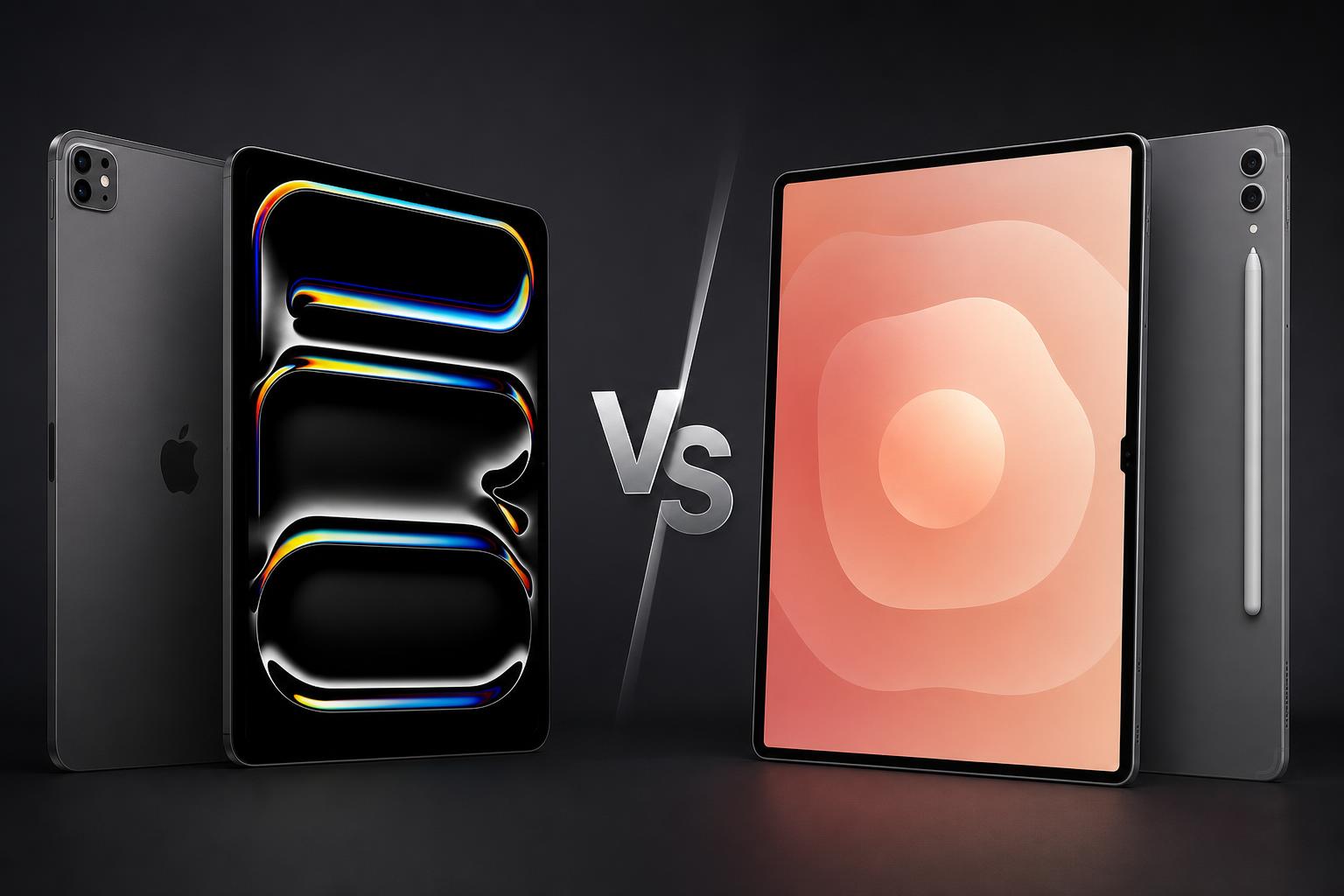
The Apple iPad Pro M5 and Samsung Galaxy Tab S11 Ultra sit at the premium end of the tablet market. Both offer high-refresh-rate OLED displays, flagship-class processors, large storage options and features intended to support more than casual browsing and streaming. They can both serve as creative tools, media devices and laptop alternatives, but they take different approaches.
Apple offers two more portable sizes, a faster M5 platform and a strong professional creative-app ecosystem. Samsung counters with a much larger 14.6-inch display, an included S Pen, microSD expansion, IP68 protection and the desktop-style Samsung DeX interface. Their prices are also close at the entry level, although the accessories required for each tablet differ.
This comparison uses the verified specifications, current listed prices and independent test results in the supplied research.
Quick verdict
The Apple iPad Pro M5 is the better all-round choice for performance, portability, graphics work, professional creative apps and measured battery endurance. Its M5 processor and GPU are substantially faster than the Galaxy Tab S11 Ultra in the available Geekbench 6 and 3DMark testing, and the 11-inch version is notably easier to carry.
The Samsung Galaxy Tab S11 Ultra is the better fit for buyers who want the biggest possible tablet screen, an included stylus, removable storage and IP68 protection. Its 14.6-inch AMOLED display is excellent for split-screen work, films and drawing, but the tablet is large and heavy enough that it is more comfortable on a desk or stand than held for long periods.
In short, choose the iPad Pro M5 for maximum performance and a more flexible choice of sizes. Choose the Galaxy Tab S11 Ultra if screen area, included pen functionality and Android flexibility matter more than benchmark leadership.
Key specifications comparison
| Feature | Apple iPad Pro M5 | Samsung Galaxy Tab S11 Ultra |
|---|---|---|
| Release date | October 22, 2025 | September 4, 2025 |
| Display | 11-inch or 13-inch Ultra Retina XDR tandem OLED; ProMotion | 14.6-inch Dynamic AMOLED 2X; up to 120Hz |
| Resolution | 11-inch: 2420 x 1668; 13-inch: 2752 x 2064 | 2960 x 1848 |
| Processor | Apple M5 | MediaTek Dimensity 9400+ |
| Memory and storage | 12GB with 256GB or 512GB; 16GB with 1TB or 2TB | 12GB with 256GB or 512GB; 16GB with 1TB |
| Rear cameras | 12MP Wide; 4K video and ProRes support | 13MP autofocus wide plus 8MP ultrawide |
| Front camera | 12MP landscape Center Stage camera | 12MP ultrawide |
| Battery | 31.29Wh on 11-inch; 38.99Wh on 13-inch | 11,600mAh typical capacity |
| Charging | Up to 50% in approximately 30 minutes with a compatible 60W-or-higher USB-C adapter | 45W; adapter and 5A cable sold separately |
| Software | iPadOS 26 | Android 16 with One UI 8 |
| Stylus and keyboard support | Apple Pencil Pro, Apple Pencil USB-C and Magic Keyboard support; accessories sold separately | Redesigned S Pen included; Book Cover Keyboard available |
| Weight | 444g Wi-Fi for 11-inch; 579g Wi-Fi for 13-inch | Approximately 689g |
| Starting price verified | From $1,199 for 11-inch Wi-Fi 256GB on the current Apple Store listing | From $1,299.99 for 256GB Wi-Fi on the current Samsung US listing |
Design and build
The iPad Pro M5 gives buyers a choice that the Samsung does not: an 11-inch model or a 13-inch model. The 11-inch version measures 249.7 x 177.5 x 5.3mm and weighs 444g in its Wi-Fi configuration. The 13-inch model measures 281.6 x 215.5 x 5.1mm and weighs 579g for Wi-Fi. Cellular versions add a small amount of weight.
That makes the iPad Pro particularly adaptable. The 11-inch model is the more natural choice for reading, travel and handheld use, while the 13-inch version offers more space for creative work and multitasking without reaching the physical scale of the Samsung tablet. The iPad Pro is available in Silver and Space Black and has four-speaker audio. Wi-Fi 7 and Bluetooth 6 are also supported.
The Galaxy Tab S11 Ultra is thin for such a large tablet, measuring approximately 326.4 x 208.5 x 5.1mm and weighing about 689g. However, its 14.6-inch size makes it substantially larger than either iPad Pro. That extra physical area can be useful when the tablet is placed on a desk, stand or keyboard cover, but it is less convenient for prolonged handheld use.
Samsung uses an Armor Aluminum construction and gives the tablet an IP68 water and dust-resistance rating. That is a meaningful advantage for buyers who value additional protection. The tablet also has quad speakers, a fingerprint sensor and Gray or Silver color options.
From a design perspective, the decision is less about which tablet is thin and more about how much device you want to carry. The Galaxy Tab S11 Ultra offers a larger working surface and durability credentials. The iPad Pro offers greater portability, especially in its 11-inch form, plus more choice over the physical size.
Display
The Galaxy Tab S11 Ultra has the larger screen. Its 14.6-inch Dynamic AMOLED 2X panel runs at up to 120Hz, has a 2960 x 1848 resolution, includes anti-reflection treatment and supports a 1,000-nit high-brightness mode with up to 1,600 nits of peak brightness.
This is the stronger option if screen area is your first priority. The generous 14.6-inch canvas is well suited to split-screen applications, document work, large spreadsheets, drawing and watching films. The anti-reflection treatment should also be helpful in environments where reflections would otherwise distract from the image, although the supplied research does not establish a direct side-by-side reflection test.
The iPad Pro uses an Ultra Retina XDR tandem OLED display in either 11-inch or 13-inch sizes. The 11-inch model has a 2420 x 1668 resolution, while the 13-inch version has a 2752 x 2064 resolution. Both support ProMotion and offer up to 1,000 nits of full-screen brightness and 1,600 nits of peak HDR brightness.
The iPad's tandem OLED approach is especially relevant for HDR content and high-contrast creative work. The available comparison research reports stronger measured HDR brightness for the iPad Pro, while the Samsung provides the larger physical viewing area. The 13-inch iPad Pro is the closer match to the Samsung in terms of productivity space, but the Galaxy Tab S11 Ultra still has a substantial size advantage.
For films and split-screen workflows, Samsung's huge panel is compelling. For HDR work, compact portability and a choice between two sizes, the iPad Pro is more versatile. Both are premium OLED tablets with smooth scrolling, so neither is a compromise on basic display quality.
Performance
Performance is the clearest win for the iPad Pro M5. The Apple M5 is available with a 9-core CPU and 10-core GPU in 256GB and 512GB models. The 1TB and 2TB versions increase the CPU to 10 cores while retaining a 10-core GPU. Memory is 12GB on the 256GB and 512GB models, and 16GB on the 1TB and 2TB configurations.
Independent Geekbench 6 and 3DMark testing cited in the research found higher CPU and GPU performance from the iPad Pro M5 than from the Galaxy Tab S11 Ultra. The difference matters most for demanding workloads such as video editing, graphics-intensive applications, advanced image work and games that can take advantage of the faster graphics hardware. It also gives the iPad Pro more performance headroom for professional use.
The Galaxy Tab S11 Ultra uses the MediaTek Dimensity 9400+. It remains a capable premium tablet for everyday productivity, gaming, web browsing, streaming and multitasking. Its 12GB or 16GB memory configurations are substantial, and Samsung's software features are designed to make use of the large screen. However, the available independent benchmarks place it clearly behind the iPad Pro in raw CPU and GPU performance.
For normal tablet use, the Samsung should not be considered slow. The more relevant question is whether you need the highest performance available. If the answer is yes, the iPad Pro M5 is the stronger purchase. If your work mainly consists of office documents, communication, entertainment and browser-based tasks, the Galaxy Tab S11 Ultra has ample capability while offering a larger canvas.
Camera and graphics
The iPad Pro M5 has a 12MP Wide rear camera with 4K video and ProRes support. Its front camera is a 12MP landscape Center Stage camera, a useful design for video calls when the tablet is positioned horizontally. The M5 also includes a 10-core GPU, and independent testing found substantially stronger graphics performance than on the Galaxy Tab S11 Ultra.
That combination makes the iPad Pro the more convincing choice for video editing, graphics-intensive work and professional creative applications. The camera system is not necessarily the deciding feature for most tablet buyers, but ProRes support and the landscape-oriented Center Stage camera give Apple a clear set of creator and conferencing advantages.
Samsung takes a more flexible rear-camera approach. The Galaxy Tab S11 Ultra has a 13MP autofocus rear camera alongside an 8MP ultrawide rear camera. Its front camera is a 12MP ultrawide unit. The additional ultrawide rear camera is useful when a wider field of view is more important than the iPad's video-focused feature set.
For camera variety, Samsung has the advantage. For video workflows, graphics performance and access to professional creative apps, Apple is the stronger choice. Neither tablet should automatically replace a dedicated camera, but both provide capable hardware for scanning documents, video calls and occasional photography.
Battery and charging
Battery capacity figures are presented differently by the two manufacturers, so the numbers should not be compared directly as though they use the same measurement system. Apple specifies a 31.29Wh battery for the 11-inch iPad Pro and a 38.99Wh battery for the 13-inch model. Apple rates all models for up to 10 hours of web browsing or video playback over Wi-Fi, or up to nine hours on cellular models.
The iPad Pro supports fast charging of up to 50% in approximately 30 minutes when paired with a compatible 60W-or-higher USB-C power adapter. The adapter requirement is worth noting when budgeting for charging accessories.
Samsung lists an 11,600mAh typical-capacity battery for the Galaxy Tab S11 Ultra and supports 45W charging. The 45W adapter and 5A cable are sold separately. The large battery is consistent with the tablet's larger body and display, but capacity alone does not determine endurance.
In Tom's Guide's Wi-Fi web-browsing test, the iPad Pro M5 lasted 13 hours and 16 minutes, compared with 12 hours and three minutes for the Galaxy Tab S11 Ultra. Based on that cited standardized test, the iPad Pro is the battery-life winner, even though the Samsung has the larger stated battery capacity.
Choose Samsung if a large battery rating and a very large display are priorities. Choose Apple if the cited independent browsing result is more important and you want the better measured endurance in this comparison.
Software and features
The iPad Pro M5 runs iPadOS 26 and supports Apple Intelligence, Apple Pencil Pro, Apple Pencil USB-C and Magic Keyboard for iPad Pro. Apple's professional creative-app ecosystem is a major part of the tablet's appeal, particularly for users working with video, graphics, illustration and other demanding content.
There are trade-offs. Apple Pencil Pro and the Magic Keyboard are separate purchases, so the cost of building a complete creative or laptop-style setup is higher than the tablet price alone. iPadOS can also feel less flexible than Android with Samsung DeX for some desktop-style workflows and multitasking preferences.
The Galaxy Tab S11 Ultra runs Android 16 with One UI 8. It includes Samsung DeX, Galaxy AI features and Samsung Notes integration. The redesigned S Pen is included in the box, which gives Samsung an immediate advantage for handwritten notes, annotation and drawing without requiring a separate stylus purchase.
The tablet also supports microSD expansion of up to 2TB. This is a practical feature for users who store large media libraries, project files or downloaded content and prefer removable storage. Samsung's broader Android multitasking approach and DeX can make the tablet feel more computer-like, although Tom's Guide found the redesigned DeX experience less functional than before.
The Book Cover Keyboard is another consideration. The research notes that it lacks a touchpad, which reduces its effectiveness as a complete laptop replacement. Samsung still offers strong productivity features, but neither tablet should be treated as an automatic substitute for a traditional laptop in every workflow.
Price and value
The current Apple Store listing gives the 11-inch Wi-Fi iPad Pro M5 with 256GB storage a starting price of $1,199. The supplied research does not independently verify the current 13-inch price from Apple's listing, so it should not be assumed to match the 11-inch model.
Samsung's current US listing starts at $1,299.99 for the 256GB Wi-Fi Galaxy Tab S11 Ultra. That makes the Samsung's listed starting price $100.99 higher than the verified 11-inch iPad Pro price. Pricing can change, and the two tablets are not identical packages: Samsung includes the redesigned S Pen, while Apple's Pencil Pro and keyboard accessories are separate purchases.
The Galaxy Tab S11 Ultra can therefore represent better value for buyers who specifically want a huge OLED display, included pen functionality, microSD expansion and IP68 resistance. Its strengths are built into the tablet experience rather than requiring as many additional purchases.
The iPad Pro offers better value for buyers who will use its faster M5 performance, stronger graphics capability, professional creative-app ecosystem and more portable 11-inch design. It can also be the more economical choice if you do not need a keyboard or stylus, although creative users should account for the extra cost of Apple accessories.
Apple iPad Pro M5: pros and cons
Pros
- Higher CPU and GPU performance than the Galaxy Tab S11 Ultra in the available independent testing.
- Choice of 11-inch and 13-inch sizes, including a particularly portable 11-inch model.
- Bright, high-contrast tandem OLED display with strong HDR capability.
- Strong professional creative-app ecosystem and Apple Pencil Pro support.
- Longer Wi-Fi browsing endurance than the Samsung in the cited Tom's Guide test.
- 4K video and ProRes support from the rear camera.
Cons
- Apple Pencil Pro and Magic Keyboard accessories are sold separately.
- The 11-inch model has less screen space than Samsung's 14.6-inch tablet.
- iPadOS workflows may feel less flexible than Android with DeX for some users.
- The current verified 13-inch price was not established in the supplied Apple listing research.
Samsung Galaxy Tab S11 Ultra: pros and cons
Pros
- Very large 14.6-inch 120Hz AMOLED display.
- Redesigned S Pen included in the box.
- MicroSD expansion supported up to 2TB.
- IP68 water and dust resistance.
- Large 11,600mAh typical-capacity battery.
- Strong Android multitasking, Samsung DeX and Galaxy AI features.
- More versatile rear-camera setup with wide and ultrawide cameras.
Cons
- Substantially lower CPU and GPU performance than the iPad Pro M5 in the available benchmarks.
- The large body can be uncomfortable for extended handheld use.
- The redesigned DeX experience was found less functional than before in Tom's Guide's review.
- The Book Cover Keyboard lacks a touchpad.
- The 45W charger and 5A cable are sold separately.
Which tablet is better for different buyers?
Best for overall performance
The iPad Pro M5 is the clear choice. Its M5 chip leads the available Geekbench 6 and 3DMark results, making it better suited to demanding creative apps, video editing, advanced graphics and performance-heavy games.
Best for portability
The 11-inch iPad Pro M5 is the better option. It is considerably lighter than the Galaxy Tab S11 Ultra and offers a more manageable size for reading, travel and handheld use. The 13-inch iPad Pro remains portable for its class, but Samsung's tablet is still larger and heavier.
Best for a large-screen workspace
The Galaxy Tab S11 Ultra wins with its 14.6-inch display. It is the strongest fit for buyers who plan to use split-screen apps, draw on a large canvas, watch films or keep the tablet on a desk or stand.
Best for drawing and handwritten notes
The Galaxy Tab S11 Ultra is the more straightforward value choice because the S Pen is included. The iPad Pro supports Apple Pencil Pro and has a strong creative-app ecosystem, but the pencil is an additional purchase.
Best for professional creatives
The iPad Pro M5 is better for video editing, graphics-intensive work and professional creative applications. Its faster GPU, ProRes support and established creative software ecosystem outweigh Samsung's larger display for many professional workloads.
Best for removable storage and durability
The Galaxy Tab S11 Ultra is the clear winner. It supports microSD expansion up to 2TB and carries an IP68 rating, two features the iPad Pro comparison does not match.
Best value
There is no universal winner. Samsung offers more built-in value through the included S Pen, microSD support, IP68 rating and huge display. Apple offers stronger value for buyers who prioritize performance, portability and professional software, particularly if they choose the 11-inch model and do not need Apple's optional accessories.
Final verdict
The Apple iPad Pro M5 is the better high-end tablet for most demanding users. It is faster, more portable in its 11-inch configuration, stronger for graphics and professional creative work, and it lasted longer in the cited Wi-Fi browsing test. Its tandem OLED display also delivers excellent HDR capability, while Apple gives buyers the flexibility to choose between 11-inch and 13-inch designs.
The Samsung Galaxy Tab S11 Ultra is a compelling alternative rather than a weaker version of the same idea. Its 14.6-inch OLED panel is a major advantage for media and split-screen productivity, and the included S Pen, microSD expansion and IP68 protection offer practical value. Android 16, One UI 8 and Samsung DeX also make it attractive to users already invested in Samsung's ecosystem.
Choose the iPad Pro M5 if performance, portability, graphics work and professional apps are your priorities. Choose the Galaxy Tab S11 Ultra if you want the largest display, included pen, removable storage and added resistance to water and dust. Both are premium options, but the iPad Pro is the stronger overall performer while the Samsung is the more feature-rich large-screen productivity tablet.
FAQs
Is the iPad Pro M5 faster than the Galaxy Tab S11 Ultra?
Yes. The available independent Geekbench 6 and 3DMark testing found higher CPU and GPU performance from the iPad Pro M5. The Galaxy Tab S11 Ultra remains capable for everyday productivity, gaming and media, but it is not the performance leader in this comparison.
Which tablet has the larger display?
The Galaxy Tab S11 Ultra has the larger display at 14.6 inches. The iPad Pro M5 is available with an 11-inch or 13-inch Ultra Retina XDR tandem OLED display.
Does the iPad Pro M5 include an Apple Pencil?
No. The iPad Pro M5 supports Apple Pencil Pro and Apple Pencil USB-C, but the research identifies these as separate purchases. Samsung includes the redesigned S Pen with the Galaxy Tab S11 Ultra.
Which tablet has better battery life?
In Tom's Guide's Wi-Fi web-browsing test, the iPad Pro M5 lasted 13 hours and 16 minutes, while the Galaxy Tab S11 Ultra lasted 12 hours and three minutes. Samsung has the larger stated battery capacity, but the iPad Pro delivered the longer result in that cited test.
Can the Galaxy Tab S11 Ultra replace a laptop?
It can support laptop-style tasks through Samsung DeX and an optional Book Cover Keyboard, but it is not a guaranteed replacement for every laptop workflow. The Book Cover Keyboard lacks a touchpad, and the supplied review research found the redesigned DeX experience less functional than before.
Which tablet is better for artists and video creators?
The iPad Pro M5 is the stronger choice for video editing, graphics-intensive work and professional creative apps. The Galaxy Tab S11 Ultra may be preferable for artists who value its much larger canvas and included S Pen.
Sources
- Apple: iPad Pro with M5 technical specifications
- Apple Newsroom: Apple introduces the powerful new iPad Pro with the M5 chip
- Apple Store: iPad Pro listing
- Samsung Newsroom: Samsung unveils Galaxy Tab S11 series
- Samsung: Galaxy Tab S11 Ultra US product listing
- Tom's Guide: Samsung Galaxy Tab S11 Ultra review
- TechRadar: Apple iPad Pro 11-inch M5 review