ROG XBOX Ally X20 vs Lenovo Legion Go SteamOS: Which Handheld PC Is Better?
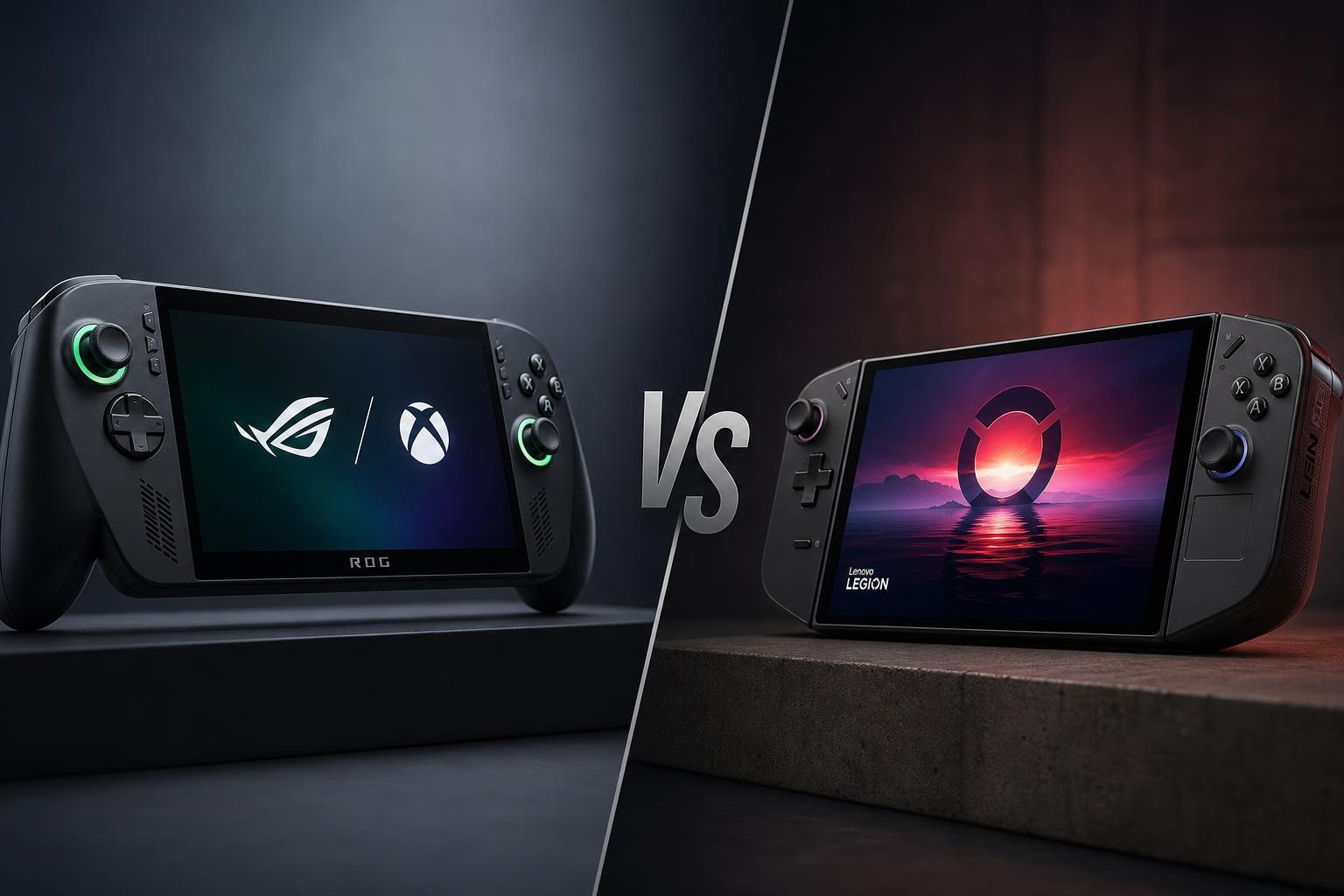
The ROG XBOX Ally X20 and Lenovo Legion Go, Powered by SteamOS are high-end Windows and SteamOS-style gaming handhelds aimed at buyers who want more than a basic portable console. Both are associated with AMD Ryzen Z2 Extreme-class hardware, high-refresh OLED displays and modern wireless connectivity, but they take notably different approaches.
ASUS lists an exact Ryzen AI Z2 Extreme configuration for the ROG XBOX Ally X20, along with 24GB of memory, a 1TB SSD, an 80Wh battery and Windows 11 Home. Lenovo’s Legion Go SteamOS model is announced with configurations of up to a Ryzen Z2 Extreme processor, 32GB of memory and 2TB of storage, but the public announcement does not identify one fixed retail configuration. Lenovo’s US listings also continue to describe the model as coming soon, so its announced price and availability require caution.
This comparison uses the verified specifications and announcements available for both devices. It does not treat the products as independently benchmarked against each other.
Quick verdict
The ROG XBOX Ally X20 is the safer overall choice for most buyers because it has a confirmed $1,299.99 US price, a stated release date of October 15, 2026, and verified availability for purchase. Its Windows 11 software also provides access to Xbox, Steam, Epic Games Store, GOG, mods and other Windows applications. It has the larger rated battery, a clearly specified processor and a lighter body.
The Lenovo Legion Go SteamOS is more compelling for Steam-focused players who value a larger screen, a 144Hz refresh rate and detachable controllers. Its 8.8-inch OLED display is physically larger than the ASUS panel, and the included kickstand and FPS mode give it more flexible control options. However, Lenovo has announced only an estimated $1,199 starting price, its retail price has not been verified, and the US product listing remains marked as coming soon.
There is no verified benchmark evidence establishing a definitive performance winner. The decision therefore comes down to availability, software ecosystem, display priorities, weight, controls and battery capacity.
Key specifications comparison
| Specification | ROG XBOX Ally X20 (2026) RC74XA | Lenovo Legion Go, Powered by SteamOS |
|---|---|---|
| Availability | Released; October 15, 2026 | Announced; US listings state coming soon |
| Price | $1,299.99 USD | $1,199 USD estimated starting price; retail price not verified |
| Display | 7.4-inch FHD OLED touchscreen, 1920x1080, 120Hz, 16:9 | 8.8-inch WUXGA OLED touchscreen, 1920x1200, 144Hz, 16:10 |
| Brightness and colour | 600 nits SDR, 1,400 nits HDR, 100% DCI-P3 | 500 nits SDR typical, 1,100 nits HDR peak, 100% DCI-P3 |
| Processor | AMD Ryzen AI Z2 Extreme, 8 cores, 16 threads, up to 5.0GHz | Up to AMD Ryzen Z2 Extreme; exact SteamOS configuration not specified |
| Graphics | Integrated AMD Radeon RDNA 3.5, 16 compute units | Integrated AMD Radeon graphics; exact GPU model not specified |
| Memory and storage | 24GB LPDDR5X; 1TB PCIe 4.0 NVMe SSD | Up to 32GB LPDDR5X; up to 2TB PCIe SSD |
| Battery | 80Wh; 68W USB-C adapter | 74Wh; Rapid Charge support |
| Operating system | Windows 11 Home, Xbox full-screen interface and Armoury Crate Special Edition | SteamOS |
| Weight | 756g | Approximately 920g with controllers |
| Controls | Transforming D-pad, TMR joysticks, Hall-effect impulse triggers and two assignable rear buttons | Detachable TrueStrike controllers, kickstand and FPS mode with mouse sensor and scroll wheel |
| Wireless | Wi-Fi 6E 2x2 and Bluetooth 5.4 | Wi-Fi 6E and Bluetooth 5.3 |
Design and build
The ROG XBOX Ally X20 uses a conventional fixed-controller handheld design. It measures 300 x 121 x 27.5-51.3mm and weighs 756g. That makes it substantially lighter than the Lenovo model, which weighs approximately 920g with its controllers attached. For players who expect to hold the device for extended sessions, the ASUS model has the clearer advantage on published weight.
ASUS also specifies rubberized grips, a transforming four-way/eight-way D-pad, TMR joysticks, Hall-effect impulse triggers and two assignable rear buttons. The control hardware is unusually extensive on paper. A six-axis IMU and fingerprint sensor are also included. These features position the Ally X20 as a fixed, traditional handheld rather than a small tablet with game controls attached.
The ROG XBOX Ally X20 has a translucent black-and-gold limited-edition design. That is primarily a styling distinction, but it gives the ASUS device a more distinctive appearance than a conventional solid-colour handheld.
Lenovo takes a more modular approach. The Legion Go SteamOS model measures 295.6 x 136.7 x 42.25mm with the controllers attached and includes detachable Legion TrueStrike controllers. A built-in kickstand allows the screen to be supported separately, while FPS mode uses a mouse sensor and scroll wheel for an alternative control setup. Those features can make the Lenovo more adaptable for different play positions and certain mouse-oriented games.
The trade-off is size and weight. The Legion Go is physically heavier and thicker in the listed configuration. Its detachable controls and kickstand offer flexibility, but buyers prioritising a lighter device should favour the ASUS design.
Display
The Lenovo Legion Go has the larger and faster display. Its 8.8-inch WUXGA OLED touchscreen runs at 1920x1200 with a 16:10 aspect ratio and a 144Hz refresh rate. It supports 10-point touch, variable refresh rate, 100% DCI-P3 colour coverage, 500 nits typical SDR brightness and up to 1,100 nits HDR peak brightness. Lenovo also specifies DisplayHDR True Black 1000.
The larger 16:10 panel gives the Lenovo more physical screen area, while its 144Hz maximum refresh rate is higher than ASUS’s 120Hz. Those differences may appeal to players who value a more spacious view or want the highest refresh rate available from these two devices. The actual benefit will depend on the game and the performance settings used; the published specifications alone do not establish frame rates.
The ROG XBOX Ally X20 uses a 7.4-inch FHD OLED touchscreen with a 1920x1080 resolution, 16:9 aspect ratio and 120Hz refresh rate. It covers 100% of the DCI-P3 colour space and specifies 600 nits SDR brightness and 1,400 nits HDR brightness. The panel also includes Dolby Vision HDR, FreeSync Premium Pro, an anti-reflection coating and Gorilla Glass Victus with DXC.
That gives ASUS the higher stated HDR brightness, plus a more extensive list of display features. Dolby Vision and FreeSync Premium Pro are meaningful additions for buyers who care about HDR presentation and variable refresh behaviour. The ASUS screen is smaller, however, and its 16:9 format is less tall than Lenovo’s 16:10 panel.
In short, Lenovo wins on size and refresh rate, while ASUS has the higher specified HDR brightness and more detailed HDR, reflection-control and variable-refresh feature set.
Performance and graphics
ASUS specifies the ROG XBOX Ally X20 with an AMD Ryzen AI Z2 Extreme processor. It has eight cores, 16 threads, a 2.0GHz base frequency, up to 5.0GHz and 24MB of cache. The processor also includes an AMD XDNA NPU rated at up to 50 TOPS. The device has 24GB of onboard LPDDR5X memory and a 1TB PCIe 4.0 NVMe M.2 2280 SSD, with a microSD Express card reader for expansion.
Tom’s Hardware identifies the Ally X20’s integrated graphics as AMD Radeon RDNA 3.5 with 16 compute units. This is the more clearly documented graphics configuration of the two devices in the available research.
Lenovo describes the Legion Go SteamOS model as supporting up to an AMD Ryzen Z2 Extreme processor, with up to 32GB of LPDDR5X memory and up to 2TB of PCIe SSD storage. These are maximum advertised configurations rather than a verified single retail configuration. Lenovo’s public announcement does not specify a single fixed processor configuration for the SteamOS model, and its exact integrated GPU model is not identified in the announcement.
That distinction matters when comparing performance. Both handhelds are associated with Ryzen Z2 Extreme-class hardware, but the information available does not provide directly comparable independent benchmark results for the exact products. It would therefore be misleading to declare one a definitive performance winner based only on the processor family or memory maximum.
The ASUS device has the clearer known configuration: Ryzen AI Z2 Extreme, 24GB memory and 1TB storage. Lenovo may offer higher maximum memory and storage, but buyers should confirm the final retail configuration before treating those maximums as included specifications.
Camera and graphics
Neither handheld is positioned as a camera-focused device. No camera specification was identified for the ROG XBOX Ally X20, while Lenovo specifies no camera for the Legion Go SteamOS model.
For graphics, ASUS has the more specific published information, with integrated AMD Radeon RDNA 3.5 graphics and 16 compute units according to Tom’s Hardware. Lenovo lists integrated AMD Radeon graphics but does not identify the exact GPU model in its public SteamOS announcement. Both are gaming handhelds rather than creator cameras, so buyers choosing between them should focus on display, software and control features rather than imaging hardware.
Battery and charging
The ROG XBOX Ally X20 has an 80Wh, four-cell lithium-ion battery and includes a 68W USB-C AC adapter. Its rated capacity is larger than the Lenovo model’s 74Wh battery, giving ASUS the advantage on battery size.
Lenovo’s Legion Go SteamOS has a 74Wh lithium-ion battery with Rapid Charge support. Lenovo states that the device can reach up to 50% charge in 30 minutes and claims up to 15 hours of local 1080p video playback under its stated test conditions.
The two battery claims should not be treated as directly comparable gaming-runtime figures. Lenovo’s 15-hour statement concerns local video playback under specified test conditions, not a standardised gaming test. No directly comparable official gaming-runtime result was verified for either handheld. Battery life in games will depend on performance settings, screen brightness, refresh rate, wireless use and the software being run.
For capacity alone, the ROG XBOX Ally X20 is the winner at 80Wh versus 74Wh. For published charging information, Lenovo provides the more specific Rapid Charge claim. Buyers who mainly play demanding games should still consider both as performance handhelds whose actual runtime can vary significantly with usage.
Software and features
The ROG XBOX Ally X20 runs Windows 11 Home with an Xbox full-screen interface, Xbox Game Pass integration and Armoury Crate Special Edition. Windows gives it access to a broad PC software environment, including Xbox, Steam, Epic Games Store, GOG, mods and other Windows applications.
That breadth is a major advantage for buyers with games spread across multiple launchers. It also makes the ASUS model more suitable for people who want to install general Windows software or use the handheld beyond a tightly controlled console-style interface. The trade-off is that Windows and its launcher ecosystem can require more setup and navigation on a handheld screen.
The Lenovo model uses SteamOS, with a gamepad-oriented interface, quick suspend and resume, Steam Library access, cloud saves, Steam Chat, centralised notifications, Game Recording and Steam Store access. This gives it a more focused handheld experience for players whose libraries are primarily on Steam.
SteamOS can be simpler for that specific use case, but compatibility is narrower outside the Steam ecosystem. Some non-Steam stores, launchers, multiplayer games and anti-cheat systems may not offer the same compatibility as they do on Windows. That makes the software choice as important as the hardware comparison.
Connectivity is strong on both devices. The ASUS includes Wi-Fi 6E 2x2, Bluetooth 5.4, USB 4 Type-C with DisplayPort 2.1 and power delivery, a second USB 3.2 Gen 2 Type-C port and a 3.5mm audio jack. Lenovo includes Wi-Fi 6E, Bluetooth 5.3, two USB4 Type-C ports with DisplayPort 2.1 and USB Power Delivery, plus a 3.5mm audio jack.
Price and value
The ROG XBOX Ally X20 has a confirmed official price of $1,299.99 in the US and is listed as released on October 15, 2026. Its availability makes the price easier to assess: buyers know what the device costs and can choose it as an immediately purchasable option.
Lenovo has announced an estimated starting price of $1,199 for the Legion Go SteamOS model. That is $100 below the ASUS price on paper, but the figure is not a verified retail price. As of November 8, 2026, Lenovo’s US product listings still identify the SteamOS Gen 2 model as coming soon, and no verified retail launch date was found.
The Lenovo announcement gives buyers more screen, a faster refresh rate, detachable controllers, a kickstand and a maximum memory and storage specification that exceeds ASUS’s listed configuration. The ASUS device counters with confirmed availability, a specified 80Wh battery, a clearly documented processor and graphics configuration, and Windows compatibility across multiple PC gaming ecosystems.
Therefore, Lenovo appears to offer the stronger announced value for Steam-focused buyers, but that value cannot be confirmed until retail availability and final pricing are verified. For a buyer who needs a handheld now, the ASUS price is the more relevant comparison because it is attached to an available product.
ROG XBOX Ally X20: pros and cons
Pros
- Released and available with a confirmed $1,299.99 US price.
- Verified Ryzen AI Z2 Extreme configuration with 24GB memory and 1TB SSD.
- 80Wh battery is larger than Lenovo’s 74Wh battery.
- OLED panel includes 1,400-nit HDR brightness, Dolby Vision, FreeSync Premium Pro and anti-reflection treatment.
- Windows supports Xbox, Steam, Epic Games Store, GOG, mods and other PC software.
- Lighter 756g design with TMR joysticks, a transforming D-pad, impulse triggers and assignable rear buttons.
Cons
- Costs $100 more than Lenovo’s announced estimated starting price.
- Its 7.4-inch screen is smaller and its 120Hz refresh rate is lower than Lenovo’s panel.
- It is a fixed-controller design without detachable controls or a built-in kickstand.
- Windows and multiple launcher ecosystems can require more setup for handheld gaming.
- No camera specification was identified.
Lenovo Legion Go SteamOS: pros and cons
Pros
- Larger 8.8-inch OLED display with 1920x1200 resolution and a 144Hz refresh rate.
- SteamOS provides a handheld-focused interface with quick suspend and resume.
- Detachable controllers, a kickstand and FPS mode offer flexible ways to play.
- Announced maximum configuration reaches 32GB of memory and 2TB of storage.
- Announced estimated starting price is lower than ASUS’s confirmed price.
- Two USB4 Type-C ports provide DisplayPort 2.1 and USB Power Delivery support.
Cons
- US listings still describe the SteamOS Gen 2 model as coming soon.
- No verified retail release date or final retail price was found.
- At approximately 920g with controllers, it is heavier than the ASUS handheld.
- SteamOS has narrower compatibility with some non-Steam stores, launchers, multiplayer games and anti-cheat systems.
- The processor, memory and storage figures are maximum advertised configurations rather than one verified retail configuration.
Which handheld is better for different buyers?
Choose the ROG XBOX Ally X20 if you want broad compatibility
The ASUS model is better for buyers who use several PC game stores or want to install Windows applications. Xbox, Steam, Epic Games Store, GOG, mods and other Windows software are all part of its stated compatibility advantage. It is also the more practical recommendation if you need a product that is available now.
Choose the Lenovo Legion Go SteamOS if you mainly use Steam
The Lenovo model is the more attractive option for a Steam-focused player who values quick suspend and resume, console-like navigation and integrated Steam features. Its larger screen and detachable controllers may also suit buyers who want more flexibility than a conventional fixed-controller handheld provides. Availability remains the major qualification.
Choose the ASUS model for lower weight and larger battery capacity
At 756g, the ROG XBOX Ally X20 is much lighter than the Legion Go’s approximately 920g listed weight. Its 80Wh battery is also larger than Lenovo’s 74Wh unit. These advantages make ASUS the better fit for buyers who prioritise portability and rated battery capacity.
Choose Lenovo for the largest, fastest display
The Legion Go has the larger 8.8-inch panel and higher 144Hz refresh rate. It is the more obvious choice for buyers who want maximum screen size and a 16:10 display. ASUS remains competitive for HDR-focused buyers because it specifies higher HDR brightness, Dolby Vision and FreeSync Premium Pro.
For creators and camera use
Neither device is a camera-focused creator product. The ROG XBOX Ally X20 is the better choice for creators who need Windows applications, while the Lenovo’s larger display, kickstand and detachable controllers may help with desktop-style or accessory-supported workflows. No camera specification was verified for ASUS, and Lenovo specifies no camera.
Final verdict
The ROG XBOX Ally X20 is the stronger recommendation for buyers who want certainty. It is released, has a confirmed $1,299.99 price, offers a clearly specified Ryzen AI Z2 Extreme configuration, includes an 80Wh battery and runs Windows 11 with broad access to PC gaming platforms. Its OLED screen is smaller than Lenovo’s, but it offers higher specified HDR brightness and a robust collection of display features.
The Lenovo Legion Go SteamOS is the more interesting alternative for a particular type of buyer: someone who prioritises SteamOS, a larger 8.8-inch OLED display, a 144Hz refresh rate and detachable controls. Its announced $1,199 starting price could make it attractive, but that value remains provisional while the product is still listed as coming soon and its final retail configuration and price are unverified.
There is no verified benchmark evidence to prove a performance winner. On the information available, choose ASUS for availability, Windows compatibility, lower weight and battery capacity. Choose Lenovo if its SteamOS experience, larger display and modular controls matter more than immediate availability and confirmed specifications.
FAQs
Is the ROG XBOX Ally X20 available now?
Yes. The ROG XBOX Ally X20 is listed as released, with a release date of October 15, 2026, and a confirmed US price of $1,299.99.
How much will the Lenovo Legion Go SteamOS cost?
Lenovo has announced a $1,199 estimated starting price, but the retail price has not been verified. Lenovo’s US listings still describe the SteamOS Gen 2 model as coming soon.
Which has the better display?
Lenovo has the larger and faster display: an 8.8-inch 144Hz OLED panel. ASUS has a smaller 7.4-inch 120Hz OLED display but specifies higher HDR brightness at 1,400 nits, compared with Lenovo’s 1,100-nit HDR peak, as well as Dolby Vision and FreeSync Premium Pro.
Which handheld has the longer battery life?
The ASUS handheld has the larger rated battery at 80Wh, compared with 74Wh for Lenovo. Lenovo publishes up to 15 hours of local 1080p video playback under its stated test conditions, but no directly comparable official gaming-runtime result was verified for either product.
Which is better for Steam games?
The Lenovo Legion Go SteamOS is designed around Steam and includes features such as quick suspend and resume, Steam Library access, cloud saves and Steam Store access. The ASUS model can also run Steam through Windows, while offering broader access to other stores and Windows software.
Which is lighter?
The ROG XBOX Ally X20 is lighter at 756g. The Lenovo Legion Go weighs approximately 920g with its controllers, although it adds detachable controls, a kickstand and an FPS mode.
Sources
- ROG XBOX Ally X20 (2026) RC74XA Gaming Handheld PC — ASUS ROG
- ROG XBOX Ally X20 (2026) RC74XA Tech Specs — ASUS ROG
- ASUS Republic of Gamers Announces Availability of ROG XBOX Ally X20 — ASUS Pressroom
- Lenovo Levels Up CES with Legion Pro Rollable Concept and Latest Gaming Devices — Lenovo StoryHub
- Lenovo Legion Go Gen 2 Product Specifications Reference — Lenovo
- Lenovo Legion product listings
- Asus ROG Xbox Ally X20 Tested: Same Performance, More Comfortable, and a Glorious OLED Screen — Tom’s Hardware