
ROG Strix SCAR 18 (2026) vs Razer Blade 18 (2026): Which Gaming Laptop Is Better?
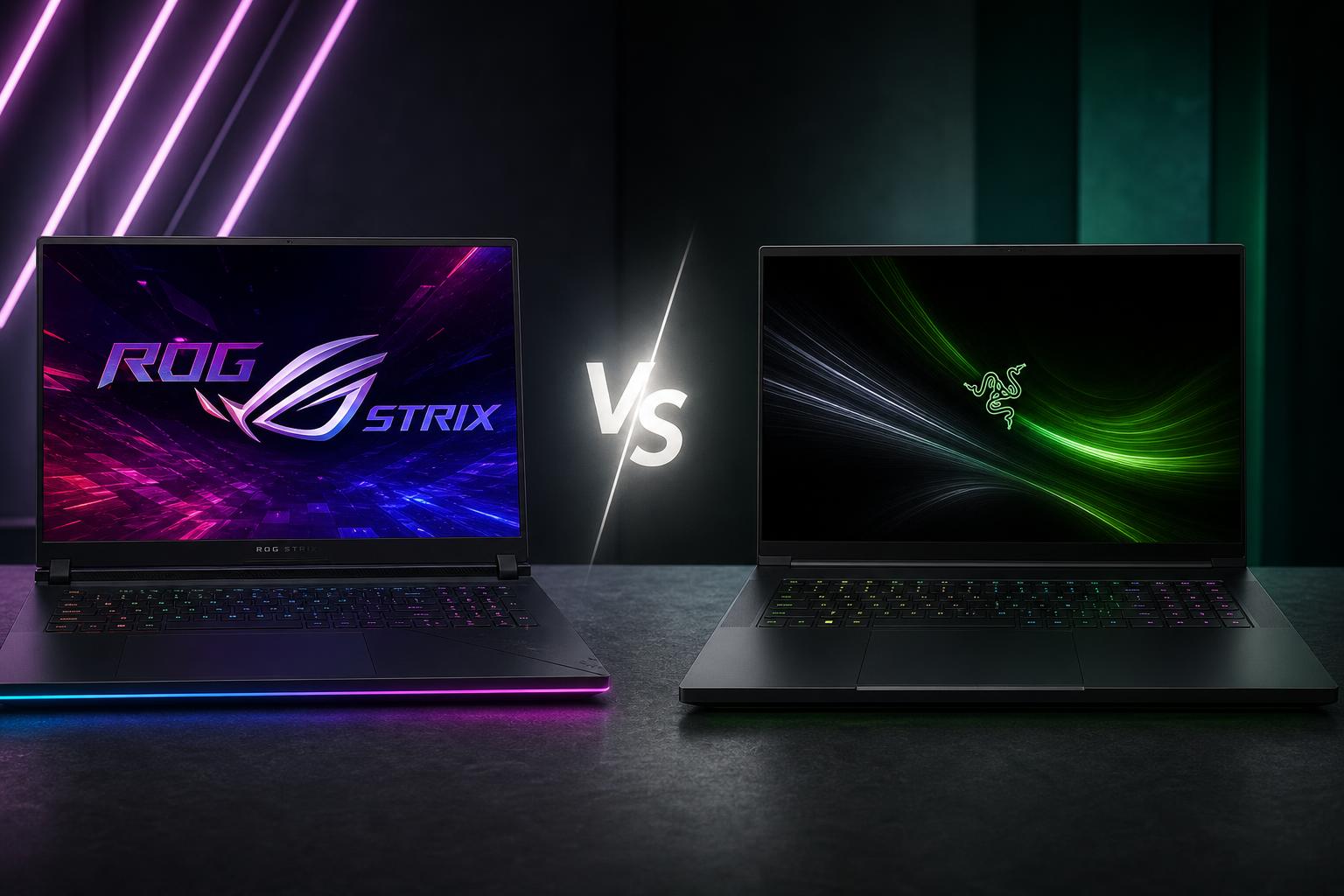
The ROG Strix SCAR 18 (2026) and Razer Blade 18 (2026) are desktop-replacement gaming laptops aimed at buyers who want high-end performance without moving to a desktop PC. Both use Intel’s Core Ultra 9 290HX Plus processor, support up to an NVIDIA GeForce RTX 5090 Laptop GPU and offer 18-inch high-refresh-rate displays. Their priorities are different, however. ASUS puts more emphasis on display technology, power delivery, upgradeability and gaming-focused customisation, while Razer offers a lighter aluminium chassis, a larger battery and a distinctive dual-mode display.
This comparison uses the verified specifications and pricing available from ASUS, Razer and the cited review source. Battery runtime has not been compared because neither product has a verified runtime figure in the supplied research.
Quick verdict
The ROG Strix SCAR 18 (2026) is the stronger choice for buyers who prioritise image quality, HDR, local dimming, sustained system power and upgradeability. Its 4K mini-LED display, up to 175W graphics power and ASUS-advertised 320W total system power give it the more ambitious gaming specification. It also starts at $4,299.99 with an RTX 5080 configuration.
The Razer Blade 18 (2026) is better suited to buyers who want a lighter and more understated 18-inch laptop. It has a 99Wh battery, a 5MP IR webcam with a mechanical privacy shutter, an SD card reader and a display that can switch between 4K at 240Hz and FHD+ at 440Hz. Its $3,999.99 starting price is lower, but that entry configuration uses an RTX 5070 Ti rather than the ASUS starting model’s RTX 5080.
For the best overall combination of display quality and high-end configuration value, the ASUS is the more compelling option. For portability within this large-screen category, camera quality and a less overtly gaming-focused design, the Razer is the better fit.
Key specifications comparison
| Specification | ROG Strix SCAR 18 (2026) | Razer Blade 18 (2026) |
|---|---|---|
| Processor | Intel Core Ultra 9 290HX Plus; 24 cores/24 threads; up to 5.5GHz; NPU up to 13 TOPS | Intel Core Ultra 9 290HX Plus; 24 cores/24 threads; up to 5.5GHz; NPU up to 13 TOPS |
| Graphics options | RTX 5080 Laptop GPU with 16GB GDDR7 or RTX 5090 Laptop GPU with 24GB GDDR7; up to 175W | RTX 5070 Ti with 12GB GDDR7, RTX 5080 with 16GB or RTX 5090 with 24GB; up to 175W on RTX 5080 and RTX 5090 models |
| Display | 18-inch 4K 3840x2400 16:10 mini-LED; 240Hz in Ultimate GPU mode; over 2,000 dimming zones; up to 1,600 nits HDR peak brightness | 18-inch dual-mode IPS; 3840x2400 at 240Hz or 1920x1200 at 440Hz; up to 600 nits |
| Colour specification | 100% DCI-P3; Pantone Validated; Dolby Vision; G-SYNC | Up to 100% DCI-P3; G-SYNC |
| Memory | 32GB DDR5-6400; expandable to 128GB | 32GB DDR5-6400 in the base configuration; expandable to 128GB |
| Storage | 1TB or 2TB PCIe 4.0 NVMe SSD, plus a 2TB+2TB RAID 0 configuration; two M.2 slots | 1TB or 2TB PCIe 4.0 NVMe SSD; two M.2 slots, each supporting up to 8TB according to Razer |
| Webcam | 1080p FHD IR camera with Windows Hello | 5MP IR webcam with Windows Hello and mechanical privacy shutter |
| Battery | 90Wh; 450W AC adapter | 99Wh; up to 100W USB-C charging |
| Weight | 3.70–3.73kg | 3.2kg |
| Wireless and ports | Wi-Fi 7, Bluetooth 5.4, 2.5Gb Ethernet, two Thunderbolt 5, three USB-A, HDMI 2.1 FRL | Wi-Fi 7, Bluetooth 5.4, 2.5Gb Ethernet, Thunderbolt 5 and Thunderbolt 4, three USB-A, HDMI 2.1, UHS-II SD card reader |
| Official starting price | $4,299.99 with the G835LWG-DB96 configuration | $3,999.99 with RTX 5070 Ti, 32GB RAM and 1TB SSD |
Design and build
The two laptops take noticeably different approaches to their physical design. The ROG Strix SCAR 18 is a large, heavy gaming machine measuring 39.9 x 29.8 x 2.35–3.50cm and weighing between 3.70kg and 3.73kg. ASUS gives it an overtly gaming-focused identity through Aura Sync per-key RGB lighting, a light bar and AniMe Vision lighting. Tool-less access is also listed, which should make opening the system for supported internal upgrades more convenient, although the research does not establish the exact process or difficulty.
Razer’s Blade 18 is lighter at 3.2kg and measures 399.96 x 275.4 x 22.79–28.7mm. Razer describes the chassis as precision-milled aluminium, and the design is more understated than the ASUS machine. That does not make it a small laptop: both products have an 18-inch screen and substantial power hardware. The Razer’s lower weight does, however, make it the easier option to carry between locations.
Port selection is strong on both machines. Each includes Wi-Fi 7, Bluetooth 5.4, 2.5Gb Ethernet, three USB-A ports and HDMI 2.1. ASUS lists two Thunderbolt 5 ports, while Razer lists Thunderbolt 5 and Thunderbolt 4. The Blade 18 adds a UHS-II SD card reader, which is a practical advantage for photographers and video users who regularly transfer files from cards.
The design decision is therefore straightforward. Choose the SCAR 18 if customisable lighting, tool-less access and maximum gaming presence matter more than weight. Choose the Blade 18 if you want a more restrained aluminium laptop and value a 500g-plus reduction in weight compared with the ASUS range.
Display
Display technology is the clearest advantage for the ROG Strix SCAR 18. Its 18-inch 16:10 panel has a 3840x2400 4K resolution, mini-LED backlighting, more than 2,000 dimming zones and up to 1,600 nits HDR peak brightness. It also supports 100% DCI-P3 coverage, Pantone Validation, Dolby Vision, G-SYNC, a 3ms response time and ROG Nebula ELMB.
Those specifications give the ASUS the more complete image-quality package on paper. Mini-LED local dimming and the stated HDR peak brightness are particularly important differentiators, while the 16:10 aspect ratio provides the same general productivity-oriented shape as the Razer panel. The 240Hz refresh rate is available in Ultimate GPU mode. ASUS lists 120Hz as the default in other GPU modes, so buyers should not assume that every operating mode delivers 240Hz.
The Razer Blade 18 takes a different route with a dual-mode IPS display. It can run at 3840x2400 and 240Hz, or switch to 1920x1200 and 440Hz. The first mode is designed around high resolution and detail; the second favours an exceptionally high refresh rate for competitive gaming. Razer lists up to 600 nits brightness, up to 100% DCI-P3 coverage and NVIDIA G-SYNC.
Razer’s flexible panel is a meaningful feature rather than a minor specification difference. A user can select a detailed 4K mode for supported games and creative work, then choose FHD+ at 440Hz when prioritising speed. However, the IPS display does not have the ASUS panel’s mini-LED local-dimming capability. Tom’s Hardware also reported that some display-mode changes may require a reboot, so the flexibility may not always be instant.
The ASUS is the better choice for HDR, contrast-focused viewing and colour-sensitive work based on the listed specifications. The Razer is more appealing to competitive players who specifically want a 440Hz mode.
Performance
At the core of both laptops is Intel’s Core Ultra 9 290HX Plus. It has 24 cores and 24 threads, reaches up to 5.5GHz and includes an integrated Intel AI Boost NPU rated at up to 13 TOPS. Since the processor specification is shared, neither laptop has an obvious advantage based on the headline CPU alone.
Graphics configurations overlap at the top end. The SCAR 18 is available with an RTX 5080 Laptop GPU with 16GB of GDDR7 or an RTX 5090 Laptop GPU with 24GB of GDDR7, with up to 175W of GPU power. The Blade 18 offers an RTX 5070 Ti with 12GB of GDDR7, an RTX 5080 with 16GB or an RTX 5090 with 24GB. Razer lists up to 175W TGP for its RTX 5080 and RTX 5090 configurations.
ASUS advertises up to 320W total system power. That makes the SCAR 18 the more performance-focused option based on the available manufacturer specification, particularly for buyers considering the higher graphics configurations. However, identical GPU names do not automatically guarantee identical results in every configuration, and the research does not provide a directly comparable benchmark set for the two laptops.
Tom’s Hardware described the tested Razer configuration as powerful but hot and reported no meaningful performance increase over the previous Blade 18. That is useful context for buyers considering the Razer, but it is not a direct comparison test against the SCAR 18. It also means expectations should remain realistic: a high-end mobile GPU and processor can deliver substantial capability, but the Blade 18’s thermal behaviour is a consideration raised by the cited review.
Both machines support up to 128GB of memory through two memory slots. ASUS uses two DDR5 SO-DIMM slots and lists 32GB DDR5-6400 as a configuration option. Razer also starts at 32GB DDR5-6400 and supports expansion to 128GB through two memory slots.
Storage is upgradeable on both systems through two M.2 slots and PCIe 4.0 NVMe SSDs. ASUS lists 1TB and 2TB options, as well as a 2TB+2TB RAID 0 configuration. Razer lists 1TB or 2TB and says each of its two M.2 slots can support up to 8TB. Neither product is specified with PCIe 5.0 storage; both use PCIe 4.0 in the supplied specifications.
Camera, graphics and creator features
The Razer Blade 18 has the stronger webcam specification. It includes a 5MP IR webcam with Windows Hello and a mechanical privacy shutter. The SCAR 18 has a 1080p FHD IR camera with Windows Hello, which still supports biometric sign-in but has a lower stated resolution and no listed mechanical shutter.
For creators, Razer’s SD card reader is another useful advantage. The display also offers a choice between 4K 240Hz and FHD+ 440Hz, giving the Blade 18 flexibility for both detailed work and high-refresh gaming. ASUS counters with its mini-LED display, 100% DCI-P3 coverage, Pantone Validation, Dolby Vision and higher stated HDR peak brightness. That makes the SCAR 18 the more display-focused option for users who value HDR presentation and local dimming.
At the graphics level, ASUS starts with RTX 5080 in the cited entry model, while Razer offers a less expensive RTX 5070 Ti configuration. Both can reach the RTX 5090 tier, but the final choice depends on the selected GPU, memory and storage configuration.
Battery and charging
Razer has the larger battery: 99Wh compared with 90Wh in the ASUS. On battery capacity alone, the Blade 18 has the advantage. It also supports up to 100W USB-C charging, a useful feature for compatible charging setups.
The SCAR 18 includes a 450W AC adapter, reflecting its high-power design. ASUS does not provide a verified runtime figure in the supplied research, and neither does Razer. As a result, it would be inappropriate to promise longer real-world battery life for the Blade 18 simply because its battery is larger. Screen mode, graphics configuration, power settings and workload can all affect runtime, and those variables have not been tested on a directly comparable basis here.
If battery capacity and USB-C charging flexibility are priorities, the Razer is the better fit. If maximum plugged-in performance is the priority, the ASUS’s large AC adapter and advertised system power are more relevant than its smaller battery.
Software and features
ASUS supplies Armoury Crate for control and configuration. The SCAR 18 also includes Aura Sync per-key RGB, light bar and AniMe Vision lighting, Dolby Atmos, AI noise cancellation and a Copilot key. Windows 11 Home or Windows 11 Pro is available depending on configuration, and ASUS lists a two-month Xbox Game Pass Premium offer.
Razer uses Synapse for performance modes, macros, lighting and audio controls. The Blade 18 includes per-key RGB and THX Spatial Audio+. Razer also lists Windows 11 Home, a one-year laptop warranty and a two-year battery warranty. The Blade’s six-speaker system and the SD card reader add to its broader multimedia and creator-oriented feature set.
Neither software suite is automatically better for every buyer. ASUS offers more visible lighting and gaming customisation, while Razer’s Synapse software covers performance, macros and lighting in a more understated product design. Buyers who prefer minimal visual branding may find the Blade 18 easier to use in mixed work and gaming environments.
Price and value
The ROG Strix SCAR 18 starts at $4,299.99 for the G835LWG-DB96 configuration. ASUS also lists $4,999.99 for the G835LXG-DB96 and $5,299.99 for the G835LXG-XB97. The supplied research identifies official U.S. pricing and availability as configuration-dependent.
The Razer Blade 18 starts at $3,999.99 for a configuration with an RTX 5070 Ti, 32GB of RAM and a 1TB SSD. Razer lists an additional $500 for the RTX 5080 and $900 for the RTX 5090, while moving to 2TB storage adds $900.
The headline starting prices therefore need careful interpretation. Razer is $300 cheaper at the entry point, but its base graphics card is the RTX 5070 Ti. ASUS starts $300 higher with an RTX 5080, making the SCAR 18 the stronger value when comparing the starting configurations by GPU tier rather than by price alone.
At RTX 5090 level, a simple verdict is harder. Storage, operating system, memory and other configuration details differ, and the supplied research does not provide a fully matched price comparison for every combination. Buyers should compare the exact configurations they intend to purchase rather than assuming the lowest listed price represents an equivalent system.
ROG Strix SCAR 18 (2026): pros and cons
Pros
- 4K mini-LED HDR display with more than 2,000 dimming zones.
- 100% DCI-P3 coverage, Pantone Validation and up to 1,600 nits HDR peak brightness.
- Up to RTX 5090 Laptop GPU with up to 175W graphics power.
- ASUS advertises up to 320W total system power.
- Two SO-DIMM slots and two M.2 slots support substantial upgrades.
- Extensive RGB lighting and tool-less access.
- Lower official starting price than the cited RTX 5080 Razer configuration.
Cons
- Heavier than the Razer Blade 18.
- Smaller 90Wh battery.
- 240Hz display operation requires Ultimate GPU mode, with 120Hz listed as the default in other modes.
- Large 450W power adapter and desktop-replacement proportions.
- 1080p webcam is less capable on paper than Razer’s 5MP camera.
Razer Blade 18 (2026): pros and cons
Pros
- Lighter 3.2kg aluminium chassis.
- 99Wh battery and up to 100W USB-C charging.
- Dual-mode screen offers 4K 240Hz or FHD+ 440Hz.
- 5MP IR webcam with Windows Hello and a mechanical privacy shutter.
- UHS-II SD card reader and broad connectivity.
- Less expensive entry configuration.
- More understated design than the ASUS gaming laptop.
Cons
- IPS display lacks ASUS’s mini-LED local dimming.
- RTX 5090 configurations become substantially more expensive.
- Tom’s Hardware reported that its tested system ran hot.
- Uses PCIe 4.0 SSD storage rather than PCIe 5.0.
- Some display-mode changes may require a reboot, according to Tom’s Hardware.
Which laptop is better for different buyers?
For maximum gaming performance
The ROG Strix SCAR 18 is the stronger pick based on ASUS’s advertised up to 320W total system power and up to 175W GPU power. Both laptops can use the Core Ultra 9 290HX Plus and RTX 5090 Laptop GPU, so the difference is not absolute, but ASUS’s power specification points more clearly toward sustained high-end gaming use.
For display quality and HDR
Choose the ROG Strix SCAR 18. Its mini-LED panel, local dimming, 1,600-nit HDR peak specification, 100% DCI-P3 coverage and Dolby Vision support give it the more advanced display specification.
For competitive gaming
The Razer Blade 18 is the more interesting option if a 440Hz mode is important. Its FHD+ 1920x1200 mode is designed for very high refresh rates, while the ASUS offers 240Hz in Ultimate GPU mode.
For portability
The Razer Blade 18 is the clear choice. It weighs 3.2kg, compared with 3.70–3.73kg for the ASUS, and has a slightly thinner maximum thickness.
For camera use and creators
The Razer is better for webcam quality and memory-card workflows because it has a 5MP IR webcam, a mechanical privacy shutter and a UHS-II SD card reader. Choose the ASUS instead if HDR, mini-LED contrast and the listed colour features are more important than the camera.
For upgradeability
Both laptops support up to 128GB of memory and have two M.2 storage slots. ASUS adds tool-less access and a listed 2TB+2TB RAID 0 configuration, while Razer states that each M.2 slot can support up to 8TB. Both are strong choices for buyers who want more than fixed, non-upgradeable hardware.
Final verdict
The ROG Strix SCAR 18 (2026) and Razer Blade 18 (2026) are aimed at different interpretations of the premium 18-inch gaming laptop. ASUS delivers the more ambitious gaming package: its mini-LED HDR display is substantially more advanced on paper, its top graphics options overlap with Razer’s, and its advertised 320W total system power supports its performance-first positioning. The starting RTX 5080 configuration also makes its official entry price look strong against Razer’s RTX 5070 Ti base model.
Razer’s answer is more balanced and portable. The Blade 18 is lighter, has a larger battery, includes a better-specified webcam and adds an SD card reader. Its dual-mode display is also unique, offering either 4K at 240Hz or FHD+ at 440Hz. Its main compromises are the lack of mini-LED local dimming, the higher cost of upper graphics configurations and the heat noted in the cited review.
For most buyers seeking the best high-end specification, the ROG Strix SCAR 18 (2026) is the winner. The Razer Blade 18 (2026) is the better alternative if reduced weight, a more discreet aluminium design, camera quality, SD card support or the 440Hz mode matters more than HDR display performance and maximum advertised system power.
FAQs
Which is cheaper, the ROG Strix SCAR 18 or Razer Blade 18?
The Razer Blade 18 has the lower official starting price at $3,999.99, compared with $4,299.99 for the ASUS. However, the Razer entry model uses an RTX 5070 Ti, while the cited ASUS starting configuration uses an RTX 5080, so the prices are not directly equivalent by graphics tier.
Which laptop has the better display?
The ROG Strix SCAR 18 has the stronger display specification for HDR and image quality. It uses a 4K mini-LED panel with more than 2,000 dimming zones, up to 1,600 nits HDR peak brightness and 100% DCI-P3 coverage. Razer’s advantage is its ability to switch between 4K 240Hz and FHD+ 440Hz.
Which has the better graphics options?
Both can be configured with an RTX 5090 Laptop GPU with 24GB of GDDR7. Razer also offers an RTX 5070 Ti entry configuration, while ASUS’s cited starting model uses an RTX 5080. ASUS and Razer both list up to 175W for applicable high-end GPU configurations.
Which is lighter?
The Razer Blade 18 weighs 3.2kg. The ROG Strix SCAR 18 weighs between 3.70kg and 3.73kg, making the Razer the more portable of the two, although both remain large 18-inch laptops.
Which has the larger battery?
The Razer Blade 18 has a 99Wh battery, compared with 90Wh for the ROG Strix SCAR 18. Neither product has a verified runtime figure in the supplied research, so the larger capacity should not be treated as a guaranteed runtime result.
Which is better for streaming and video calls?
The Razer Blade 18 has the stronger camera specification, with a 5MP IR webcam, Windows Hello and a mechanical privacy shutter. The ASUS has a 1080p FHD IR camera with Windows Hello.