
Apple Watch Ultra 4 vs Samsung Galaxy Watch9: Which Smartwatch Is Better?
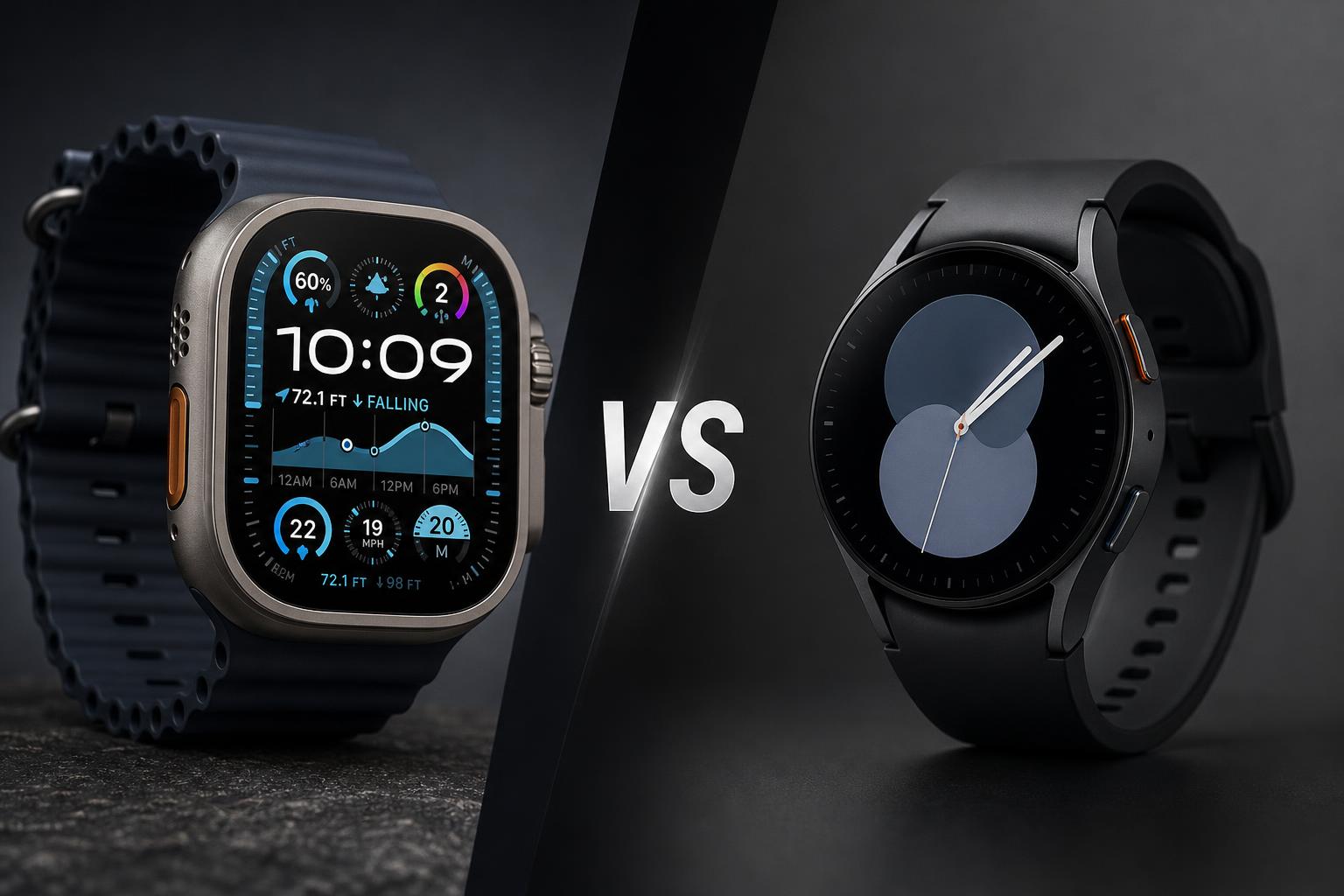
The Apple Watch Ultra 4 and Samsung Galaxy Watch9 target different kinds of smartwatch buyer. Apple’s model is a larger, more rugged watch with a titanium case, satellite connectivity, diving features and the longest published battery figures of the two. Samsung’s Galaxy Watch9 is a more affordable and slimmer alternative, available in two case sizes and designed for eligible Android phones.
The choice is therefore less about finding one universal winner and more about matching the watch to your phone, budget and priorities. This comparison looks at the verified specifications, features, battery information and pricing for both models.
Quick verdict
The Apple Watch Ultra 4 is the stronger choice for iPhone owners who want a rugged outdoor smartwatch with a titanium case, 64GB of storage, satellite connectivity, diving support and longer published battery-life figures. It also offers a broader set of outdoor, safety and health features, but it starts at a much higher price and is substantially larger and heavier.
The Samsung Galaxy Watch9 is the better-value option for most Android users. It starts at $379.99, comes in 40mm and 44mm sizes, is thinner and lighter than the Apple model, and includes Wear OS 7, Google Gemini and Samsung Health features. However, some health features require a Samsung smartphone, and its published battery information is less comparable with Apple’s normal-use and workout claims.
Key specifications comparison
| Specification | Apple Watch Ultra 4 | Samsung Galaxy Watch9 |
|---|---|---|
| Release date | September 18, 2026 | August 7, 2026 |
| Starting price | From $799 in the U.S. | From $379.99 for 40mm Bluetooth |
| Case options | 49mm; natural or black Grade 5 titanium | 40mm or 44mm aluminum |
| Weight | 63.0g natural titanium; 63.1g black titanium | 31.5g for 40mm; 34.0g for 44mm |
| Display | Always-On Retina wide-angle OLED LTPO3; 422 x 514 pixels; up to 3,000 nits | Super AMOLED Always-On display; 438 x 438 pixels on 40mm or 480 x 480 pixels on 44mm; up to 3,000 nits |
| Processor | Apple S11; 64-bit dual-core processor and 4-core Neural Engine | Qualcomm Snapdragon Wear Elite Platform; 3nm, 5-core processor |
| Storage and memory | 64GB capacity | 2GB memory and 32GB storage |
| Battery information | Up to 50 hours normal use; up to 84 hours Low Power Mode; up to 45 hours Max Extended Workout tracking | 390mAh for 40mm; 445mAh for 44mm; up to 30 hours with Always-On Display enabled for 40mm |
| Charging | About 45 minutes to reach 80% | Up to 80 minutes for 40mm; up to 90 minutes for 44mm |
| Software | watchOS, Apple Intelligence and Siri AI features | Wear OS 7 powered by Samsung, One UI 9 Watch and Google Gemini |
| Phone compatibility | iPhone 11 or later, including iPhone SE 2nd generation or later, with iOS 27 or later | Android 13 or higher with more than 1.5GB memory and Google Mobile Services |
| Connectivity | Cellular, satellite connectivity and 5G capability | Bluetooth, Wi-Fi, NFC and GPS; LTE variants available |
| Durability and outdoor features | Titanium case, recreational diving to 40m, water temperature sensor and Action button | 5ATM, IP68 and MIL-STD-810H durability |
Design and build
Apple Watch Ultra 4
The Apple Watch Ultra 4 is the more substantial watch of the two. Its case measures 49mm high, 44mm wide and 12mm deep, and weighs 63.0g in natural titanium or 63.1g in black titanium. The Grade 5 titanium case is available in natural and black finishes.
This larger construction is central to the Ultra 4’s identity. It accommodates a bigger physical design and a feature set aimed at outdoor use, including an Action button, cellular and satellite connectivity, a water temperature sensor and recreational diving support to 40m. Apple also lists ECG, blood oxygen, sleep apnea and hypertension notifications among the health and safety features.
The trade-off is size and weight. The Ultra 4 is larger and heavier than either Galaxy Watch9 option, so buyers who prefer a compact watch should consider that carefully. It may also feel less suitable for users who want a discreet everyday wearable, although the verified specifications do not establish how either watch feels in use.
Samsung Galaxy Watch9
Samsung offers the Galaxy Watch9 in two sizes: 40mm and 44mm. The 40mm model measures 42.7 x 40.4 x 8.6mm and weighs 31.5g, while the 44mm version measures 46.0 x 43.7 x 8.6mm and weighs 34.0g. Both are considerably lighter and thinner than the Apple Watch Ultra 4.
The case is aluminum rather than titanium. The 40mm model comes in Cream and Graphite, while the 44mm model is available in Silver and Graphite. Samsung lists 5ATM, IP68 and MIL-STD-810H durability, along with Bluetooth, Wi-Fi, NFC and GPS. LTE versions are also available.
The two-size approach gives Samsung an advantage for buyers who want more choice over the physical fit. The 40mm model is the smaller option, while the 44mm model offers a larger screen and a higher-capacity battery. The lighter aluminum design also makes the Galaxy Watch9 the more straightforward choice for anyone prioritizing low weight.
Display
Both watches have always-on displays with brightness ratings of up to 3,000 nits. That headline figure means the two models are specified for strong outdoor visibility, although the research does not provide directly comparable real-world visibility testing.
The Apple Watch Ultra 4 uses an Always-On Retina wide-angle OLED LTPO3 display with a resolution of 422 x 514 pixels and a pixel density of 326 ppi. It has a flat sapphire crystal cover and can reduce brightness to 1 nit at minimum.
Samsung uses a Super AMOLED full-color Always-On display. The 40mm Galaxy Watch9 has a 1.34-inch panel with 438 x 438 pixels, while the 44mm version has a 1.47-inch panel with 480 x 480 pixels. Both use sapphire crystal.
There is no simple resolution winner because the watches use different display shapes and layouts. Apple provides a taller 422 x 514-pixel panel, while Samsung uses square 438 x 438 and 480 x 480 displays. The 44mm Galaxy Watch9 gives buyers the largest stated Samsung display, while the Ultra 4 offers a larger overall rugged watch format and a wide-angle OLED panel.
Performance
Apple Watch Ultra 4 is powered by the Apple S11 chip, which includes a 64-bit dual-core processor and a 4-core Neural Engine. Samsung’s watch uses Qualcomm’s Snapdragon Wear Elite Platform, described as a 3nm, 5-core processor.
Both manufacturers position their processors as supporting responsive smartwatch performance, but no directly comparable benchmark results were verified for this comparison. It would therefore be misleading to declare one processor the performance winner based only on the core descriptions.
Storage is a clearer difference. Apple provides 64GB of capacity, twice the Galaxy Watch9’s 32GB storage. Samsung lists 2GB of memory in addition to that storage. The Ultra 4’s larger capacity may matter to buyers who plan to keep more apps or locally stored media on the watch, although the available research does not specify how much storage the operating system reserves.
Camera and graphics
Neither Apple nor Samsung lists a camera specification for these watches. Neither product should therefore be treated as a camera watch, and there is no verified camera comparison to make.
The Apple Watch Ultra 4 does offer more storage than the Galaxy Watch9, which may be useful for locally stored media and apps. However, that is a storage advantage rather than a camera advantage. No separate graphics specification was provided for either model, so this comparison does not make claims about graphics performance.
Battery and charging
Apple Watch Ultra 4 battery
Apple publishes up to 50 hours of normal use for the Watch Ultra 4. It also lists up to 84 hours in Low Power Mode and up to 45 hours of Max Extended Workout tracking. Charging to 80% takes about 45 minutes.
These are the longest published battery-life figures in this comparison, particularly for normal use and extended workout tracking. The results will depend on usage and settings, and Apple’s different operating modes should not be confused with a single guaranteed runtime for every user.
Galaxy Watch9 battery
The Galaxy Watch9 has a 390mAh battery in the 40mm model and a 445mAh battery in the 44mm model. Samsung lists up to 30 hours with Always-On Display enabled for the 40mm version. Charging is listed as taking up to 80 minutes for the 40mm model and up to 90 minutes for the 44mm model.
The larger 44mm model has the higher battery capacity, but Samsung’s verified information does not provide an equivalent normal-use figure for that version in the supplied research. This means the battery claims are not directly comparable with Apple’s figures: the manufacturers report different capacities, models, modes and usage conditions.
Even with that qualification, the published information gives Apple the clearer battery advantage for buyers focused on longer normal-use and workout figures. Samsung may still appeal to users who prefer the 44mm case and its 445mAh battery, but the supplied data does not establish a direct runtime winner for every use pattern.
Software and features
Apple ecosystem and outdoor tools
Apple Watch Ultra 4 runs watchOS and supports Apple Intelligence and Siri AI features. It requires an iPhone 11 or later, including the iPhone SE 2nd generation or later, running iOS 27 or later.
Its feature list is particularly broad for outdoor and safety use. The verified specifications include cellular and satellite connectivity, 5G capability, an Action button, recreational diving to 40m and a water temperature sensor. Health features include ECG, blood oxygen, sleep apnea and hypertension notifications. Apple also highlights integration with Apple Health and watchOS apps.
This makes the Ultra 4 a focused option for iPhone users who want more than notifications and basic fitness tracking. Satellite connectivity and diving support are significant differentiators in the specification list, although the supplied research does not detail the exact operating conditions or regional availability of those features.
Samsung health and Android compatibility
Galaxy Watch9 runs Wear OS 7 powered by Samsung with One UI 9 Watch. It includes Google Gemini features and Samsung Health features, including sleep and health insights. The watch is compatible with Android 13 or higher devices that have more than 1.5GB of memory and Google Mobile Services.
That broader Android compatibility gives Samsung a major platform advantage over Apple, whose watch requires a compatible iPhone. However, Samsung notes that some health features require a Samsung smartphone. Android users should therefore check whether the health functions they want are supported by their particular phone before buying.
The Galaxy Watch9 also offers the familiar smartwatch connectivity essentials listed in the research: Bluetooth, Wi-Fi, NFC and GPS. LTE versions are available for buyers who want cellular connectivity, though the supplied information does not specify LTE pricing beyond the official starting prices listed below.
Price and value
The Apple Watch Ultra 4 starts at $799 in the U.S. That price places it well above the Galaxy Watch9 range, but it includes a titanium case, 64GB capacity, satellite connectivity, 5G capability, diving support and the larger published battery figures.
Samsung’s entry point is much lower. The Galaxy Watch9 starts at $379.99 for the 40mm Bluetooth model. The 44mm Bluetooth version starts at $409.99. LTE models start at $429.99 for 40mm and $459.99 for 44mm.
The price gap means the Galaxy Watch9 is the value choice on the supplied figures. It provides two sizes, Android compatibility, Wear OS 7, Google Gemini, Samsung Health features and a sapphire crystal display at a substantially lower starting price. It also avoids the Ultra 4’s larger and heavier form factor.
Apple’s higher price is easier to justify for buyers who specifically need or value the combination of titanium construction, satellite connectivity, diving features, greater storage, deeper iPhone integration and longer published battery claims. Those features make it a specialist outdoor and safety-focused purchase rather than a direct low-cost alternative to Samsung’s standard smartwatch.
Apple Watch Ultra 4: pros and cons
Pros
- Longest published normal-use and extended-workout battery figures of the two watches.
- Grade 5 titanium case with natural and black finish options.
- Extensive outdoor, health, safety and diving features.
- Satellite connectivity, 5G capability, Action button and water temperature sensor.
- 64GB capacity, compared with 32GB storage on Galaxy Watch9.
- Strong integration with iPhone, Apple Health, Apple Intelligence and watchOS apps.
Cons
- Starts at a much higher price than Galaxy Watch9.
- Works only with compatible iPhones.
- Larger and heavier than both Galaxy Watch9 sizes.
- Apple does not specify a camera for the product.
Samsung Galaxy Watch9: pros and cons
Pros
- Much lower starting price than Apple Watch Ultra 4.
- Available in 40mm and 44mm sizes.
- Lighter and thinner than Apple’s rugged watch.
- Compatible with eligible Android phones.
- Includes Wear OS 7, One UI 9 Watch, Google Gemini and Samsung Health features.
- LTE versions are available, with Bluetooth, Wi-Fi, NFC and GPS listed.
Cons
- 32GB storage is smaller than the Apple Watch Ultra 4’s 64GB capacity.
- Some health features require a Samsung smartphone.
- Battery capacity and official usage figures vary by size and are not directly comparable with Apple’s claims.
- Samsung does not specify a camera for the product.
Which watch is better for different buyers?
Best for iPhone owners
The Apple Watch Ultra 4 is the clear fit for iPhone owners who want the broader feature set in this comparison. It requires an iPhone, but its watchOS, Apple Health, Siri AI and Apple Intelligence integration are designed around that ecosystem. The Ultra 4 is particularly compelling if you also want satellite connectivity, advanced outdoor features or diving support.
Best for Android owners
The Samsung Galaxy Watch9 is the practical choice for Android users because it supports Android 13 or higher phones that meet Samsung’s memory and Google Mobile Services requirements. Buyers with a Samsung phone may also be better placed to access the full range of compatible health features.
Best for value
Choose the Galaxy Watch9 if price is the main consideration. Its $379.99 starting price is less than half the Apple Watch Ultra 4’s $799 starting price, while still providing a full smartwatch platform, health features, GPS and a choice of case sizes.
Best for battery-focused buyers
Apple Watch Ultra 4 has the stronger published battery figures, with up to 50 hours of normal use and up to 45 hours of Max Extended Workout tracking. Galaxy Watch9 buyers may prefer the 44mm model because it has a 445mAh battery, but Samsung’s published usage information is reported differently and does not provide a directly equivalent figure in the supplied research.
Best for outdoor and diving features
The Apple Watch Ultra 4 is the stronger option for outdoor-focused buyers. Its verified feature list includes satellite connectivity, recreational diving to 40m, a water temperature sensor, an Action button and extensive health and safety functions. Galaxy Watch9 has useful durability ratings, but the supplied specifications do not list equivalent diving or satellite features.
Best for a smaller or lighter watch
Galaxy Watch9 is better suited to buyers who want a smaller or lighter design. The 40mm model weighs 31.5g and measures 8.6mm deep, while the 44mm model weighs 34.0g. Both are lighter and thinner than the 63g, 12mm-deep Apple Watch Ultra 4.
Best for creators or camera features
Neither watch is a camera product, and neither manufacturer lists a camera specification. If local storage matters for apps or media, Apple has the advantage with 64GB versus Samsung’s 32GB, but there is no verified camera winner.
Final verdict
The Apple Watch Ultra 4 is the more capable and feature-rich option on paper. Its titanium case, larger storage capacity, satellite connectivity, diving support, outdoor controls and longer published battery figures make it the better choice for iPhone users who want a rugged specialist smartwatch. The downside is its $799 starting price, larger dimensions and exclusive compatibility with iPhone.
The Samsung Galaxy Watch9 is the better buy for most shoppers who use Android or want to spend less. It is available in two sizes, weighs considerably less, offers a modern Wear OS platform and starts at $379.99. The 44mm version also provides a larger battery than the 40mm model, while LTE configurations give buyers additional connectivity choice.
In short, choose Apple Watch Ultra 4 for the strongest outdoor, safety, storage and battery specification, provided you use an iPhone and can justify the price. Choose Samsung Galaxy Watch9 for lower cost, lighter design, Android compatibility and better overall value.
FAQs
Is Apple Watch Ultra 4 compatible with Android phones?
No. The verified requirements state that Apple Watch Ultra 4 requires an iPhone 11 or later, including iPhone SE 2nd generation or later, with iOS 27 or later.
Is Samsung Galaxy Watch9 compatible with iPhone?
The supplied specifications list compatibility with Android 13 or higher devices with more than 1.5GB of memory and Google Mobile Services. They do not list iPhone compatibility, so iPhone buyers should not assume that Galaxy Watch9 will provide the same support.
Which watch has better battery life?
Apple Watch Ultra 4 has the stronger published figures: up to 50 hours of normal use, up to 84 hours in Low Power Mode and up to 45 hours of Max Extended Workout tracking. Samsung reports up to 30 hours with Always-On Display enabled for the 40mm Galaxy Watch9. Because the manufacturers use different test conditions and reporting methods, the figures are not perfectly comparable.
Which smartwatch is cheaper?
Samsung Galaxy Watch9 is cheaper. The 40mm Bluetooth model starts at $379.99, compared with $799 for Apple Watch Ultra 4. Samsung also lists the 44mm Bluetooth model at $409.99 and LTE models from $429.99 for 40mm and $459.99 for 44mm.
Does either watch have a camera?
Neither manufacturer lists a camera specification for these products. They should not be chosen as camera watches. Apple Watch Ultra 4 does have more storage, with 64GB compared with 32GB on Galaxy Watch9.
Sources
- Apple Watch Ultra 4 Technical Specifications — Apple
- Apple unveils Apple Watch Ultra 4 — Apple Newsroom
- Shop Apple Watch Ultra 4 — Apple
- Discover the Galaxy Watch9 Smartwatch Features — Samsung
- Samsung Galaxy Watch Ultra2 and Watch9: Your Health Companion on the Wrist — Samsung Newsroom
- Buy the Samsung Galaxy Watch9 40mm Bluetooth — Samsung