
Apple Watch SE 3 vs Samsung Galaxy Watch9: Which Smartwatch Should You Buy?
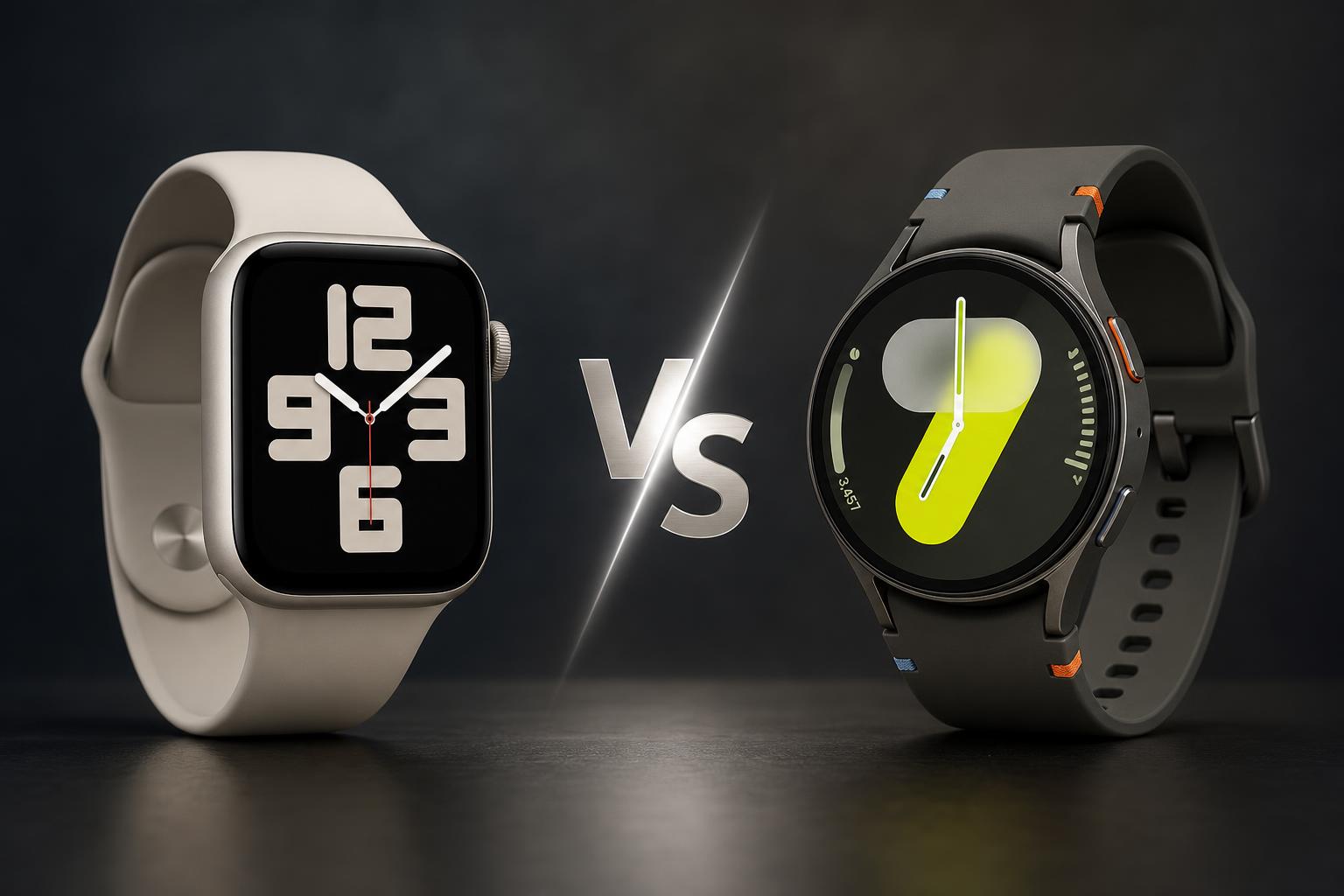
The Apple Watch SE 3 and Samsung Galaxy Watch9 take different approaches to the modern smartwatch. Apple focuses on a relatively accessible price, close iPhone integration and a broad collection of safety and fitness tools. Samsung asks more, but counters with a brighter display, a larger stated battery endurance, Android compatibility and a wider selection of documented health sensors.
The right choice depends first on the phone you use. The Apple Watch SE 3 requires a compatible iPhone, while the Galaxy Watch9 requires a compatible Android device and some of its health features work only with Samsung Galaxy phones. Once that is settled, display quality, battery expectations, health features and price become the main points of comparison.
Quick verdict
For iPhone owners, the Apple Watch SE 3 is the better-value choice. It starts at $249 in the United States, has an Always-On Retina OLED display, includes 64GB of capacity and offers features such as sleep tracking, fall detection, crash detection and irregular-rhythm notifications. Its main compromise is the shorter official battery rating of up to 18 hours in normal use.
For Android owners, the Samsung Galaxy Watch9 is the more versatile option. It offers a sapphire-crystal Super AMOLED display rated for up to 3,000 nits, 2GB of RAM, 32GB of storage and an official battery estimate of approximately 40 hours with the Always-On Display off. It also adds features such as body composition, ECG, blood-pressure tracking, sleep coaching and Google Gemini integration. However, it costs considerably more, and some health features require a Samsung Galaxy phone or depend on regional availability.
There is no universal winner. Choose the Apple Watch SE 3 for the lower entry price and Apple ecosystem integration. Choose the Galaxy Watch9 for Android compatibility, a brighter display, more explicitly documented memory and longer stated battery life.
Key specifications comparison
| Specification | Apple Watch SE 3 | Samsung Galaxy Watch9 |
|---|---|---|
| Release date | September 19, 2025 | August 7, 2026 |
| Starting price | From $249 in the United States | $379.99 for 40mm Bluetooth |
| Case sizes | 40mm and 44mm | 40mm and 44mm |
| Display | Always-On Retina OLED LTPO; up to 1,000 nits; Ion-X front glass | Sapphire-crystal Super AMOLED; up to 3,000 nits |
| Processor | Apple S10; 64-bit dual-core processor; 4-core Neural Engine | Qualcomm Snapdragon Wear Elite Platform; penta-core 3nm Qualcomm SDW6100 platform |
| Memory and storage | 64GB capacity; RAM not specified | 2GB RAM and 32GB internal storage |
| Battery rating | Up to 18 hours normal use; up to 32 hours in Low Power Mode | Approximately 40 hours without Always-On Display; up to 30 hours with it |
| Charging | Up to 80% in about 45 minutes | Charging details not specified in the supplied research |
| Water and durability | 50-meter water resistance | 5ATM+, IP68 and MIL-STD-810H |
| Connectivity | GPS, Bluetooth 5.3, Wi-Fi and optional cellular with 5G RedCap and LTE | Bluetooth 6.0, Wi-Fi, NFC, GPS and optional LTE |
| Phone compatibility | iPhone 11 or later, including iPhone SE 2nd generation or later, running iOS 27 or later | Android 13 or later devices with Google Mobile Services |
Design and build
The two watches look noticeably different on the wrist. The Apple Watch SE 3 uses Apple's familiar rectangular case, with 40mm and 44mm versions. The case is made from aluminum and is available in Midnight and Starlight finishes. The 40mm GPS model weighs 26.3g, while the GPS + Cellular version weighs 26.4g. The 44mm versions weigh 32.9g for GPS and 33.0g for GPS + Cellular.
That makes the smaller Apple Watch SE 3 the lighter option on paper. Its dimensions are 34 x 40 x 10.7mm for the 40mm model and 38 x 44 x 10.7mm for the 44mm model. The 50-meter water-resistance rating supports swimming and general water exposure, although the supplied research does not describe it as a rugged outdoor watch.
The Galaxy Watch9 takes a round-watch approach, using a round display inside a cushion-shaped aluminum case. The 40mm model is available in Cream and Graphite, while the 44mm model comes in Silver and Graphite. Samsung lists the 40mm watch at 42.7 x 40.4 x 8.6mm and 31.5g. The 44mm version measures 46.0 x 43.7 x 8.6mm and weighs 34.0g.
Although the Galaxy Watch9 is heavier than the 40mm Apple model, it is thinner at 8.6mm compared with 10.7mm. Its durability specification is also more extensive, combining 5ATM+, IP68 and MIL-STD-810H ratings. Those ratings give the Samsung model the stronger documented durability position, while Apple's lighter 40mm option may appeal to users who prefer a smaller watch.
Design is ultimately subjective. The Apple shape works particularly well if you like a smartwatch that resembles a compact phone interface. The Samsung design is closer to a traditional round watch and may be preferable if that appearance matters more than rectangular screen space.
Display
The Galaxy Watch9 has the stronger display specification. Both sizes use a sapphire-crystal Super AMOLED Full Color Always-On Display, with brightness reaching up to 3,000 nits. The 40mm model has a 1.34-inch screen with a 438 x 438-pixel resolution. The 44mm model increases that to 1.47 inches and 480 x 480 pixels.
Sapphire crystal is also a notable difference in the published specifications. It is intended to offer a robust front surface, although the supplied research does not provide independent scratch or drop testing. The combination of AMOLED technology, a round layout and up to 3,000 nits gives the Galaxy Watch9 the clear specification advantage for bright outdoor viewing.
The Apple Watch SE 3 uses an Always-On Retina OLED LTPO display with a peak brightness of 1,000 nits and 326 pixels per inch. The 40mm version has a 324 x 394-pixel resolution and a 759-square-millimetre display area. The 44mm version has 368 x 448 pixels and a 977-square-millimetre display area. Apple uses Ion-X front glass rather than the Galaxy Watch9's specified sapphire crystal.
The Apple display is not a weak point in isolation. Always-On functionality is available at SE pricing, and the two case sizes make it easier to choose between a more compact watch and a larger display. However, if maximum brightness, a round interface or the published front-glass specification is important, the Galaxy Watch9 is ahead.
Performance and storage
Apple Watch SE 3 uses the Apple S10 chip, with a 64-bit dual-core processor and a four-core Neural Engine. Apple lists 64GB of capacity, while RAM is not specified. The available storage is unusually generous on paper for this comparison, particularly for users who want room for apps and other supported content.
Samsung uses the Qualcomm Snapdragon Wear Elite Platform, identified as a penta-core 3nm Qualcomm SDW6100 platform. The Galaxy Watch9 has 2GB of RAM and 32GB of internal storage. Samsung therefore provides a clearer memory specification, while Apple lists twice the storage capacity.
It is important not to overstate the performance difference. No directly comparable independent benchmark result was verified for these two watches. The hardware descriptions indicate that both use modern smartwatch platforms, but they do not establish a definitive real-world performance winner. App response, animations, fitness tracking and battery behaviour can also vary with software updates, settings and connected services.
For everyday buying decisions, ecosystem compatibility is more important than the chip names. The Apple Watch SE 3 is designed around iPhone integration and watchOS. The Galaxy Watch9 is designed around Android, Wear OS and Samsung's wider services. A faster-sounding platform is not useful if the watch cannot work with your phone.
Health, fitness and safety features
Apple Watch SE 3 covers a broad set of general health, fitness and safety features. The verified specifications include sleep tracking, sleep-apnea notifications, wrist-temperature sensing, heart-rate alerts, irregular-rhythm notifications, fall detection and crash detection. The watch also supports workout tracking, with Apple rating it for up to seven hours of workout tracking under its stated battery information.
Apple introduced the watch with watchOS 26 features including sleep score, Workout Buddy and updated health and fitness capabilities. For iPhone owners who already use Apple Health or other Apple services, this creates a connected experience across the phone and watch. Cellular connectivity is optional, and cellular or 5G capabilities require the appropriate model and compatible carrier service.
Galaxy Watch9 has a broader list of documented sensor-based health tools. These include sleep coaching, sleep-apnea risk detection, Energy Score, Daily Cardio Load, body composition, ECG, blood-pressure tracking, blood-oxygen tracking and temperature sensing. It also supports Samsung Health features and Google services, including Google Play Store access and Google Gemini integration.
There are important limitations to consider. Some Galaxy Watch9 health functions require a compatible Samsung Galaxy phone, and regional availability may affect access. The supplied research does not state that every health feature works on every Android phone. Buyers should therefore check compatibility in their country and with their particular handset before treating the Galaxy Watch9's full feature list as guaranteed.
Neither watch has a specified camera. Neither Apple nor Samsung publishes enough GPU information for a factual graphics-performance comparison. These are wrist-based health and productivity devices, not camera or creator-focused products.
Battery and charging
Battery life is one of the largest differences in the published specifications. Apple rates the Watch SE 3 for up to 18 hours of normal use, up to 32 hours in Low Power Mode and up to seven hours of workout tracking. It can charge to 80% in about 45 minutes, which is useful when you need a quick top-up before leaving home or tracking sleep.
The Galaxy Watch9 has a 390mAh battery in the 40mm model and a 445mAh battery in the 44mm model. Samsung states approximately 40 hours without the Always-On Display and up to 30 hours with the Always-On Display. Based on official ratings and capacities, the Samsung watch has the battery advantage.
Those figures should not be read as guaranteed everyday results. Battery life varies with display settings, connectivity, health monitoring, workout tracking and other use. Independent testing referenced in the research indicates that the Galaxy Watch9 may deliver about a day under heavier use, substantially below its maximum stated figure. That does not erase its advantage, but it does make the usage conditions important.
Apple's faster published charging figure is the counterpoint. The Watch SE 3 may need charging more often, but an 80% charge in about 45 minutes can make its shorter endurance easier to manage. Samsung's supplied specifications do not include a directly comparable charging-time claim.
Software and smart features
Apple Watch SE 3 runs watchOS and was introduced with watchOS 26 features including sleep score, Workout Buddy and updated health and fitness capabilities. The broader Apple experience includes iPhone integration, Apple Health, Apple Pay, Siri and Apple fitness features, alongside the safety functions listed earlier.
Compatibility is strict: the Apple Watch SE 3 works with an iPhone 11 or later, including the iPhone SE 2nd generation or later, running iOS 27 or later. It does not support Android phones. This makes the watch a natural fit for Apple households but removes it from consideration for Android users.
Galaxy Watch9 runs Wear OS 7 powered by Samsung with One UI 9 Watch. It includes access to the Google Play Store and Google Gemini integration, giving Android users a wider route to apps and Google services. It is compatible with Android 13 or later devices with Google Mobile Services, but it does not support iPhones.
The Samsung software package is particularly attractive to users already invested in Galaxy phones and Samsung Health. However, the phone-specific restrictions around some health functions matter. If ECG, blood-pressure tracking or other advanced health tools are a major reason for buying, confirm that your phone and region support them before choosing the watch.
Price and value
Apple has the clear price advantage at the entry level. The Apple Watch SE 3 starts at $249 in the United States. The research does not provide separate prices for its 40mm and 44mm versions or for every connectivity configuration, so those should not be assumed.
Samsung's United States MSRP is $379.99 for the 40mm Bluetooth model, $409.99 for the 44mm Bluetooth model, $429.99 for the 40mm LTE model and $459.99 for the 44mm LTE model. The least expensive Galaxy Watch9 is therefore $130 more than the Apple Watch SE 3 starting price.
The price gap buys tangible specification differences. Galaxy Watch9 offers the brighter display, sapphire crystal, longer official battery estimate, Android compatibility, 2GB of RAM, 32GB of storage and a broader list of documented health functions. Apple counters with lower cost, 64GB of capacity, fast charging and strong iPhone integration.
For an iPhone owner, the Apple Watch SE 3 is the better value because the Galaxy Watch9 is not an iPhone-compatible alternative. For an Android owner, the comparison is more direct: the Galaxy Watch9 costs more, but it is the relevant ecosystem choice and offers more advanced hardware specifications in several areas.
Apple Watch SE 3: pros and cons
Pros
- Lower starting price of $249 in the United States.
- Strong integration with compatible iPhones, Apple Health, Apple Pay, Siri and Apple fitness features.
- Always-On Retina OLED display at SE pricing.
- 64GB capacity, while Apple does not specify RAM.
- Fast charging to 80% in about 45 minutes.
- Broad safety and health tools, including fall detection, crash detection and sleep-apnea notifications.
- Compact and lightweight 40mm option.
Cons
- Requires a compatible iPhone and does not support Android phones.
- Shorter official battery rating than the Galaxy Watch9.
- Peak brightness is lower at 1,000 nits.
- Uses Ion-X front glass rather than the Galaxy Watch9's specified sapphire crystal.
- No camera, and Apple does not publish GPU or RAM specifications.
- Cellular and 5G capability require the cellular model and compatible carrier service.
Samsung Galaxy Watch9: pros and cons
Pros
- Much brighter display, rated for up to 3,000 nits.
- Sapphire-crystal Super AMOLED display.
- Longer official battery estimate and larger battery capacities.
- Works with compatible Android phones.
- 2GB of RAM and 32GB of internal storage are explicitly specified.
- Extensive health and fitness feature list, including body composition, ECG and blood-pressure tracking.
- Wear OS 7, Google Play Store and Google Gemini integration.
- 5ATM+, IP68 and MIL-STD-810H durability ratings.
Cons
- Higher starting price than the Apple Watch SE 3.
- Does not support iPhones.
- Some health features are limited to Samsung Galaxy phones or specific regions.
- Independent testing referenced in the research indicates shorter real-world endurance under heavier use than the maximum official claim.
- No camera, and Samsung does not publish GPU specifications.
Which watch is better for different buyers?
Best for iPhone owners
The Apple Watch SE 3 is the straightforward choice for iPhone owners. It is the only one of these two watches designed for that ecosystem, and its lower starting price makes it easier to buy without giving up an Always-On display, safety alerts or core sleep and fitness tracking.
Best for Android owners
The Galaxy Watch9 is the better option for Android users because the Apple Watch SE 3 does not support Android. Compatibility is clearest with Samsung Galaxy phones, especially if you want to use the full range of Samsung health features.
Best for display brightness
The Galaxy Watch9 wins on the published display specifications. Its up-to-3,000-nit sapphire-crystal Super AMOLED panel is substantially brighter than the Apple Watch SE 3's 1,000-nit Always-On OLED display.
Best for battery life
Choose the Galaxy Watch9 if you prioritise official battery capacity and stated endurance. Samsung rates it for approximately 40 hours without Always-On Display and up to 30 hours with it. Apple is the better choice if fast top-ups matter more, with a published charge to 80% in about 45 minutes.
Best for value
The Apple Watch SE 3 is the value winner for compatible iPhone users because its starting price is $130 below the 40mm Bluetooth Galaxy Watch9 MSRP. The Galaxy Watch9 can justify its higher cost for Android users who value the brighter display, additional health sensors and longer stated battery life.
Best for creators and camera use
Neither product is a camera or creator-focused watch. Neither manufacturer specifies a camera, and neither publishes enough GPU information for a reliable graphics comparison. Choose based on your phone ecosystem instead: Apple Watch SE 3 for iPhone and Galaxy Watch9 for Android.
Final verdict
The Apple Watch SE 3 and Samsung Galaxy Watch9 are aimed at different users more than they are direct substitutes. Apple delivers the more affordable package, a light 40mm option, 64GB of capacity, fast charging and excellent integration with compatible iPhones. Its shorter battery rating and lower display brightness are the main compromises.
Samsung's Galaxy Watch9 is the more ambitious hardware choice. It has the brighter and more durable-specified display, larger battery capacities, longer stated endurance, Android support, documented RAM and storage, and a wider selection of health features. Its higher price and Samsung-phone restrictions for some tools need to be factored into the decision.
Our overall recommendation is simple: buy the Apple Watch SE 3 if you own an iPhone and want the strongest value. Buy the Galaxy Watch9 if you use Android and want a brighter display, broader health tracking and longer official battery life. Neither is the right choice based on camera or graphics performance, because neither product has a specified camera and the available GPU information is insufficient for a fair comparison.
FAQs
Does the Apple Watch SE 3 work with Android phones?
No. The Apple Watch SE 3 requires a compatible iPhone. Apple lists support for iPhone 11 or later, including the iPhone SE 2nd generation or later, running iOS 27 or later.
Does the Samsung Galaxy Watch9 work with iPhone?
No. The Galaxy Watch9 is compatible with Android 13 or later devices with Google Mobile Services and does not support iPhones.
Which watch has the brighter display?
The Samsung Galaxy Watch9. Its Super AMOLED display is rated for up to 3,000 nits, while the Apple Watch SE 3's Always-On Retina OLED display is rated for up to 1,000 nits.
Which has better battery life?
The Galaxy Watch9 has the advantage based on official figures. Samsung states approximately 40 hours without the Always-On Display and up to 30 hours with it. Apple rates the Watch SE 3 for up to 18 hours of normal use or up to 32 hours in Low Power Mode. Actual results vary with settings and usage.
Does either smartwatch have a camera?
No camera is specified for either the Apple Watch SE 3 or Samsung Galaxy Watch9. The supplied specifications also do not provide enough GPU information for a reliable graphics-performance comparison.
Which is cheaper?
The Apple Watch SE 3 is cheaper at the starting price. It begins at $249 in the United States, while the Galaxy Watch9 starts at $379.99 for the 40mm Bluetooth model.
Sources
- Apple Watch SE 3 - Technical Specifications — Apple
- Apple introduces Apple Watch SE 3 — Apple
- Buy Apple Watch SE 3 — Apple
- Samsung Galaxy Watch Ultra2 and Watch9: Your Health Companion on the Wrist — Samsung Newsroom
- Discover the Galaxy Watch9 Smartwatch Features — Samsung
- Samsung Galaxy Watch9 Review — TechRadar
- Review: Samsung Galaxy Watch9 — WIRED