Apple Watch Series 12 vs Samsung Galaxy Watch8: Which Smartwatch Should You Buy?
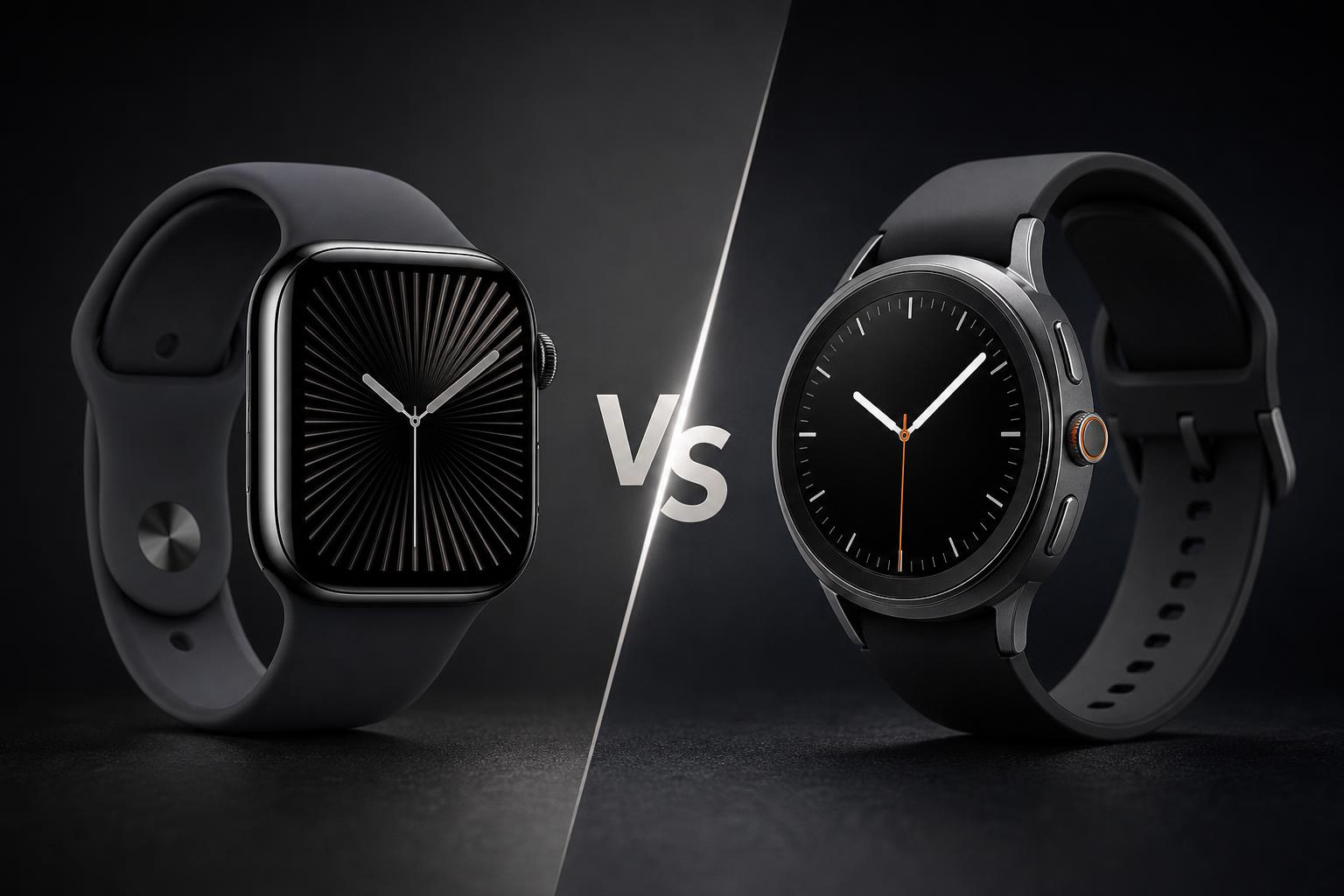
The Apple Watch Series 12 and Samsung Galaxy Watch8 are premium smartwatches designed around different smartphone ecosystems. Apple’s model is built for close integration with the iPhone, Apple services and Apple’s health and safety tools. Samsung’s watch is aimed at compatible Android users, with Wear OS 6, Google apps, Gemini, Samsung Health and optional LTE connectivity.
Both watches offer always-on displays, advanced wellness tracking, water and dust resistance, built-in storage and cellular options. However, they differ substantially in case shape, display technology, battery claims, phone compatibility and starting price. This comparison uses the verified specifications and pricing available for each model, rather than unverified hands-on impressions or independent benchmark results.
Quick verdict
Choose the Apple Watch Series 12 if you use an iPhone and want the deepest integration with Apple’s ecosystem, including Apple Health, Siri AI, Apple Intelligence features, ECG and a broad set of health and safety tools. It also offers aluminum, titanium and ceramic case options, which gives buyers more choice over materials and finish.
Choose the Samsung Galaxy Watch8 if you use a compatible Android phone, particularly a Samsung Galaxy handset, or if battery life, display brightness and starting price are your priorities. Samsung’s watch has a stated peak brightness of up to 3,000 nits, compared with up to 2,000 nits for Apple’s model, and its manufacturer-rated maximum battery life is higher.
There is no verified head-to-head benchmark result that proves one processor is faster than the other. In practical buying terms, phone compatibility should be the first decision: Apple Watch Series 12 requires a supported iPhone, while Galaxy Watch8 is designed for compatible Android phones and is not compatible with iPhones.
Key specifications comparison
| Specification | Apple Watch Series 12 | Samsung Galaxy Watch8 |
|---|---|---|
| Release date | September 18, 2026 | July 25, 2025 |
| Starting official price | From $399 USD | $349.99 for 40mm Bluetooth |
| Case sizes | 42mm and 46mm | 40mm and 44mm |
| Case materials | Aluminum, titanium and ceramic | Armor Aluminum |
| Display | Always-On Retina LTPO3 wide-angle OLED; up to 2,000 nits | Sapphire Crystal Always-On Super AMOLED; up to 3,000 nits |
| Display resolution | 42mm: 374×446; 46mm: 416×496; 326 ppi | 40mm: 438×438; 44mm: 480×480 |
| Processor | Apple S11, 64-bit dual-core, 4-core Neural Engine | Samsung Exynos W1000, 5-core, 3nm |
| Memory and storage | 64GB; RAM not specified by Apple | 2GB memory and 32GB storage |
| Battery claim | Up to 24 hours normal use; up to 38 hours in Low Power Mode | Samsung rates the series for up to 40 hours |
| Fast charging | 15 minutes provides up to 12 additional hours | Fast-charging detail not verified in the research |
| Water and dust resistance | WR50 and IP6X | 5ATM, IP68 and MIL-STD-810H durability |
| Connectivity | GPS and dual-band cellular options | Bluetooth 5.3, Wi-Fi, NFC, dual-frequency L1+L5 GPS and optional LTE |
| Compatible phones | iPhone 11 or later, or iPhone SE 2nd generation or later, with iOS 27 or later | Compatible Android phones; not compatible with iPhones |
Design and build
Apple Watch Series 12
Apple Watch Series 12 retains Apple’s rectangular case design and is offered in 42mm and 46mm sizes. The aluminum GPS 42mm model measures 42×37×9.7mm and weighs 32.2g, while the 46mm aluminum GPS model measures 46×40×9.7mm and weighs 39.5g. Titanium and ceramic versions are available and are heavier than the listed aluminum GPS models.
The choice of aluminum, titanium and ceramic is a significant design advantage for buyers who want more than one case material. Aluminum is the listed option with the lightest verified weights, while titanium and ceramic provide alternative finishes without changing the overall rectangular identity of the Apple Watch.
Apple lists WR50 water resistance and IP6X dust resistance. The watch is also available with dual-band cellular options, although the exact model and connectivity choice will affect the purchase price. Buyers should therefore check the configuration carefully rather than assuming that every Series 12 model includes cellular service.
Samsung Galaxy Watch8
Galaxy Watch8 takes a more traditional watch approach, using a round display inside a slimmer cushion-shaped Armor Aluminum case. The two sizes are 40mm and 44mm. The 40mm model measures 40.4×42.7×8.6mm and weighs 30g, while the 44mm model measures 43.7×46×8.6mm and weighs 34g.
On the listed dimensions, Galaxy Watch8 is thinner than Apple Watch Series 12, although the case shapes and measurements are not directly identical. Samsung offers Armor Aluminum for the standard Galaxy Watch8, with no titanium or ceramic case options verified for this model.
Durability is a strong part of Samsung’s specification sheet. Galaxy Watch8 has 5ATM water resistance, IP68 protection and MIL-STD-810H durability. It also includes dual-frequency L1+L5 GPS, Bluetooth 5.3, Wi-Fi, NFC and optional LTE. That combination gives it a broad connectivity package, particularly for Android users who want navigation and cellular flexibility.
Design preference is subjective, but the distinction is clear: Apple Watch Series 12 is the better fit for people who prefer Apple’s rectangular interface and multiple case materials, while Galaxy Watch8 suits buyers who want a round watch appearance, a thinner listed case and a stronger stated durability specification.
Display
Apple Watch Series 12 uses an always-on Retina LTPO3 wide-angle OLED display. The 42mm version has a resolution of 374×446 pixels, while the 46mm version has 416×496 pixels. Both are listed at 326 pixels per inch. Apple rates the display for up to 2,000 nits of brightness, with a minimum brightness of 1 nit.
The wide-angle OLED design is intended to keep the screen readable across viewing angles, while the always-on function allows key information to remain visible without the user raising their wrist. The two case sizes also give buyers a choice between a more compact display and a larger viewing area. Apple lists the 42mm display at 970 square millimetres and the 46mm display at 1,196 square millimetres.
Samsung Galaxy Watch8 uses a round, full-color always-on Super AMOLED display protected by sapphire crystal. The 40mm version is 1.34 inches with a 438×438-pixel resolution, while the 44mm version is 1.47 inches with a 480×480-pixel resolution. Samsung rates both models for up to 3,000 nits.
Based on the stated peak-brightness figures, Galaxy Watch8 has the display advantage, with up to 3,000 nits compared with Apple’s 2,000 nits. That may matter to people who frequently check a watch outdoors, although brightness figures alone do not establish overall display quality. Apple’s rectangular layout and Samsung’s circular layout also produce different interfaces, so buyers should consider which format better suits their preferred watch style.
Performance and storage
Apple Watch Series 12 is powered by Apple’s S11 chip, which has a 64-bit dual-core processor and a 4-core Neural Engine. Apple lists 64GB of capacity but does not specify the amount of RAM. The combination of a current Apple chip and relatively generous storage supports the watch’s software, health features and Apple ecosystem integration.
Samsung Galaxy Watch8 uses the Exynos W1000, a 5-core processor manufactured on a 3nm process. It has 2GB of memory and 32GB of storage. The processor specification and memory figures give buyers more detail about the hardware than Apple provides, but the storage capacity is half the listed capacity of Apple Watch Series 12.
There are no directly comparable independent benchmark results verified for this comparison. As a result, it would be inaccurate to declare a benchmark winner or to translate the core counts directly into real-world speed. Apple Watch Series 12 is the safer choice for people seeking tightly integrated iPhone-based performance and app responsiveness, while Galaxy Watch8 is the natural Android-oriented choice.
For storage, Apple has the numerical advantage at 64GB versus Samsung’s 32GB. Storage can be useful for apps and other supported content, but the research does not verify how much usable space remains after the operating system and pre-installed software are accounted for.
Health, fitness and safety features
Apple Watch Series 12 health features
Apple Watch Series 12 has a broad health and safety feature set. Verified features include ECG, blood oxygen monitoring, sleep apnea notifications, hypertension notifications, a readiness score and high-frequency heart-rate tracking. These tools make it particularly attractive to iPhone users who want health information integrated with Apple’s wider ecosystem.
Apple also lists Siri AI and Apple Intelligence features as part of the watch’s software experience. The watch requires an iPhone 11 or later, or an iPhone SE 2nd generation or later, running iOS 27 or later. Compatibility is therefore not just a matter of owning any iPhone; the required phone generation and software version matter.
Health and safety features can vary by region, configuration or regulatory availability. The verified research identifies the features included in the product information, but it does not establish that every feature is available in every country or under all circumstances.
Samsung Galaxy Watch8 health and fitness features
Galaxy Watch8 includes Samsung’s BioActive Sensor and supports body-composition analysis, sleep apnea detection, Energy Score, Antioxidant Index and Running Coach features. It also supports Samsung Health, with some parts of the fullest feature set requiring a Samsung Galaxy phone, Samsung Health or regional availability.
The watch’s dual-frequency L1+L5 GPS is another notable feature for fitness users and people who use location-based activities. Samsung also includes Gemini built in, alongside Google Play and Google Maps support through Wear OS 6. This creates a broader Google-oriented software experience than Apple Watch Series 12 can provide outside the iPhone ecosystem.
Samsung’s feature list is extensive, but buyers should check phone requirements before purchasing. While Galaxy Watch8 works with compatible Android phones, some health functions and the fullest set of features may be tied to a Samsung Galaxy device or to regional availability.
Camera and graphics
Neither smartwatch is positioned as a camera-focused product. No camera specifications were verified for Apple Watch Series 12 or Samsung Galaxy Watch8, so neither model can be given a camera advantage.
The research also does not verify directly comparable graphics-processor specifications. Apple lists a 4-core Neural Engine as part of the S11 chip, while Samsung lists the 5-core Exynos W1000, but those details do not provide a like-for-like graphics comparison. Buyers choosing between these watches should focus on display, health, software and phone compatibility rather than camera or graphics capability.
Battery and charging
Battery life is one of the clearest differences between the two models. Apple rates Watch Series 12 for up to 24 hours of normal use or up to 38 hours in Low Power Mode. Apple also states that 15 minutes of fast charging can provide up to 12 additional hours.
Samsung rates Galaxy Watch8 for up to 40 hours, although the battery experience varies by model and usage. The listed battery capacities are 325mAh for the 40mm model and 435mAh for the 44mm model. TechRadar’s verified listing gives up to 30 hours for the 40mm version and up to 40 hours for the 44mm version, while Samsung’s broader series claim is up to 40 hours.
These figures are manufacturer or publication claims under stated conditions, not a directly controlled test between the two watches. Even so, Galaxy Watch8 has the advantage on stated battery capacity and maximum rated runtime, especially in the 44mm version. Apple’s fast-charging claim may be useful for people who need a quick top-up during the day.
For the strongest battery case, choose the Galaxy Watch8 44mm. For users who value a clearly specified fast-charge benefit and are already committed to an iPhone, Apple Watch Series 12 remains a practical option, but its normal-use claim is shorter.
Software and smart features
Apple Watch Series 12 runs watchOS 27 and includes Siri AI and Apple Intelligence features. Its key advantage is ecosystem integration: it is designed to work with Apple services, Apple Health and compatible iPhones. This makes it the more straightforward choice for people who already use Apple devices and want notifications, health data and smartwatch functions connected to the same account and phone environment.
The compatibility requirement is strict. Apple Watch Series 12 requires an iPhone 11 or later, or an iPhone SE 2nd generation or later, running iOS 27 or later. It is not compatible with Android phones.
Galaxy Watch8 runs Wear OS 6 powered by Samsung with One UI 8 Watch and Gemini built in. It offers access to Google Play and Google Maps, and it works with compatible Android phones. Samsung’s software package is therefore better suited to Android users, particularly those already using Samsung Health or a Galaxy smartphone.
Galaxy Watch8 is not compatible with iPhones. Some health features and the fullest feature set require a Samsung Galaxy phone, Samsung Health or regional availability, so Android compatibility should not be interpreted as identical functionality across every Android handset.
Price and value
Apple Watch Series 12 starts at $399 USD. The verified research does not provide separate prices for every case material, size or cellular configuration, so it would be misleading to present the starting price as the cost of all versions.
Samsung Galaxy Watch8 has a lower starting MSRP. The 40mm Bluetooth model is listed at $349.99, while the 44mm Bluetooth model is $399.99. LTE versions are listed at $399.99 for 40mm and $429.99 for 44mm.
On starting price alone, Galaxy Watch8 is the better value. It also combines the lower entry price with a brighter stated display, Android compatibility and longer stated maximum battery life. It has less storage than Apple’s model and offers only an Armor Aluminum case for the standard Galaxy Watch8, but those trade-offs may be acceptable to buyers who prioritize battery and price.
Apple Watch Series 12 justifies its higher starting price through iPhone integration, a broader choice of case materials, 64GB capacity and a health and safety ecosystem that includes ECG, sleep apnea notifications and hypertension notifications. For an iPhone owner, switching to Galaxy Watch8 is not a like-for-like value decision because Samsung’s watch is not compatible with iPhones.
Apple Watch Series 12: pros and cons
Pros
- Strong integration with iPhone, Apple services and the wider Apple ecosystem.
- Advanced health and safety tools including ECG, sleep apnea notifications and hypertension notifications.
- Apple S11 chip, 64GB capacity and high-frequency heart-rate tracking.
- Choice of aluminum, titanium and ceramic case materials.
- Fast-charging claim of up to 12 additional hours from 15 minutes of charging.
Cons
- Requires a supported iPhone and is not compatible with Android phones.
- Shorter stated normal-use battery life than Galaxy Watch8’s maximum manufacturer claim.
- Higher starting price than the Galaxy Watch8 40mm Bluetooth model.
- Apple does not specify RAM or a separate graphics processor.
Samsung Galaxy Watch8: pros and cons
Pros
- Works with compatible Android phones and includes Google Play, Google Maps and Gemini integration.
- Higher stated peak brightness of up to 3,000 nits.
- Larger stated battery capacities and up to 40 hours of manufacturer-rated series battery life.
- Dual-frequency GPS, 32GB storage and broad fitness and wellness features.
- Lower starting MSRP than Apple Watch Series 12.
- 5ATM, IP68 and MIL-STD-810H durability specifications.
Cons
- Not compatible with iPhones.
- Some health features and the fullest experience require a Samsung Galaxy phone, Samsung Health or regional availability.
- Samsung’s battery claim varies by model and usage conditions.
- No titanium or ceramic case options are verified for the standard Galaxy Watch8.
Which watch is better for different buyers?
Best for iPhone owners
Apple Watch Series 12 is the clear choice for iPhone users. It is the model designed for Apple’s ecosystem and combines Apple Health, Siri AI, Apple Intelligence features and Apple’s safety tools. Galaxy Watch8 cannot be used with an iPhone.
Best for Android owners
Galaxy Watch8 is the appropriate choice for Android users because Apple Watch Series 12 requires an iPhone. It is especially compelling for Samsung Galaxy owners who can access Samsung Health and the fullest set of compatible features.
Best for battery life
Samsung Galaxy Watch8 wins on the verified stated figures, particularly in the 44mm version. Its 435mAh battery and up to 40-hour series claim give it the stronger battery proposition. Apple’s advantage is its specific fast-charging claim, which may help when time for charging is limited.
Best for display brightness
Galaxy Watch8 has the higher stated peak brightness at up to 3,000 nits, compared with up to 2,000 nits for Apple Watch Series 12. Apple may be preferable to buyers who want a rectangular wide-angle OLED, while Samsung is the stronger choice on the headline brightness figure.
Best for health and safety
Apple Watch Series 12 is the better fit for iPhone users who prioritize ECG, sleep apnea notifications, hypertension notifications, readiness tracking and Apple’s health ecosystem. Galaxy Watch8 offers a different but also broad set of tools, including body-composition analysis, sleep apnea detection, Energy Score, Antioxidant Index and Running Coach.
Best for value
Galaxy Watch8 offers the stronger overall value based on its lower starting MSRP, brighter display, Android compatibility and longer stated maximum battery life. Apple Watch Series 12 can still be the better value for an iPhone owner because its ecosystem compatibility is more relevant than a simple price comparison.
Best for creators and camera users
Neither watch is a camera-focused smartwatch, and no verified camera advantage was found. Buyers who need a smartwatch companion for notifications, fitness and health should compare those features instead.
Final verdict
Apple Watch Series 12 and Samsung Galaxy Watch8 are both capable premium smartwatches, but they are not interchangeable. The phone you own determines the most sensible choice before price, processor or display specifications enter the discussion.
Apple Watch Series 12 is best for iPhone owners who want deep Apple integration, a broad health and safety feature set, 64GB capacity and more case-material choices. Its disadvantages are the higher starting price, stricter phone requirement and shorter stated normal-use battery life.
Samsung Galaxy Watch8 is best for Android users and for buyers who value battery life, display brightness, GPS flexibility and a lower starting price. Its limitations include the lack of iPhone compatibility, some Samsung-specific health requirements and fewer case-material choices.
Overall, choose Apple Watch Series 12 for the iPhone ecosystem and Galaxy Watch8 for Android, battery life and value. There is no verified benchmark evidence to make processor speed the deciding factor, so ecosystem fit and the features you will use most should guide the purchase.
Frequently asked questions
Can Samsung Galaxy Watch8 work with an iPhone?
No. The verified research states that Galaxy Watch8 is not compatible with iPhones. It is designed to work with compatible Android phones.
Can Apple Watch Series 12 work with Android?
No. Apple Watch Series 12 requires an iPhone 11 or later, or an iPhone SE 2nd generation or later, with iOS 27 or later. It is not compatible with Android phones.
Which has the brighter display?
Galaxy Watch8 has the higher stated peak brightness, at up to 3,000 nits. Apple Watch Series 12 is rated for up to 2,000 nits.
Which watch has better battery life?
Galaxy Watch8 has the stronger stated battery figures. Samsung rates the series for up to 40 hours, with the 44mm model using a 435mAh battery. Apple rates Watch Series 12 for up to 24 hours of normal use or up to 38 hours in Low Power Mode.
Which smartwatch has more storage?
Apple Watch Series 12 has 64GB of capacity, while Galaxy Watch8 has 32GB of storage and 2GB of memory. Apple does not specify the amount of RAM.
Is one watch faster than the other?
No directly comparable independent benchmark results were verified. Apple Watch Series 12 uses the S11 dual-core chip, while Galaxy Watch8 uses the 5-core, 3nm Exynos W1000. The available research does not support a benchmark-based winner.
Sources
- Apple Watch Series 12 - Apple
- Apple Watch Series 12 - Tech Specs
- Introducing Apple Watch Series 12, with the all-new Health Sensing System
- Galaxy Watch8 | Health & Fitness Smartwatch
- Samsung Galaxy Watch8 Series: Ultra Comfort, from Sleep to Workout
- Samsung Galaxy Watch8 Series Specifications
- Samsung Wearables MSRP Price List
- Samsung Galaxy Watch8 review - TechRadar