
Apple Watch Series 12 vs Google Pixel Watch 4: Which smartwatch should you buy?
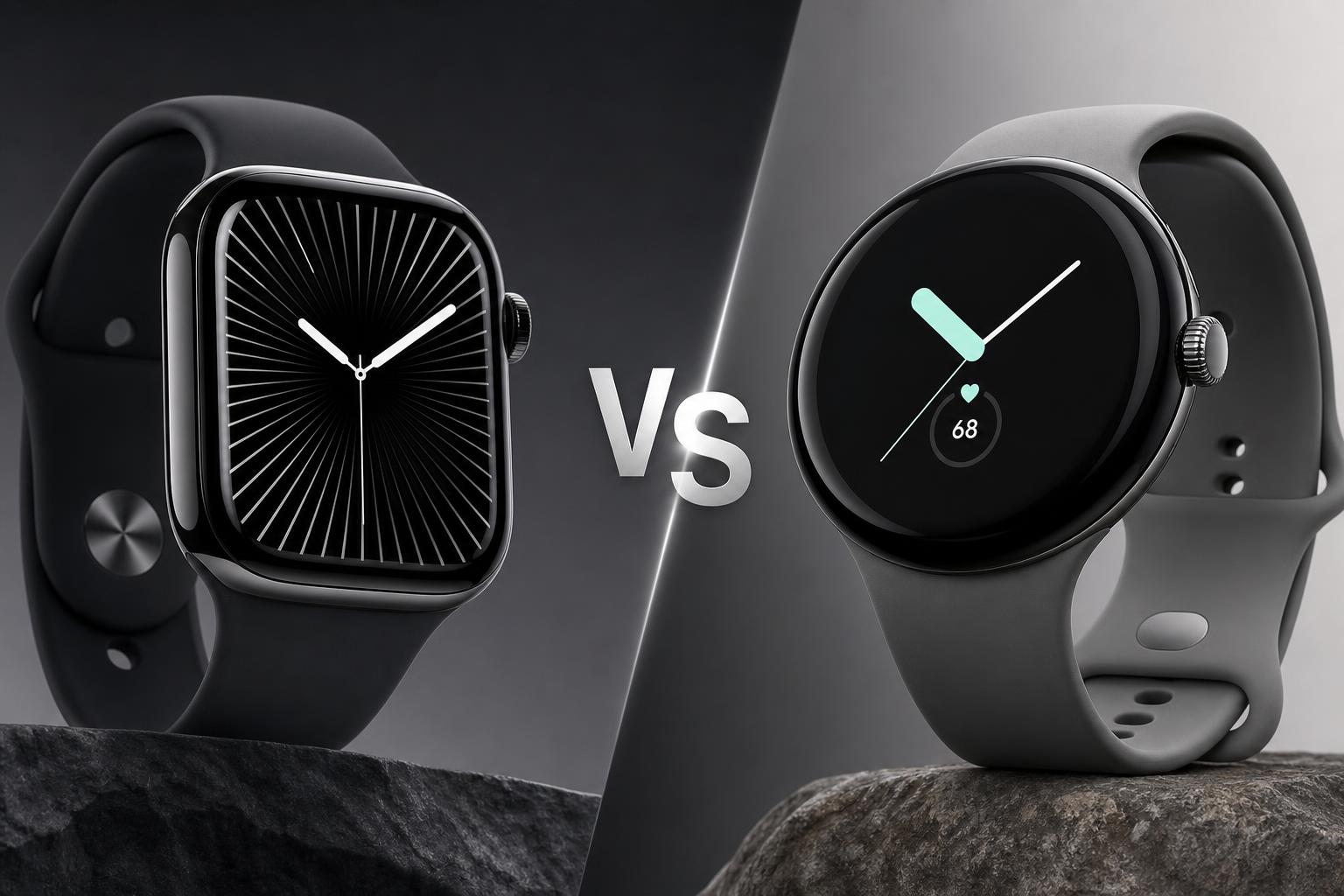
The Apple Watch Series 12 and Google Pixel Watch 4 are premium smartwatches designed around two different mobile ecosystems. Apple’s model is built for iPhone owners and offers a rectangular design, multiple case materials, 64GB of storage and a broad set of health and safety tools. Google’s Pixel Watch 4 is aimed at Android users, uses a circular case, offers a brighter display and promises considerably longer battery life, particularly in its 45mm version.
Neither watch has a camera, and official manufacturer information does not provide directly comparable benchmark results. That means the most important buying decision is less about a definitive processor winner and more about which phone you use, how often you want to charge, and which health and software services you prefer.
Quick verdict
Choose the Apple Watch Series 12 if you own an iPhone and want the closest integration with Apple Health, Apple Pay, Siri AI, Apple Intelligence and Apple’s safety features. It also offers twice the listed storage of the Pixel Watch 4 and more choice in case materials, including titanium and ceramic.
Choose the Google Pixel Watch 4 if you use Android, especially if battery life is a priority. Its quoted battery performance is substantially better, its display reaches a higher peak brightness, and it combines Wear OS 6.0, Gemini features, Fitbit tools, dual-frequency GPS and supported satellite SOS functionality.
For original U.S. list pricing, the Pixel Watch 4 starts $50 below the Apple Watch Series 12. However, the best choice depends first on compatibility: Apple Watch Series 12 requires a compatible iPhone, while Pixel Watch 4 requires a phone running Android 11 or newer and does not work with iPhone.
Key specifications comparison
| Specification | Apple Watch Series 12 | Google Pixel Watch 4 |
|---|---|---|
| Design and sizes | Rectangular; 42mm and 46mm | Circular; 41mm and 45mm |
| Case materials | Aluminum, titanium and ceramic | Aluminum |
| Display | Always-On Retina wide-angle OLED LTPO3; 326 ppi; up to 2000 nits | Actua 360 AMOLED LTPO; 320 ppi; up to 3000 nits |
| Processor | Apple S11, 64-bit dual-core, 4-core Neural Engine | Snapdragon W5 Gen 2 with Cortex-M55 co-processor |
| Storage and memory | 64GB | 2GB SDRAM and 32GB eMMC flash |
| Battery claim | Up to 24 hours; up to 38 hours in Low Power Mode | 41mm: up to 30 hours with always-on display; 45mm: up to 40 hours |
| Charging | Up to 80% in about 30 minutes; 15 minutes provides up to 12 hours of normal use | Approximately 15 minutes charges to 50% |
| Water and dust resistance | Water resistant to 50 meters; IP6X dust resistant | 5 ATM water resistance; IP68 rating |
| Phone compatibility | iPhone 11 or later, including iPhone SE (2nd generation or later), with iOS 27 or later | Most phones running Android 11 or newer; not compatible with iPhone |
| Original U.S. starting price | $399 for 42mm aluminum GPS | $349 for 41mm Wi-Fi |
Design and build
The Apple Watch Series 12 keeps Apple’s familiar rectangular smartwatch design. It is available in 42mm and 46mm case sizes, giving buyers a smaller option and a larger model with a bigger display area. Aluminum models use Ceramic Shield 2, while titanium and ceramic versions use sapphire crystal. This gives Apple the broader material range of the two watches, particularly for buyers who want something more premium than aluminum.
The 42mm aluminum GPS version measures 42mm high, 37mm wide and 9.7mm deep, with a listed weight of 32.2g. The 46mm aluminum GPS version measures 46mm high, 40mm wide and 9.7mm deep, weighing 39.5g. Aluminum GPS plus Cellular versions are slightly lighter at the listed sizes, although titanium and ceramic weights vary by size and finish.
Google takes a different approach with the Pixel Watch 4’s circular design. It is available in 41mm and 45mm versions and uses an aluminum case. The domed display gives it a conventional round-watch appearance, while the larger 45mm model is the better fit for anyone who wants the longest quoted battery life and more room on the screen.
The 41mm Pixel Watch 4 has a listed height of 12.3mm and weighs 31.0g without its band. The 45mm model has the same listed height and weighs 36.7g without its band. That makes the Pixel Watch 4 deeper than the 9.7mm Apple Watch Series 12, while the weights are relatively close in the smaller sizes.
Google also describes the Pixel Watch 4 as having a serviceable design with a replaceable battery and display. Both watches are designed for use around water, but their published ratings are expressed differently: Apple lists water resistance to 50 meters and IP6X dust resistance, while Google lists 5 ATM water resistance and an IP68 rating.
Display
The Pixel Watch 4 has the higher quoted peak brightness. Its Actua 360 AMOLED LTPO display reaches up to 3000 nits, compared with up to 2000 nits for the Apple Watch Series 12. That specification gives Google the advantage on paper for viewing the screen in very bright conditions, although real-world visibility can also depend on the watch face, ambient light and viewing angle.
Both watches support an always-on display and use low-power LTPO display technology. Apple lists a 1Hz refresh rate for its Retina wide-angle OLED display, while Google lists a responsive refresh rate from 1Hz to 60Hz. The Pixel Watch 4 also supports DCI-P3 color.
Apple has the higher quoted pixel density at 326ppi versus 320ppi for Google. The Series 12 provides 374 by 446 pixels at 42mm and 416 by 496 pixels at 46mm. Google’s circular display changes how information is arranged compared with Apple’s rectangular screen, so the preference here is partly a matter of watch design as well as resolution.
In simple terms, Pixel Watch 4 wins on peak brightness, while Apple Watch Series 12 has a small advantage in quoted pixel density and offers a larger rectangular display option in its 46mm model.
Performance
Apple Watch Series 12 uses the Apple S11 chip, with a 64-bit dual-core processor and a four-core Neural Engine. The Neural Engine supports the watch’s machine-learning capabilities, while Apple also highlights Siri AI and Apple Intelligence as part of its wider software experience.
Google Pixel Watch 4 uses the Snapdragon W5 Gen 2 with a Cortex-M55 co-processor. It is paired with 2GB of SDRAM and 32GB of eMMC flash storage. Google’s watch also includes Gemini features through Wear OS 6.0.
Both manufacturers describe current-generation processor and machine-learning hardware, but their official information does not provide directly comparable benchmark results. It is therefore not possible to verify an overall performance winner from the published specifications alone. Buyers should instead consider ecosystem integration, storage and battery life.
Apple provides 64GB of capacity, double the Pixel Watch 4’s listed 32GB of eMMC flash. That extra capacity may be useful for locally stored apps and media, although neither watch is positioned as a camera or creator device.
Health, safety and fitness features
Health monitoring is a major part of both watches, although the feature mix differs. Apple Watch Series 12 includes an ECG, blood oxygen sensor, wrist-temperature sensing, sleep apnea notifications and hypertension notifications. It also offers high-frequency heart-rate tracking and readiness scoring according to Apple’s listed strengths.
Apple’s safety features include fall detection, crash detection and Emergency SOS. Precision L1 GPS is included, while cellular versions add 5G RedCap and LTE connectivity. The combination makes the Series 12 a particularly strong option for iPhone owners who want health and safety tools closely connected to Apple’s wider services.
Pixel Watch 4 includes ECG-compatible electrical sensors, SpO2 sensors, a skin-temperature sensor and a cEDA sensor. It also includes Fitbit health and fitness features. For location tracking, Google lists dual-frequency GPS, which is a notable part of the Pixel Watch 4’s outdoor positioning specification.
Google also lists standalone satellite SOS communications in supported circumstances and regions. Availability for satellite, health, AI and Google Health features can depend on location, connectivity or subscription availability, so buyers should check what is supported in their market before treating any one feature as guaranteed.
Camera and graphics
Neither the Apple Watch Series 12 nor the Google Pixel Watch 4 has a camera. That makes them unsuitable for buyers specifically looking for wrist-based photography, video capture or visual creator tools.
The manufacturers also do not provide directly comparable standalone graphics-performance specifications. Both watches are designed primarily for notifications, health tracking, apps, communications and connected services rather than intensive graphics work. Apple’s larger 64GB capacity may be more useful for locally stored apps and media, but that is a storage advantage rather than proof of superior graphics performance.
Battery and charging
Battery life is one of the clearest differences between these watches. Apple rates the Watch Series 12 for up to 24 hours of normal use and up to 38 hours in Low Power Mode. Fast charging can take it to 80% in about 30 minutes, while 15 minutes of charging provides up to 12 hours of normal use.
Google quotes longer figures for both Pixel Watch 4 sizes. The 41mm model offers up to 30 hours with the always-on display enabled and up to 48 hours in Battery Saver mode. The 45mm model is rated for up to 40 hours with the always-on display and up to 72 hours in Battery Saver mode.
Google says approximately 15 minutes charges the Pixel Watch 4 to 50%. Apple provides a more specific claim for the amount of normal use available after a 15-minute charge, while Google provides the percentage charged. These figures are not directly equivalent, but both watches support relatively rapid top-ups.
For buyers who dislike daily charging, the Pixel Watch 4 is the stronger choice on published battery figures. The 45mm version has the biggest advantage, with up to 40 hours of always-on use and up to 72 hours in Battery Saver mode. Apple remains competitive for people who value fast charging and do not mind a shorter quoted runtime.
Software and features
Apple Watch Series 12 runs watchOS 27 and requires an iPhone 11 or later, including an iPhone SE from the second generation or later, running iOS 27 or later. This restriction is important: the watch is not a general-purpose smartwatch for Android owners. Its main advantage is the depth of integration with Apple services, including Apple Health, Apple Pay, Siri AI, Apple Intelligence and Precision Finding.
Pixel Watch 4 runs Wear OS 6.0 with Gemini features and works with most phones running Android 11 or newer. It requires a Google Account and the Google Pixel Watch app. Unlike Apple’s watch, it is not limited to a specific phone brand, so it can suit owners of compatible Android phones from different manufacturers.
Google’s software package includes Fitbit features and Google services, with supported satellite SOS functionality adding another safety option in eligible circumstances and regions. Apple’s advantage is the integrated iPhone experience and broader choice of case materials, while Google’s advantage is Android flexibility and its combination of Wear OS, Gemini and Fitbit.
Price and value
Apple Watch Series 12 starts at $399 for the 42mm aluminum GPS model. The 46mm aluminum GPS model starts at $449. Aluminum GPS plus Cellular models start at $499, while titanium starts at $699 and ceramic starts at $899.
Google Pixel Watch 4 originally launched in the U.S. at $349 for the 41mm Wi-Fi model, $449 for the 41mm LTE model, $399 for the 45mm Wi-Fi model and $499 for the 45mm LTE model. Google Store currently displays promotional pricing from $229.99, but promotional prices are temporary and can change.
Based on original U.S. MSRP, the Pixel Watch 4 starts $50 below the Apple Watch Series 12. It also offers longer quoted battery life and a brighter display. Apple counters with 64GB of storage, compared with 32GB for Google, plus aluminum, titanium and ceramic case choices.
The value decision therefore depends on more than the cheapest entry price. For an Android owner, the Pixel Watch 4 is the compatible option and offers strong battery value. For an iPhone owner, Apple Watch Series 12 is the relevant choice despite its higher starting price, because Pixel Watch 4 is not compatible with iPhone.
Apple Watch Series 12: pros and cons
Pros
- Works closely with iPhone, Apple Health, Apple Pay, Siri AI and Apple Intelligence.
- Broad health and safety feature set, including ECG, sleep apnea notifications, hypertension notifications, fall detection and crash detection.
- 64GB of listed storage, double the Pixel Watch 4’s listed capacity.
- Available in aluminum, titanium and ceramic case materials.
- Thinner 9.7mm case and fast charging to 80% in about 30 minutes.
Cons
- Requires an iPhone 11 or later, or a compatible iPhone SE, running iOS 27 or later.
- Shorter quoted battery life than Pixel Watch 4.
- Higher original starting price than the Pixel Watch 4 Wi-Fi model.
- No camera.
Google Pixel Watch 4: pros and cons
Pros
- Longer quoted battery life, particularly the 45mm model.
- Higher quoted peak brightness of 3000 nits.
- Works with most Android phones running Android 11 or newer.
- Includes Wear OS 6.0, Gemini features, Fitbit tools and Google services.
- Offers dual-frequency GPS and supported satellite SOS communications.
- Lower original U.S. starting MSRP than Apple Watch Series 12.
Cons
- Not compatible with iPhone.
- 32GB storage is half the Apple Watch Series 12’s listed capacity.
- Only available with an aluminum case.
- No camera.
- Some health, AI, satellite and Google Health features may depend on region, connectivity or subscription availability.
Which watch is better for different buyers?
Best for iPhone owners: Apple Watch Series 12
Apple Watch Series 12 is the clear choice for iPhone users. It is designed around Apple’s ecosystem and offers Apple Health, Apple Pay, Siri AI, Apple Intelligence, Precision Finding and Apple’s safety tools. Pixel Watch 4 does not work with iPhone, so Google’s battery and display advantages do not change the compatibility decision.
Best for Android owners: Google Pixel Watch 4
Pixel Watch 4 is the more suitable option for Android users because it works with most phones running Android 11 or newer. It also brings Wear OS, Gemini features, Fitbit functionality and Google services without requiring a particular phone brand.
Best for battery life: Google Pixel Watch 4
Google wins on published battery figures. The 45mm model is rated for up to 40 hours with its always-on display and up to 72 hours in Battery Saver mode. Apple Watch Series 12 is rated for up to 24 hours of normal use and up to 38 hours in Low Power Mode.
Best for premium materials: Apple Watch Series 12
Apple offers aluminum, titanium and ceramic cases, while Pixel Watch 4 is available with an aluminum case. Buyers who want a wider range of finishes or a more premium case material should look at the Apple range, although titanium and ceramic versions cost considerably more.
Best for storage: Apple Watch Series 12
Apple lists 64GB of capacity, compared with 32GB of eMMC flash for Pixel Watch 4. That makes Apple the better option for buyers who expect to keep more apps and media stored locally on the watch.
Best value: Google Pixel Watch 4
Using original U.S. MSRP, Pixel Watch 4 offers the lower entry price and longer battery life. Google Store promotional pricing can lower the cost further, although current promotions are subject to change. Apple may still be the better value for an iPhone owner because it is the compatible model and integrates more fully with Apple services.
Final verdict
The Apple Watch Series 12 and Google Pixel Watch 4 are both capable modern smartwatches, but they are not interchangeable. The Apple Watch Series 12 is the better all-round option for iPhone owners, offering deeper Apple integration, a wider health and safety feature set, more storage and more case-material choices.
The Pixel Watch 4 is the better choice for Android users who want longer battery life, a brighter display, Fitbit and Google services, and the flexibility to use most compatible Android phones. Its 45mm model is particularly appealing if reducing charging frequency is the priority.
There is no verified overall processor winner from the available official specifications, and neither watch has a camera. The practical decision is therefore straightforward: choose Apple Watch Series 12 for the iPhone ecosystem and Google Pixel Watch 4 for Android, especially when battery life and original price matter most.
FAQs
Does Apple Watch Series 12 work with Android phones?
No. Apple Watch Series 12 is officially compatible with iPhone 11 or later, including iPhone SE models from the second generation or later, running iOS 27 or later.
Does Google Pixel Watch 4 work with iPhone?
No. Google Pixel Watch 4 is compatible with most phones running Android 11 or newer and is not compatible with iPhone.
Which watch has better battery life?
Google Pixel Watch 4 has the longer quoted battery life. The 41mm model is rated for up to 30 hours with its always-on display, while the 45mm model is rated for up to 40 hours. Apple Watch Series 12 is rated for up to 24 hours of normal use.
Which watch has the brighter display?
Pixel Watch 4 has the higher quoted peak brightness at up to 3000 nits. Apple Watch Series 12 is listed at up to 2000 nits.
Which smartwatch has more storage?
Apple Watch Series 12 has more listed storage, with 64GB compared with 32GB of eMMC flash on Google Pixel Watch 4.
Do either of these smartwatches have a camera?
No. Neither Apple Watch Series 12 nor Google Pixel Watch 4 has a camera.
Sources
- Apple Watch Series 12 - Technical Specifications — Apple
- Apple Watch Series 12 — Apple
- Introducing Apple Watch Series 12, with the all-new Health Sensing System — Apple
- Google Pixel Watch 4 — Google Store
- Pixel Watch 4: Design upgrades, new fitness features and expanded AI — Google
- Pixel Watch 4 - enUS - Tech Specs — Google