
Apple Watch Series 12 vs Garmin fēnix 9 Pro: Which Smartwatch Should You Buy?
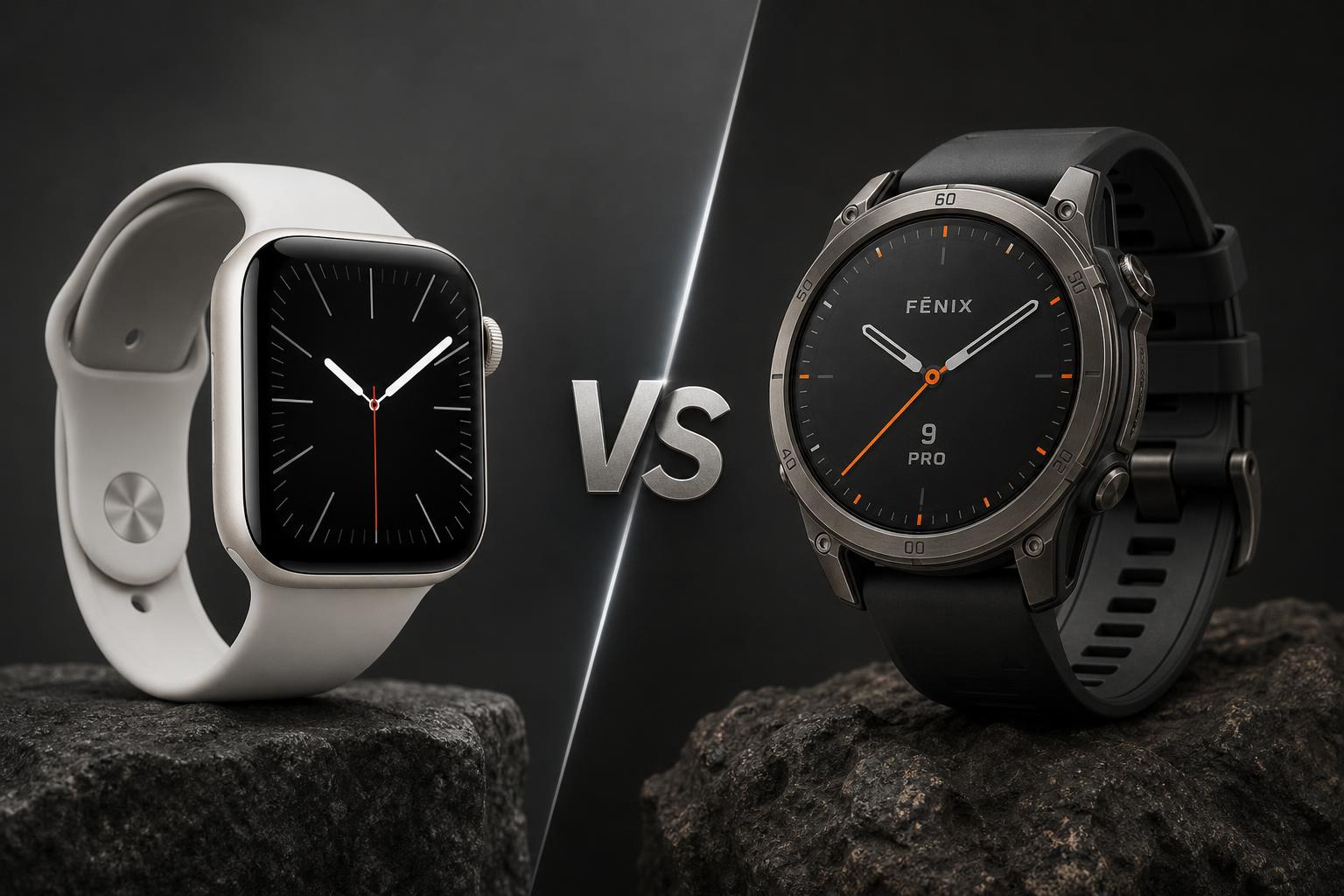
The Apple Watch Series 12 and Garmin fēnix 9 Pro are both premium smartwatches, but they are designed around different priorities. Apple focuses on everyday smartwatch convenience, iPhone integration, health features and apps. Garmin puts greater emphasis on long battery life, outdoor durability, training analysis, navigation and multisport use.
That difference matters more than the headline specifications. The Apple Watch Series 12 starts at $399, while the Garmin fēnix 9 Pro starts at $1,099.99. Garmin therefore needs to justify a much higher price with features such as titanium construction, a sapphire lens, built-in maps, multi-band GPS, longer battery life and optional inReach satellite and LTE connectivity.
This comparison uses the verified specifications and product information available for both watches. It does not treat either product as tested first-hand, and there is no directly comparable independent benchmark available in the supplied research.
Quick verdict
For most iPhone owners who want a general-purpose smartwatch, the Apple Watch Series 12 is the better-value choice. It is smaller and lighter, starts at a substantially lower price and offers strong integration with iPhone, Apple Pay, watchOS apps, health features and Apple services. Its main compromise is battery life: Apple rates it for up to 24 hours of normal use.
The Garmin fēnix 9 Pro is the better choice for serious outdoor athletes, endurance users and adventurers. Its battery can last up to 10, 16 or 31 days in smartwatch mode depending on the AMOLED case size, while select solar models can reach up to 57 days under Garmin’s stated solar-use conditions. It also offers a tougher build, 10 ATM water resistance, routable maps, multi-band GPS and optional inReach connectivity.
In short, choose Apple for a more accessible everyday smartwatch and Garmin for a specialist outdoor and training instrument.
Key specifications comparison
| Specification | Apple Watch Series 12 | Garmin fēnix 9 Pro |
|---|---|---|
| Starting price | Starts at $399 USD | Starts at $1,099.99 USD |
| Display | Always-On Retina display, up to 2,000 nits | AMOLED touchscreen, up to 3,000 nits; solar-display variants also available |
| Display sizes | 42mm or 46mm | 43mm, 47mm or 51mm |
| Resolution detail | 42mm: 374 x 446 pixels; 46mm: 416 x 496 pixels | 51mm AMOLED: 1.5 inches, 466 x 466 pixels |
| Processor | Apple S11, 64-bit dual-core processor and four-core Neural Engine | Processor specification not published in the verified materials |
| Storage | 64GB capacity | 64GB memory |
| Battery | Up to 24 hours normal use; up to 38 hours in Low Power Mode | Up to 10 days for 43mm AMOLED, 16 days for 47mm AMOLED and 31 days for 51mm AMOLED; select solar models up to 57 days under stated conditions |
| Charging | Up to 80% in about 30 minutes | Battery and charging details vary by model; solar variants are available |
| Durability | IP6X dust resistance and 50-metre water resistance | Titanium case and bezel, sapphire lens and 10 ATM water rating |
| Health and fitness | ECG, blood oxygen, temperature sensing, sleep apnea notifications, readiness features and high-frequency heart-rate tracking | Training readiness, training status, advanced stamina metrics, ECG and multisport tools |
| Navigation | GPS and optional cellular connectivity | Built-in routable maps, updated map engine, perspective map view and multi-band GPS |
| Phone compatibility | Requires iPhone 11 or later, including iPhone SE 2nd generation or later, with iOS 27 or later | Connected features depend on phone compatibility, network coverage or an inReach plan |
Design and build
The Apple Watch Series 12 is the more compact and lightweight option. It comes in 42mm and 46mm sizes, with aluminum, titanium and ceramic case options. The 42mm aluminum GPS model weighs 32.2g, while the 46mm aluminum GPS model weighs 39.5g. Both listed aluminum versions are 9.7mm thick.
That makes the Apple Watch a practical fit for buyers who want a watch that is relatively thin and easy to wear throughout the day. The available case materials also provide more choice between a lighter everyday design and higher-end finishes. Titanium and ceramic versions have different weights and dimensions, so shoppers should check the specification for the exact configuration they are considering.
Apple rates the Series 12 at IP6X for dust resistance and 50-metre water resistance. That is useful for everyday exposure to dust and water, but the rating is below the Garmin’s 10 ATM specification.
The Garmin fēnix 9 Pro takes a more rugged approach. It uses a titanium case and bezel, a sapphire lens and leakproof inductive buttons. The range is available in 43mm, 47mm and 51mm sizes. The 43mm model measures 43 x 43 x 13.3mm and weighs 62g including its band. The larger 51mm model measures 51 x 51 x 15.8mm and weighs 99g including its band.
Those figures show the trade-off clearly. Even the smaller Garmin configuration is substantially more substantial than the listed aluminum Apple Watch models, while the 51mm version is designed for buyers who value battery capacity and outdoor visibility over a low-profile fit. The 10 ATM water rating, titanium construction and sapphire lens make the Garmin the stronger option for demanding outdoor use on paper.
There is no single winner for design. Apple is better suited to people who prefer a lighter, thinner and more discreet smartwatch. Garmin is better suited to those who specifically want a rugged multisport watch and are comfortable with a larger case.
Display
The Apple Watch Series 12 uses a rectangular Always-On Retina display with brightness up to 2,000 nits. The 42mm model has a resolution of 374 x 446 pixels and a 970 square millimetre display area. The 46mm model increases that to 416 x 496 pixels and a 1,196 square millimetre display area.
The choice between Apple’s two sizes is therefore not only about wrist fit. The 46mm model provides a larger display area, which may be useful for reading notifications or viewing information at a glance, while the 42mm model keeps the watch smaller and lighter.
Garmin uses a round AMOLED touchscreen with brightness up to 3,000 nits. The verified specifications identify the 51mm AMOLED version as having a 1.5-inch display with a 466 x 466-pixel resolution. Garmin also offers solar-display variants, giving buyers an alternative aimed at extending time between charges rather than simply selecting an AMOLED panel.
Garmin has the higher stated peak brightness, but the screen experience is shaped by more than brightness alone. Apple’s rectangular display is closely tied to watchOS and its app interface, while Garmin’s round screen suits its watch-style presentation and outdoor functions. Buyers should choose based on the type of information they expect to view most often: Apple for notifications, apps and general smartwatch use; Garmin for training data, maps and outdoor information.
Performance
Apple publishes a clear processor specification for the Series 12: an Apple S11 chip with a 64-bit dual-core processor and a four-core Neural Engine. The watch also has 64GB of capacity. This gives buyers a defined hardware platform for Apple’s watchOS software, apps and audio-related features.
The Garmin fēnix 9 Pro has 64GB of memory, which Garmin says can store up to 7,000 songs and twice as many maps as the preceding generation. Garmin also emphasizes 50% more RAM than the prior fēnix generation and a faster map engine in the supplied product information. However, Garmin has not published a processor specification in the verified materials.
It would therefore be misleading to declare one watch universally faster. There is no directly comparable independent benchmark in the research provided. The more useful distinction is how each watch uses its hardware.
Apple’s hardware supports an app-oriented smartwatch experience, Apple Intelligence and Siri AI features, media playback and Apple services. Garmin’s hardware and storage are used heavily for maps, music, training data and outdoor tools. A buyer who wants a broad smartwatch platform and published general-purpose processor details will find the Apple Watch more straightforward. A buyer who prioritizes navigation, training and endurance use should focus on Garmin’s feature set rather than processor comparisons.
Health, fitness, cameras and graphics
Health and fitness features
The Apple Watch Series 12 has a broad health and safety feature set. The verified specifications include ECG, blood oxygen, temperature sensing, sleep apnea notifications, readiness features, high-frequency heart-rate tracking and GPS. Optional cellular connectivity is also available, and Apple Pay is supported.
These features make the Series 12 a strong general-purpose health smartwatch for an iPhone owner. It is not positioned primarily as an expedition device, but it covers a wide range of everyday health, safety and connected-watch requirements.
The Garmin fēnix 9 Pro is more focused on training and outdoor performance. Its software features include advanced stamina metrics, training readiness, training status, ECG, multisport tracking and built-in mapping. Garmin also offers multi-band GPS, which is particularly relevant to users who want advanced positioning tools for outdoor activities.
The two watches overlap in health tracking, but their emphasis differs. Apple presents a wider consumer health and smartwatch package, while Garmin provides more extensive training and navigation features for users who plan workouts, races, outdoor routes or longer adventures around the watch.
Cameras and graphics
Neither watch has a camera specified in the verified research, so neither should be bought as a camera device. Apple emphasizes media playback and Apple Intelligence audio features. Garmin focuses on built-in routable maps, an updated map engine, perspective map view and an integrated LED flashlight with green-light mode.
This makes Apple the better fit for buyers interested in voice features, media playback and a broader smartwatch app ecosystem. Garmin is more useful for visual navigation and practical outdoor awareness, particularly when maps and route guidance matter more than media features.
Battery and charging
Battery life is the clearest hardware advantage for the Garmin fēnix 9 Pro. AMOLED models are rated for up to 10 days in smartwatch mode for the 43mm model, up to 16 days for the 47mm model and up to 31 days for the 51mm model. Select solar models can offer up to 57 days under Garmin’s stated solar-use conditions.
The exact result depends on the model and use pattern, but even the shortest listed AMOLED rating is considerably longer than Apple’s official rating. This is important for people who spend time away from power outlets, travel frequently or want to track sleep and activity without regular charging interruptions.
Apple rates the Watch Series 12 for up to 24 hours of normal use or up to 38 hours in Low Power Mode. It supports fast charging to up to 80% in about 30 minutes. The fast-charge capability helps reduce the inconvenience of the shorter runtime, particularly when a quick top-up is practical.
Apple’s approach suits a daily smartwatch routine with regular charging. Garmin’s approach is better for endurance events, camping, travel and extended outdoor use. If battery life is the deciding factor, the fēnix 9 Pro is the clear winner.
Software and smart features
The Apple Watch Series 12 runs watchOS 27 and supports Apple Intelligence and Siri AI features. It also benefits from Apple’s smartwatch app ecosystem, Apple Pay and integration with Apple services. However, compatibility is a firm requirement: the Series 12 requires an iPhone 11 or later, including the second-generation iPhone SE or later, running iOS 27 or later. It does not support Android phones.
Optional cellular connectivity can add independence from an iPhone in supported situations, but cellular models require a compatible wireless service plan. That additional requirement should be included in the ownership cost when comparing configurations.
The Garmin fēnix 9 Pro uses Garmin smartwatch software and works with Garmin Connect, Garmin Epic, Garmin Pay and Connect IQ. It includes music storage, built-in maps, advanced training tools and multi-band GPS. It also has a built-in speaker and microphone, enabling voice calling on supported configurations and connected circumstances.
Optional inReach connectivity can provide LTE and satellite messaging, voice calling, LiveTrack and SOS features. However, an active inReach plan is required for connected inReach services. Phone calling, messaging and other connected features can also depend on phone compatibility, network coverage or an inReach plan.
Apple is the more natural choice for someone already invested in the iPhone and Apple services ecosystem. Garmin is more compelling for someone who wants a dedicated training and outdoor platform, especially when maps, satellite communication or long periods away from a charger are part of the use case.
Price and value
The Apple Watch Series 12 starts at $399 USD. The Garmin fēnix 9 Pro starts at $1,099.99 USD, making it $700.99 more expensive at the listed starting prices. That is a significant difference before considering case sizes, display types, cellular options or any subscription required for inReach services.
Apple offers more immediate value for the typical iPhone user. The lower starting price buys a thin smartwatch with a broad health feature set, Apple Pay, watchOS apps, an S11 chip, 64GB capacity and strong integration with Apple services. The main compromises are the shorter battery life, lower water-resistance rating than Garmin and dependence on a compatible iPhone.
Garmin’s higher price is easier to justify for a narrower group of buyers. Its value comes from the combination of long battery life, titanium and sapphire construction, 10 ATM water resistance, routable maps, multi-band GPS, training analytics, music storage and optional inReach connectivity. Those features are particularly relevant to serious outdoor athletes, endurance users and adventurers.
For general smartwatch value, Apple wins. For outdoor capability and reduced charging frequency, Garmin can be the better investment despite its much higher entry price.
Apple Watch Series 12: pros and cons
Pros
- Starts at a much lower price than the Garmin fēnix 9 Pro.
- Strong integration with iPhone, Apple services, Apple Pay and watchOS apps.
- Broad health feature set including ECG, blood oxygen, temperature sensing and sleep apnea notifications.
- Relatively thin and lightweight aluminum configurations.
- Published S11 processor specification and 64GB capacity.
- Fast charging can reach up to 80% in about 30 minutes.
Cons
- Requires a compatible iPhone and does not support Android phones.
- Up to 24 hours of normal-use battery life is much shorter than Garmin’s rating.
- 50-metre water resistance is below the Garmin’s 10 ATM rating.
- It is not primarily designed for extended expedition use or advanced outdoor navigation.
- Cellular models require a compatible wireless service plan.
Garmin fēnix 9 Pro: pros and cons
Pros
- Much longer battery life than the Apple Watch Series 12.
- Titanium case and bezel, sapphire lens and 10 ATM water rating.
- Built-in routable maps, multi-band GPS and advanced outdoor navigation.
- Training readiness, training status and advanced stamina metrics.
- Optional inReach LTE and satellite connectivity on supported models.
- 64GB memory for music and maps, plus Garmin Pay and Connect IQ support.
- AMOLED and solar-display options are available.
Cons
- Much higher starting price than the Apple Watch Series 12.
- Larger and heavier, particularly in the 51mm configuration.
- Some inReach communication and SOS features require an active subscription plan.
- Garmin has not published a processor specification in the verified materials.
- Some calling, messaging and connected features depend on phone compatibility, coverage or a plan.
Which watch is better for different buyers?
For most iPhone users
The Apple Watch Series 12 is the better choice for most iPhone owners. Its price is much lower, its design is lighter and thinner in the listed aluminum versions, and its software is closely integrated with the iPhone. It also offers a wide selection of health, safety, payment, voice and app features.
For serious outdoor athletes
The Garmin fēnix 9 Pro is the stronger option for serious outdoor athletes. Training readiness, training status, advanced stamina metrics, multisport features, multi-band GPS and built-in routable maps are central to its appeal.
For runners, hikers and adventurers
Garmin is better suited to users who need route guidance, long battery life and a durable case. The optional inReach connectivity may also be valuable to supported users who need satellite messaging, SOS or tracking away from normal cellular coverage, although an active plan is required for connected inReach services.
For buyers on a budget
The Apple Watch Series 12 is the clear value choice based on the listed starting prices. It costs substantially less while still offering a broad health and smartwatch feature set. It is only a suitable option if the buyer already has, or plans to use, a compatible iPhone.
For long battery life
Choose the Garmin fēnix 9 Pro. Its AMOLED models are rated for up to 10 to 31 days depending on size, and select solar versions can reach up to 57 days under Garmin’s stated conditions. Apple’s fast charging is useful, but it does not change the fundamental gap in runtime.
For media, voice features and apps
The Apple Watch Series 12 is the better fit for media playback, Apple Intelligence audio features, Siri AI features and a broader smartwatch app ecosystem. Neither watch has a camera specified in the verified research, so neither is appropriate for buyers specifically looking for a camera-equipped wearable.
Final verdict
The Apple Watch Series 12 and Garmin fēnix 9 Pro are not direct substitutes for every buyer. Apple is the more affordable, accessible and connected smartwatch, while Garmin is the more specialised outdoor and training device.
Choose the Apple Watch Series 12 if you own an iPhone and want everyday convenience, health tracking, Apple Pay, apps and Apple service integration at a lower price. Its 24-hour battery rating is the main limitation, but fast charging and Low Power Mode help make that limitation more manageable.
Choose the Garmin fēnix 9 Pro if you prioritise battery life, rugged materials, advanced training, routeable maps, multi-band GPS or optional satellite and LTE connectivity. Its much higher price and larger design make less sense for a casual smartwatch buyer, but the feature set is more appropriate for endurance athletes, outdoor professionals and adventurers.
Overall, the Apple Watch Series 12 is the better choice for most iPhone users and the better value. The Garmin fēnix 9 Pro is the clear specialist winner for outdoor performance, navigation and battery life.
FAQs
Does the Apple Watch Series 12 work with Android phones?
No. The verified specifications state that the Apple Watch Series 12 requires an iPhone 11 or later, including the iPhone SE 2nd generation or later, with iOS 27 or later. It does not support Android phones.
Which watch has better battery life?
The Garmin fēnix 9 Pro has substantially better battery life. Its AMOLED models are rated for up to 10 days in 43mm, 16 days in 47mm and 31 days in 51mm smartwatch mode. Select solar models can offer up to 57 days under Garmin’s stated solar-use conditions. Apple rates the Series 12 for up to 24 hours of normal use or up to 38 hours in Low Power Mode.
Which watch is better for navigation?
The Garmin fēnix 9 Pro is better for navigation because it includes built-in routable maps, an updated map engine, perspective map view and multi-band GPS. The Apple Watch Series 12 includes GPS, but the verified research does not position it as an advanced outdoor navigation device.
Which watch is more durable?
The Garmin fēnix 9 Pro has the stronger stated ruggedness specification, with a titanium case and bezel, sapphire lens and 10 ATM water rating. The Apple Watch Series 12 has IP6X dust resistance and 50-metre water resistance, which is suited to everyday use but below Garmin’s rating.
Is the Garmin fēnix 9 Pro worth the extra cost?
It can be worth the extra cost for users who will use its long battery life, rugged construction, maps, multi-band GPS, training analytics or optional inReach features. For a general-purpose smartwatch user, particularly an iPhone owner, the Apple Watch Series 12 offers better value at its much lower starting price.
Do either of these watches have a camera?
No camera is specified for either product in the verified research. Apple focuses on media playback and audio features, while Garmin focuses on maps, navigation and its integrated flashlight.
Sources
- Apple Watch Series 12 - Technical Specifications — Apple
- Apple Watch Series 12 - Tech Specs — Apple Support
- Introducing Apple Watch Series 12, with the all-new Health Sensing System — Apple Newsroom
- Garmin announces the fēnix 9 and fēnix 9 Pro GPS smartwatch — Garmin Newsroom
- Garmin Product Comparison: fēnix 9 Pro — Garmin
- Garmin fēnix 9 Pro - 43mm — Garmin