
NVIDIA GeForce RTX 5080 vs AMD Radeon RX 9070 XT: Which GPU Is Better?
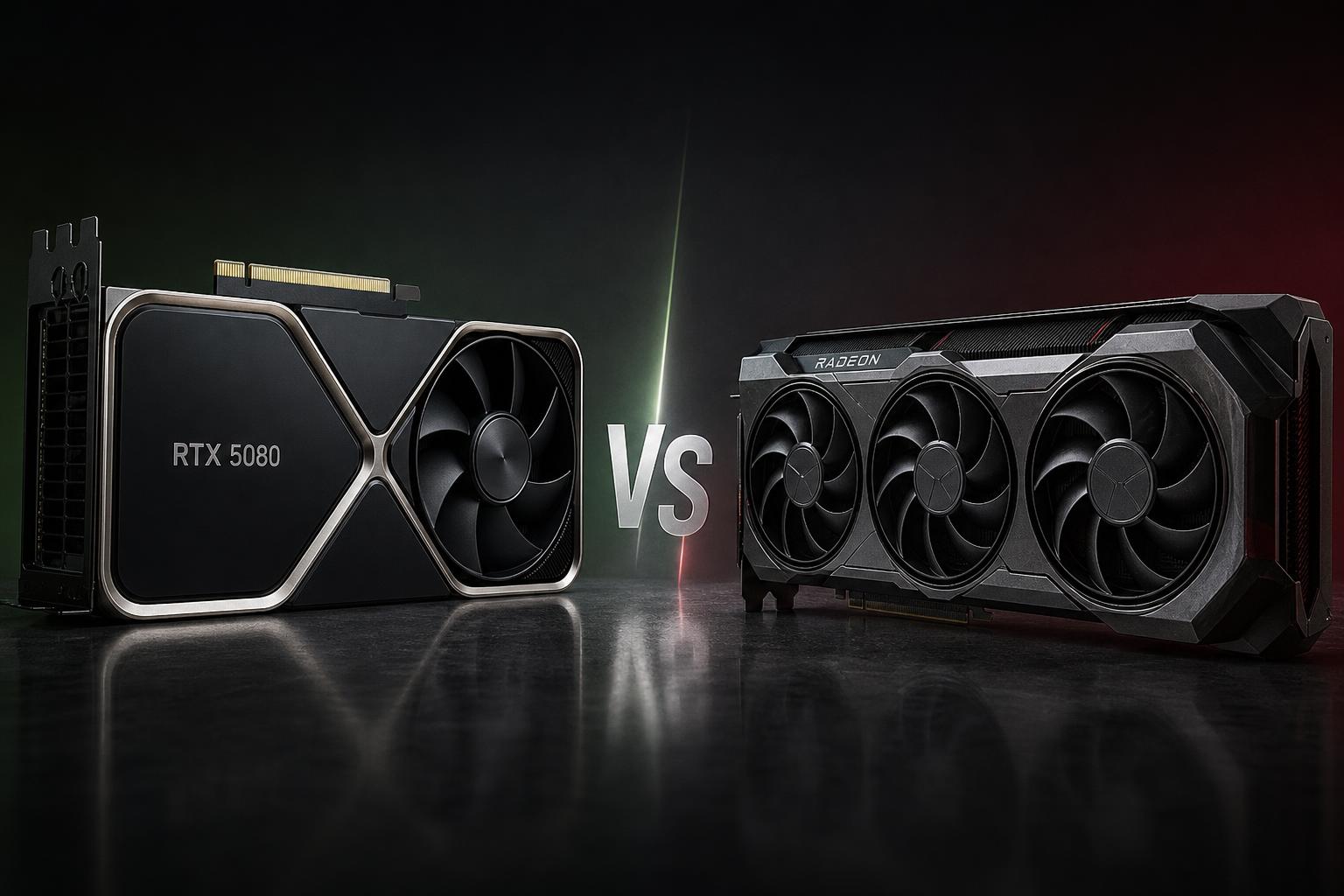
The NVIDIA GeForce RTX 5080 and AMD Radeon RX 9070 XT are high-end desktop graphics cards aimed at demanding 1440p and 4K gaming. They also take different approaches to value: NVIDIA offers higher overall performance and a broader ray-tracing, AI and creator ecosystem, while AMD launched the RX 9070 XT at a much lower official price.
This comparison uses the manufacturers’ published specifications and Tom’s Hardware benchmark results supplied for this guide. It does not treat partner-card pricing, cooling or dimensions as universal, because those details vary between models.
Quick verdict
The NVIDIA GeForce RTX 5080 is the better graphics card for buyers who want the highest performance, stronger ray tracing, DLSS 4 with Multi Frame Generation, CUDA support, NVIDIA Studio features and more advanced video-encoding hardware. In Tom’s Hardware’s June 2026 native-resolution testing, it was faster than the RX 9070 XT in both rasterization and ray tracing.
The AMD Radeon RX 9070 XT is the better-value choice for most high-end gaming builds. Its official $599 USD SEP was $400 below the RTX 5080’s $999 USD MSRP, while delivering close 1440p raster performance and a substantial share of the RTX 5080’s 4K performance. Both cards have 16GB of graphics memory, but NVIDIA’s premium is easier to justify if you use ray tracing, AI tools, CUDA applications or creator software.
Key specifications comparison
| Specification | NVIDIA GeForce RTX 5080 | AMD Radeon RX 9070 XT |
|---|---|---|
| Release date | January 30, 2025 | March 6, 2025 |
| Official launch price | $999 USD MSRP | $599 USD SEP |
| Architecture | NVIDIA Blackwell | AMD RDNA 4, Navi 48 |
| Compute hardware | 10,752 CUDA cores; fifth-generation Tensor Cores; fourth-generation Ray Tracing Cores | 64 Compute Units; 4,096 Stream Processors; 64 Ray Accelerators; 128 AI Accelerators |
| Memory | 16GB GDDR7; 256-bit interface | 16GB GDDR6; 256-bit interface; up to 640GB/s; 64MB Infinity Cache |
| Clock speeds | 2.30GHz base; 2.62GHz boost | 2.40GHz game clock; up to 2.97GHz boost |
| Raster performance | 128.3 FPS at 1440p; 77.4 FPS at 4K in Tom’s Hardware testing | 116.5 FPS at 1440p; 65.8 FPS at 4K in Tom’s Hardware testing |
| Ray-tracing performance | 74.0 FPS at 1440p; 42.1 FPS at 4K in Tom’s Hardware testing | 55.5 FPS at 1440p; 30.1 FPS at 4K in Tom’s Hardware testing |
| Video outputs | 3x DisplayPort 2.1b; 1x HDMI 2.1b; up to four displays | DisplayPort 2.1a and HDMI 2.1b; up to four displays |
| Power | 360W total graphics power; 850W recommended system power | 304W typical board power; 750W minimum PSU recommendation |
| Power connectors | Three PCIe 8-pin cables with adapter, or one 450W-or-greater PCIe Gen 5 cable | Two 8-pin power connectors |
| Upscaling and frame generation | DLSS 4, Super Resolution, Ray Reconstruction, Frame Generation and Multi Frame Generation | FSR 4, FSR Redstone, Fluid Motion Frames and Radeon Super Resolution |
| Video encoding | Two ninth-generation NVENC encoders; AV1 encode and decode | AV1, H.264 and H.265/HEVC encode and decode |
| PCIe | PCIe 5.0 | PCIe 5.0 x16 |
Design and build
Neither product has one universal physical design across the entire range. Both are desktop PCIe 5.0 graphics cards available through partner models, so cooler layouts, dimensions, weights and pricing can vary. This is particularly important when comparing a specific retail RX 9070 XT with a particular RTX 5080 rather than comparing the GPU families in general.
NVIDIA lists its GeForce RTX 5080 Founders Edition at 304mm long and 137mm wide. NVIDIA also states that add-in-card dimensions vary by manufacturer. AMD does not publish one universal RX 9070 XT card dimension or weight on the cited product page, so prospective buyers should check the measurements of the exact card before purchasing.
Power requirements are one clear difference. The RTX 5080 has a 360W total graphics power rating and NVIDIA recommends an 850W system power supply. It can use three PCIe 8-pin cables with an adapter or one 450W-or-greater PCIe Gen 5 cable. The RX 9070 XT has a lower 304W typical board power and AMD specifies a 750W minimum PSU recommendation. It uses two 8-pin power connectors.
That does not make the RX 9070 XT a low-power card, but its published power requirements are less demanding. For either model, the exact partner card’s cooler, thickness and connector arrangement should be checked against the PC case and power supply.
Display support
The RTX 5080 has the more detailed display specification. It provides three DisplayPort 2.1b outputs and one HDMI 2.1b output, supports up to four independent displays, and is specified for up to 4K at 480Hz or 8K at 165Hz with Display Stream Compression.
The RX 9070 XT supports up to four displays and provides DisplayPort 2.1a and HDMI 2.1b. AMD’s cited product page does not specify an equivalent maximum resolution-and-refresh combination, so it is not possible to make a like-for-like claim about a maximum display mode from the supplied research.
For typical high-refresh 1440p or 4K gaming monitors, both cards provide modern display connectivity. The RTX 5080 has the advantage when the published maximum display capability is an important part of the buying decision.
Performance
Tom’s Hardware’s June 2026 native-resolution testing puts the RTX 5080 ahead overall. At 1440p rasterization, the RTX 5080 averaged 128.3 frames per second compared with 116.5 FPS for the RX 9070 XT. At 4K, the averages were 77.4 FPS and 65.8 FPS respectively.
That makes the RTX 5080 faster in conventional rendering, but the gap is not equally important for every buyer. At 1440p, the RX 9070 XT delivered roughly 91% of the RTX 5080’s tested raster performance. At 4K, it delivered roughly 85%. Those results help explain why AMD’s card can be a compelling option for buyers focused on standard rasterized gaming rather than every available graphics feature.
The RTX 5080’s advantage becomes more substantial in ray tracing. Tom’s Hardware recorded 74.0 FPS for the RTX 5080 versus 55.5 FPS for the RX 9070 XT at 1440p. At 4K, the corresponding results were 42.1 FPS and 30.1 FPS.
In practical buying terms, the RTX 5080 is the stronger choice for demanding games that make heavy use of ray-traced lighting, reflections or shadows. The RX 9070 XT still brings improved ray-tracing hardware through AMD’s RDNA 4 architecture, but the supplied testing shows that it remains well behind NVIDIA in this category.
Graphics, AI and video production
The RTX 5080 has a broader set of hardware and software features for graphics-intensive work. Its Blackwell design includes 10,752 CUDA cores, fifth-generation Tensor Cores and fourth-generation Ray Tracing Cores. NVIDIA rates it at 171 TFLOPS of ray-tracing performance and 1,801 AI TOPS.
Its DLSS 4 feature set includes Super Resolution, Ray Reconstruction, Frame Generation and Multi Frame Generation. DLSS features depend on supported games or applications, but the supplied research identifies NVIDIA’s overall software ecosystem as broader and more mature than AMD’s.
The RX 9070 XT uses AMD’s RDNA 4 architecture with 64 Compute Units, 4,096 Stream Processors, 64 Ray Accelerators and 128 AI Accelerators. It supports FSR 4 and FSR Redstone, AMD Fluid Motion Frames and Radeon Super Resolution. These features give AMD a modern set of upscaling and frame-generation options, although the research notes that FSR 4 and AMD frame-generation support are not as broadly available as NVIDIA’s DLSS ecosystem.
Both cards include 16GB of graphics memory, but the memory technologies differ. The RTX 5080 uses GDDR7 on a 256-bit interface. The RX 9070 XT uses GDDR6 on a 256-bit interface, with up to 640GB/s of bandwidth and 64MB of AMD Infinity Cache. The equal memory capacity means neither card has a capacity advantage in this comparison.
For creators, the RTX 5080 has several additional advantages. It includes two ninth-generation NVENC encoders and two sixth-generation NVDEC decoders, supports AV1 encoding and decoding, and offers support for 4:2:2 video workflows according to the supplied research. NVIDIA also provides CUDA, Studio drivers, Broadcast, Omniverse and RTX Remix. These capabilities make the RTX 5080 the more suitable option for CUDA-accelerated applications, AI tools and advanced video production.
The RX 9070 XT supports AV1, H.264 and H.265/HEVC encoding and decoding, alongside AMD Software: Adrenalin Edition. It is a capable general-purpose graphics card, but the verified comparison gives NVIDIA the advantage for creator applications and software support.
Battery and charging
Battery life and charging do not apply to these products. The RTX 5080 and RX 9070 XT are desktop graphics cards installed in a PC, not battery-powered devices. The relevant considerations are system power requirements, graphics-card power consumption and the connectors required by the selected model.
Software and features
NVIDIA’s software feature list is extensive. The RTX 5080 supports the NVIDIA App, Game Ready and Studio drivers, NVIDIA Broadcast, NVIDIA Reflex 2, NVIDIA Omniverse, RTX Remix, CUDA 12.0, Vulkan 1.4, OpenGL 4.6 and DirectX 12 Ultimate.
This range covers gaming drivers, creator-focused drivers, latency reduction, broadcasting, 3D collaboration and development APIs. CUDA is particularly relevant for applications that are built around NVIDIA’s computing platform. Reflex 2, DLSS 4 and Multi Frame Generation also strengthen the RTX 5080’s appeal for supported games.
AMD’s RX 9070 XT supports AMD Software: Adrenalin Edition, FidelityFX Super Resolution, Radeon Anti-Lag, Radeon Boost, Radeon Chill, Radeon Image Sharpening, Radeon Super Resolution, Smart Access Memory, FreeSync, Enhanced Sync and AMD Noise Suppression.
AMD therefore offers a substantial collection of gaming and display features. Smart Access Memory and FreeSync can be useful parts of an AMD-based gaming system, while Anti-Lag, Radeon Boost and Fluid Motion Frames target responsiveness and smoother output. However, Tom’s Hardware reports that NVIDIA retains an advantage in software support and features overall.
Price and value
At official launch pricing, the RX 9070 XT has the clearest value advantage. AMD listed the card at a $599 USD SEP, while NVIDIA launched the RTX 5080 at a $999 USD MSRP. The difference is $400, or approximately two-thirds of the RX 9070 XT’s official launch price.
In Tom’s Hardware’s testing, the RX 9070 XT delivered approximately 91% of the RTX 5080’s 1440p raster performance and approximately 85% of its 4K raster performance. That combination makes AMD’s card attractive for buyers who want high-end conventional gaming performance without paying for NVIDIA’s additional ray-tracing and software capabilities.
The RTX 5080’s premium is more defensible for users who specifically need its advantages. These include stronger ray tracing, DLSS 4 with Multi Frame Generation, CUDA applications, NVIDIA Studio workflows, AI tools and advanced video encoding. For those workloads, comparing only frames per dollar would leave out features that may be central to the purchase.
These are official launch prices rather than a claim about current retail pricing. Partner-card prices vary, and the research supplied here does not verify a universal current street price for either product.
Pros and cons
NVIDIA GeForce RTX 5080
Pros
- Higher native rasterization performance than the RX 9070 XT in Tom’s Hardware’s 2026 test suite.
- Substantially stronger ray-tracing performance at both 1440p and 4K in the supplied testing.
- DLSS 4 includes Super Resolution, Ray Reconstruction, Frame Generation and Multi Frame Generation.
- Broad software support through CUDA, NVIDIA Studio, Broadcast, Reflex 2, Omniverse and RTX Remix.
- Two ninth-generation NVENC encoders and support for advanced video workflows.
- More explicitly documented display support, including up to 4K at 480Hz or 8K at 165Hz with DSC.
Cons
- The $999 launch MSRP was $400 higher than the RX 9070 XT’s official launch price.
- Its 360W total graphics power rating and 850W recommended system power are higher than AMD’s published requirements.
- It also has 16GB of memory, matching the less expensive RX 9070 XT.
- Add-in-card dimensions vary by manufacturer, so the Founders Edition measurements cannot be applied to every RTX 5080.
AMD Radeon RX 9070 XT
Pros
- Much lower official launch price than the RTX 5080.
- Strong raster performance, including close 1440p results in Tom’s Hardware’s testing.
- 16GB of VRAM on a 256-bit memory interface.
- RDNA 4 improves AMD’s ray-tracing and AI capabilities compared with the previous generation.
- Supports FSR 4, Fluid Motion Frames, Radeon Super Resolution, Smart Access Memory and FreeSync.
- Lower published power requirements than the RTX 5080.
Cons
- Lower native rasterization performance than the RTX 5080 at 4K in the supplied testing.
- Significantly lower ray-tracing performance than NVIDIA’s card.
- AMD’s software support and feature ecosystem is less extensive according to Tom’s Hardware.
- FSR 4 and AMD frame-generation support are not as broadly available as NVIDIA’s DLSS ecosystem.
- Partner-card dimensions, cooling and pricing vary because there is no single universal retail design.
Which graphics card is better for different buyers?
Choose the RTX 5080 for maximum performance
The RTX 5080 is the straightforward choice if your priority is the highest performance between these two cards. It leads in both rasterization and ray tracing in the supplied Tom’s Hardware results, with the largest advantage appearing in ray-traced workloads.
Choose the RX 9070 XT for high-end gaming value
The RX 9070 XT is better suited to buyers who want strong 1440p or 4K raster gaming while keeping more of the budget available for the rest of the PC. Its official launch price was substantially lower, and its conventional rendering results remained relatively close to the RTX 5080 at 1440p.
Choose the RTX 5080 for ray tracing and DLSS
If ray tracing is a major reason for upgrading, NVIDIA’s card is the stronger option. It recorded higher ray-tracing averages in both tested resolutions and offers DLSS 4, including Multi Frame Generation, where supported.
Choose the RTX 5080 for creators and AI workloads
CUDA, NVIDIA Studio, two NVENC encoders, Broadcast, Omniverse and the broader AI feature set make the RTX 5080 the better fit for the creator and professional applications identified in the research. The RX 9070 XT remains capable for video encoding and general graphics work, but it does not offer the same verified software breadth.
Choose the RX 9070 XT if power requirements matter
AMD’s 304W typical board power and 750W minimum PSU recommendation are lower than NVIDIA’s 360W total graphics power and 850W recommended system power. Buyers should still check the exact partner card, but the published platform requirements favour AMD.
Final verdict
The AMD Radeon RX 9070 XT wins on official launch-price value. It offers 16GB of memory, strong native gaming performance and modern FSR features for $599 USD SEP, making it the more sensible choice for many buyers who mainly play rasterized games.
The NVIDIA GeForce RTX 5080 is the better overall performer and the more capable feature platform. Its advantages include faster rasterization, much stronger ray tracing, DLSS 4 with Multi Frame Generation, CUDA, NVIDIA Studio, advanced NVENC hardware and a broader software ecosystem. If those capabilities matter to you, the additional cost has a clearer purpose.
In short, buy the RX 9070 XT for value-focused high-end gaming. Buy the RTX 5080 when maximum performance, ray tracing, AI features or creator support matter more than the initial price difference.
FAQs
Is the RTX 5080 faster than the RX 9070 XT?
Yes. In Tom’s Hardware’s June 2026 native-resolution testing, the RTX 5080 averaged 128.3 FPS versus 116.5 FPS at 1440p rasterization, and 77.4 FPS versus 65.8 FPS at 4K rasterization. It also led substantially in ray tracing.
Which is better value, the RTX 5080 or RX 9070 XT?
The RX 9070 XT is better value based on official launch pricing. Its $599 USD SEP was $400 below the RTX 5080’s $999 USD MSRP, while it achieved roughly 91% of the RTX 5080’s tested 1440p raster performance and roughly 85% of its 4K raster performance.
Do both graphics cards have 16GB of VRAM?
Yes. Both cards have 16GB of graphics memory. The RTX 5080 uses GDDR7 with a 256-bit interface, while the RX 9070 XT uses GDDR6 with a 256-bit interface, up to 640GB/s of bandwidth and 64MB of Infinity Cache.
Which card is better for ray tracing?
The RTX 5080 is better for ray tracing. The supplied Tom’s Hardware results show 74.0 FPS versus 55.5 FPS at 1440p and 42.1 FPS versus 30.1 FPS at 4K for the RTX 5080 and RX 9070 XT respectively.
Which GPU is better for video editing and creator software?
The RTX 5080 is the stronger choice for the creator workloads covered by the research. It includes CUDA, NVIDIA Studio, two ninth-generation NVENC encoders, AV1 support and support for 4:2:2 video workflows. The RX 9070 XT supports AV1, H.264 and H.265/HEVC encoding and decoding, but NVIDIA has the broader verified creator ecosystem.
Do these graphics cards have battery-life differences?
No. Both are desktop graphics cards, so battery life and charging are not applicable. The relevant differences are their power ratings, recommended system power supplies and connector requirements.